
Walk into any Nigerian workshop or factory floor and you will find both types of motor running side by side: a small single-phase motor spinning a bench grinder, and a three-phase motor driving a borehole pump or a production line conveyor.
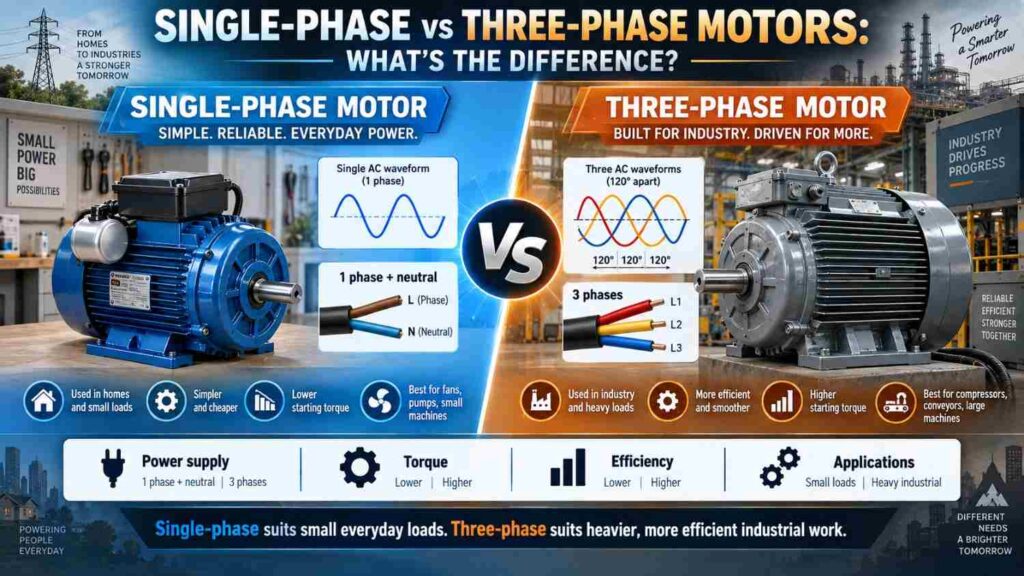
The two look similar from the outside, but the way they start, run, and handle load is fundamentally different, and knowing which one you are dealing with matters when you are specifying equipment, troubleshooting a fault, or deciding what your generator or transformer needs to supply.
What Actually Separates the Two
A single-phase motor runs on one live conductor and a neutral, the standard household and small-shop supply found across most of Nigeria. A three-phase motor runs on three live conductors carrying voltage waveforms offset from each other by 120 electrical degrees, the kind of supply typically metered to factories, water treatment plants, and larger commercial premises.
That phase offset is the whole story: three-phase supply naturally produces a rotating magnetic field inside the motor, while single-phase supply produces a field that simply pulses back and forth without a fixed direction to turn in.
Why Single-Phase Motors Need a Trick to Start
Because a single pulsating field cannot start rotation on its own, single-phase motors need an auxiliary winding, a starting capacitor, or a shaded pole arrangement to nudge the rotor into a preferred direction before the main winding takes over. This is why you will find start capacitors, run capacitors, and centrifugal switches inside single-phase motor housings, components that add cost, take up space, and are common failure points.
A three-phase motor needs none of this. The rotating field created naturally by the three offset phases spins the rotor from the moment power is applied, which is one reason three-phase motors are simpler and more reliable at the mechanical level.
Power and Torque Differences That Matter in Practice
Single-phase motors are practical up to roughly 3 to 5 horsepower before the physics starts working against you. Beyond that range, the starting components become large and expensive, the current draw on a single line becomes difficult for typical wiring and supply to handle, and the running smoothness suffers because power delivery still pulses at twice the supply frequency.
Three-phase motors deliver constant, non-pulsating torque because at any instant at least one phase is near its peak, and they scale efficiently into hundreds of horsepower, which is why virtually all industrial pumps, compressors, and large fans in Nigerian factories are three-phase machines.
Efficiency, Size, and Cost Comparison
For an equivalent power output, a three-phase motor is typically smaller, lighter, and more efficient than its single-phase counterpart, largely because it does not waste winding space and copper on starting components. Three-phase motors also run cooler under continuous load and tolerate overload conditions somewhat better.
The tradeoff is supply availability and cost: three-phase connections from the local DisCo require higher-capacity service and often a dedicated transformer, which is a real barrier for small workshop owners who only have single-phase supply at their premises.
| Feature | Single-Phase Motor | Three-Phase Motor |
|---|---|---|
| Typical power range | Up to about 3-5 HP | From fractional HP into hundreds of HP |
| Starting method | Needs capacitor or auxiliary winding | Self-starting, no auxiliary components |
| Running smoothness | Pulsating torque | Constant, smooth torque |
| Typical efficiency | Lower for equivalent output | Higher for equivalent output |
| Common Nigerian use | Fans, pumps, small workshop tools | Industrial pumps, compressors, conveyors |
What This Means for Generator and Supply Sizing
If you are running three-phase equipment off a generator, the generator must genuinely be a three-phase unit, not three separate single-phase outputs improvised together, because the motor depends on the fixed 120-degree phase relationship to produce its rotating field correctly.
Undersized or poorly balanced three-phase generator supply is a common source of nuisance tripping, a topic covered in more depth in our dedicated motor protection article, because unbalanced voltage across the three lines stresses the windings even when the motor appears to run normally at first glance.
Choosing Between Them for a New Installation
The decision usually comes down to available supply and the load size rather than personal preference. A few practical points to weigh:
- If the driven load is under roughly 2 HP and only single-phase supply is available, a single-phase motor is the simpler and cheaper choice.
- If three-phase supply already exists on the premises, using three-phase motors even for smaller loads often pays off in reliability and smoother running.
- For any load above about 5 HP, a three-phase motor combined with proper starting equipment (soft starters or star-delta arrangements, discussed in our dedicated star-delta starting article) is almost always the more practical route.
- Where a facility only has single-phase supply but needs to run a three-phase motor, a variable frequency drive with single-phase input can sometimes convert supply internally, though this has capacity limits worth checking with a qualified engineer.
Common Misconceptions
- “Three-phase motors always use three times the current of single-phase for the same power.” For the same power output, three-phase current per line is actually lower than the equivalent single-phase current, since the load is shared across three conductors.
- “You can run a three-phase motor from single-phase supply by wiring it differently.” Without a phase-converting device such as a VFD, a three-phase motor simply will not start correctly on single-phase supply, no matter how the windings are connected.
- “Single-phase motors are just smaller versions of three-phase motors.” They are built differently at the winding level, with dedicated starting components that three-phase motors do not need at all.
Frequently Asked Questions
Can a three-phase motor run if it loses one phase?
It can sometimes continue running in a degraded state, drawing excess current on the remaining phases, a failure mode covered in detail in our dedicated article on motors running after losing a phase, but it should never be left running that way.
Is a three-phase motor more expensive to buy than an equivalent single-phase motor?
For small loads a single-phase motor is usually cheaper upfront, but as power rating increases, three-phase motors often become the more economical option per horsepower delivered.
Do single-phase motors need overload protection like three-phase motors do?
Yes, single-phase motors still need appropriately rated overload protection, though the starter and protection arrangements used are typically simpler than the contactor-based setups used for larger three-phase motors.
Final Thoughts
The difference between single-phase and three-phase motors is not just about how many wires are involved, it comes down to how the rotating magnetic field is created and how efficiently that translates into usable torque.
Single-phase motors remain the practical choice for small, low-power applications where only single-phase supply is available, while three-phase motors dominate anywhere serious power, smooth running, and long-term reliability matter.
Understanding this distinction helps you specify the right motor the first time, rather than discovering the mismatch after installation.