
Open the distribution board in an older Nigerian home or small business and you may notice discoloured plastic around a breaker, a faint burning smell, or a panel that feels unusually warm to the touch. These are not minor cosmetic issues; they are early warning signs of a panel that is overheating, one of the leading precursors to electrical fires.
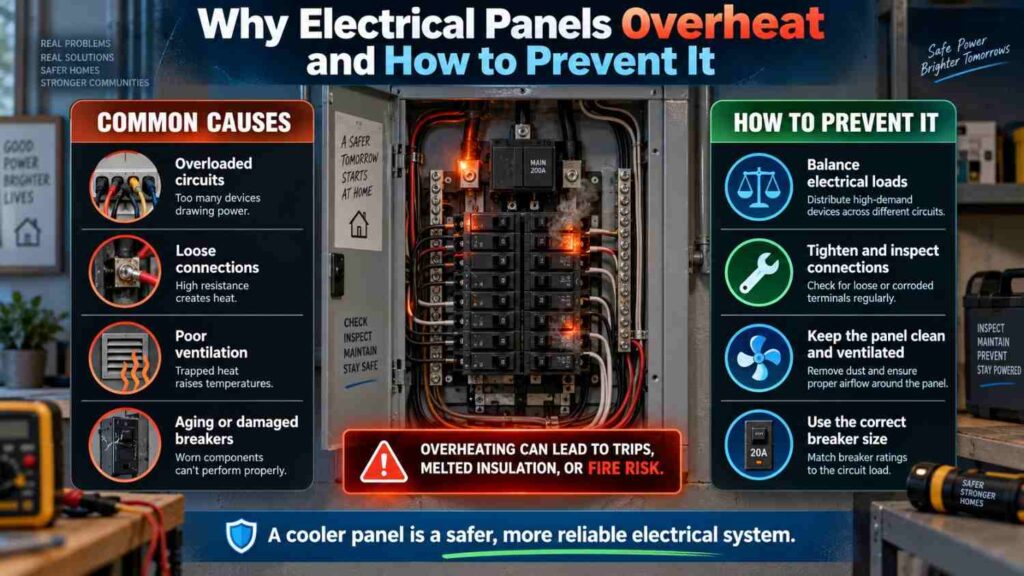
This article explains why electrical panels overheat, what makes some installations more prone to it than others, and the practical steps that prevent it.
What Actually Happens Inside an Overheating Panel
A distribution board, sometimes still called a panel or consumer unit, houses the main switch, individual circuit breakers, and the busbars and connections that distribute current to every circuit in a building. Every connection point inside that panel, from the main incoming cable to each breaker terminal, has a small amount of electrical resistance. Under normal conditions this resistance produces negligible heat, but when a connection is loose, corroded, or undersized for the current passing through it, resistance at that point rises, and heat is generated in proportion to the current squared. Left unaddressed, this heat can degrade insulation, discolour plastic components, and in the worst cases ignite surrounding material.
The Main Causes of Panel Overheating
| Cause | Why It Generates Heat |
|---|---|
| Loose terminal connections | Increases resistance at the contact point, concentrating heat there |
| Overloaded circuits | Sustained current above rated capacity heats conductors and breakers |
| Undersized cables or breakers | Components forced to carry more current than they are designed for |
| Poor quality or counterfeit breakers | Substandard contact material and mechanisms heat up faster and fail unpredictably |
| Corroded connections | Oxidation increases resistance, especially in humid coastal areas |
| Poor ventilation around the panel | Heat that would normally dissipate instead accumulates inside an enclosed space |
Why This Is a Bigger Issue in Nigeria Than It Should Be
Several conditions common in the Nigerian context make panel overheating more likely. Humidity, particularly along the coast and during the rainy season, accelerates corrosion at connection points inside panels that are not properly sealed. The prevalence of counterfeit or substandard breakers and cables in some markets means components fail to meet their stated ratings, heating up under loads they should comfortably handle. And frequent switching between grid power, generator power, and inverter backup means change-over connections and terminals inside the panel are subjected to more connect and disconnect cycles than a stable single-source system, which can gradually loosen terminal screws over time if they are not periodically checked and re-tightened.
Warning Signs a Panel Is Overheating
- Discoloured, browned, or melted plastic around a specific breaker or terminal.
- A persistent burning or hot-plastic smell near the distribution board, even faint.
- A breaker that feels noticeably warmer than others when touched briefly on its casing.
- Buzzing, crackling, or humming sounds coming from inside the panel.
- Lights that flicker or dim specifically when a particular appliance switches on, sometimes indicating a loose connection under load.
- A breaker that trips inconsistently or fails to reset properly.
Any one of these signs should prompt an immediate call to a qualified electrician rather than continued normal use, since heat damage inside a panel tends to worsen quickly once it begins.
How Panels Are Properly Protected From Overheating
Correct design starts with matching breaker ratings to cable capacity, a principle covered in depth in our dedicated wiring and cable sizing article, so no single component is forced to carry more current than it can safely handle. Beyond that, panels should be installed with adequate ventilation, away from direct sunlight or enclosed, poorly ventilated cupboards that trap heat. Using breakers and components from reputable manufacturers, rather than the cheapest available option, significantly reduces the risk of premature failure under normal load. Distribution boards serving mixed power sources, including generator and inverter change-over arrangements, benefit from professional design that accounts for the additional switching stress those systems place on terminals and contacts.
Routine Maintenance That Prevents Overheating
A qualified electrician should inspect and, where necessary, re-tighten all terminal connections inside the panel every couple of years, or sooner in humid or heavily used installations. Overloading individual circuits should be avoided by spreading high-demand appliances across multiple circuits rather than one, and any breaker showing discolouration, pitting, or inconsistent operation should be replaced immediately rather than left until it fails completely. The area around the distribution board should be kept clear of stored items, dust, and moisture, and where possible, a thermal inspection during routine electrical maintenance can catch hot spots before they become visible damage.
Common Misconceptions
- “A panel only overheats if it’s very old.” New panels can overheat quickly if fitted with substandard breakers, loose connections, or undersized cabling, regardless of age.
- “A slightly warm panel is normal and nothing to worry about.” Panels should run close to room temperature under normal load; noticeable warmth, especially localised to one breaker, indicates a developing problem.
- “Tightening panel connections is a one-time job done at installation.” Connections can loosen gradually through vibration, thermal cycling, and repeated switching, so periodic re-tightening by a qualified electrician is genuinely necessary.
Frequently Asked Questions
Is it normal for a distribution board to make any noise at all?
A well-functioning panel should be essentially silent; any buzzing, crackling, or humming is a sign that something needs professional attention.
Can I tighten loose connections inside my panel myself?
This work involves the live main supply and should only be done by a qualified electrician who can safely isolate the panel before opening it.
How often should a distribution board be professionally inspected?
Most homes benefit from an inspection every two to three years, though older properties, humid locations, or panels showing early warning signs should be checked sooner.
Final Thoughts
Panel overheating rarely happens suddenly; it builds gradually through loose connections, overloaded circuits, or substandard components, giving off warning signs like discolouration, odd smells, or unusual warmth well before anything catastrophic occurs. Recognising these signs early, and addressing them through proper maintenance rather than ignoring them, is one of the most effective ways to prevent electrical fires at their source.
Given Nigeria’s humidity, variable component quality in some markets, and the added switching stress of generator and inverter systems, distribution boards deserve more routine attention than they typically receive. When any warning sign appears, the right response is always to call a qualified electrician promptly rather than waiting to see if it gets worse.