
Many Nigerian homeowners have experienced this exact scenario: a distant storm rolls through, no lightning appears to hit anywhere near the house, yet the next morning the television, router, or refrigerator no longer works. This is not a coincidence or bad luck.
Lightning can damage electrical appliances from kilometres away without ever striking the building directly, through effects that travel invisibly along power lines and even through the air.
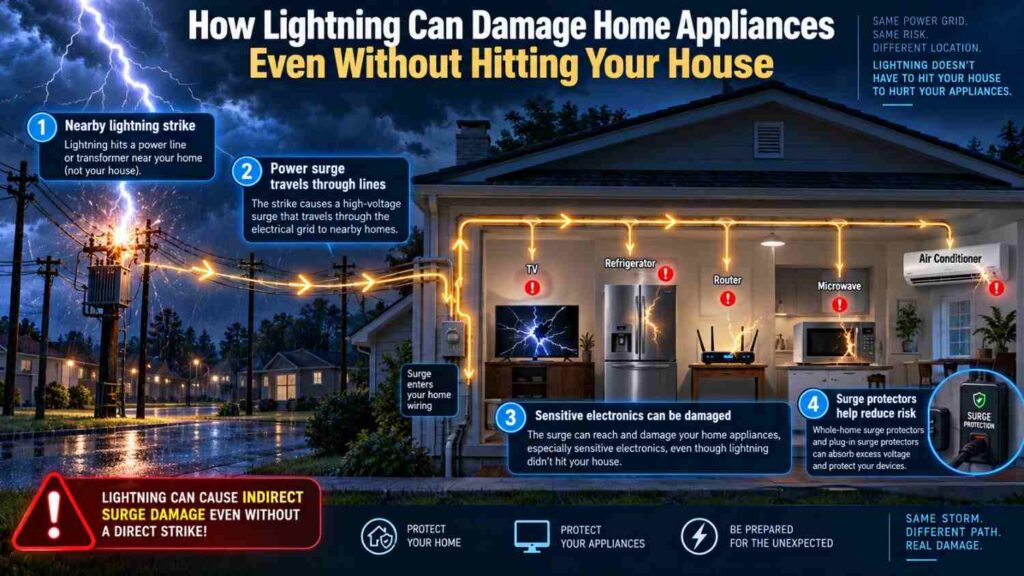
This article explains exactly how that happens and what can be done to reduce the risk.
How Lightning Damages Appliances Without a Direct Hit
Lightning does not need to strike a building to affect the electrical system inside it. When lightning strikes the ground, a nearby tree, or a utility pole some distance away, the surrounding electromagnetic field changes violently for a brief moment.
This sudden change can induce a voltage spike in nearby overhead power lines, underground cables, and even telephone or internet lines, and that spike then travels along those lines into connected homes, arriving at sockets as a surge far above the normal 230V supply. Appliances plugged in at that moment can be damaged internally, even though the storm never touched the building itself.
The Main Pathways Lightning Uses to Reach Your Appliances
| Pathway | How It Happens |
|---|---|
| Power Lines | A nearby strike induces a surge that travels along the DisCo distribution network into the home |
| Telephone / Internet Lines | Surges travel along overhead or buried communication cables into routers and modems |
| Direct Strike to the Building | A strike hits the building or its lightning arrester and some energy still couples into internal wiring |
| Ground Potential Rise | A nearby strike raises the local ground voltage, affecting anything connected to earth, including some earthed appliances |
Of these, surges arriving through the power lines are by far the most common cause of appliance damage in homes that were never directly struck, since the utility network itself acts almost like an antenna, collecting and transmitting these induced spikes over long distances.
Why Nigeria’s Power Network Makes This Worse
Overhead distribution lines, which remain the dominant form of electricity delivery across most of Nigeria, are particularly exposed to induced lightning surges compared to underground cabling, simply because they run exposed through open air over long distances between poles.
Add to this the frequency and intensity of thunderstorms during the rainy season, and homes connected to the grid face a real, recurring risk of surge damage even without a strike anywhere near the property itself. Buildings that also rely on generators or inverters are not automatically safer, since a surge that enters through the mains supply before a change-over switch acts can still reach wiring depending on how the system is configured.
Which Appliances Are Most Vulnerable
Televisions, routers, and set-top boxes are especially exposed, since they contain sensitive microelectronics with very little tolerance for voltage spikes. Refrigerators and air conditioners are also common casualties, with their compressor control boards often the first component to fail.
Computers and laptops left plugged in and charging during a storm face the same risk, and so, somewhat ironically, do inverters and battery charge controllers, which are damaged by the very surges they are meant to help households survive without. Appliances connected simultaneously to both a power socket and a telephone or antenna line, such as older landline-connected devices, are particularly vulnerable, since they can be hit from two directions at once.
How Surge Protection Reduces This Risk
A surge protection device, whether a simple plug-in surge strip or a properly installed device at the distribution board, works by detecting a voltage spike above normal levels and instantly diverting the excess energy away from the connected appliance, typically to earth, before it can reach sensitive components.
This is a smaller-scale, faster-acting cousin of the lightning arrester covered in our dedicated lightning arrester article, which handles the much larger energy of a direct strike to the building itself. For genuinely comprehensive protection, board-level surge protection combined with good earthing offers far better coverage than relying only on individual plug-in strips scattered around the house.
Practical Steps to Protect Your Appliances During Storms
- Have a qualified electrician assess whether board-level surge protection is fitted, and install it if not already present.
- Unplug particularly sensitive electronics, such as televisions, routers, and computers, when a storm is approaching and expected to be severe.
- Ensure the building has a good, low-resistance earthing system, since surge protection devices rely on a solid earth connection to actually divert excess voltage safely.
- Avoid touching plugged-in appliances or wired telephone handsets during an active thunderstorm.
- Consider a whole-house surge protector at the main distribution board rather than relying solely on individual socket-level protectors for critical equipment.
Common Misconceptions
- “If lightning didn’t hit my house, my appliances can’t be damaged by it.” Induced surges from nearby strikes routinely travel through power and telephone lines and damage appliances without any direct hit to the property.
- “Unplugging appliances after the storm starts is good enough.” Damage often happens in the very first surge of a storm, so appliances should ideally be unplugged before or as soon as a storm is noticed approaching.
- “A generator or inverter automatically protects appliances from lightning surges.” Unless the change-over and wiring are specifically designed with surge protection, a generator or inverter setup does not inherently block induced surges from reaching connected appliances.
Frequently Asked Questions
Can a router or modem really be damaged by lightning several kilometres away?
Yes, because the surge travels along the telephone or internet cable itself, distance from the actual strike location does not prevent the induced voltage from reaching and damaging the device.
Is it enough to just switch off an appliance at the socket during a storm?
Switching off is better than nothing, but fully unplugging is safer, since a surge can still jump across a switched-off connection in some cases, especially with older sockets.
Do surge protector strips wear out over time?
Yes, most plug-in surge protectors absorb energy with each surge event and gradually lose effectiveness, so they should be replaced periodically rather than assumed to work indefinitely.
Final Thoughts
Lightning damage to appliances is far more often a story of induced surges travelling through power and communication lines than of a direct strike on the building itself, which is exactly why so many Nigerian households lose electronics during storms that never appeared to touch their property.
Understanding these pathways makes the case for taking surge protection seriously, both at the distribution board and for individual sensitive devices, rather than treating appliance losses during storms as random bad luck. Simple habits like unplugging sensitive electronics before a storm arrives add a meaningful layer of protection at no cost.
For lasting peace of mind, a qualified electrician can assess whether the home’s earthing and surge protection are actually adequate for the level of storm activity the area experiences.