
Of all the devices sitting quietly inside a distribution board, few do as much to directly protect human life as the residual current circuit breaker, better known as an RCCB.
While ordinary circuit breakers protect wiring and equipment from overheating, the RCCB exists specifically to protect people from electric shock, reacting in a fraction of a second to leakage currents far too small for a standard breaker to notice.
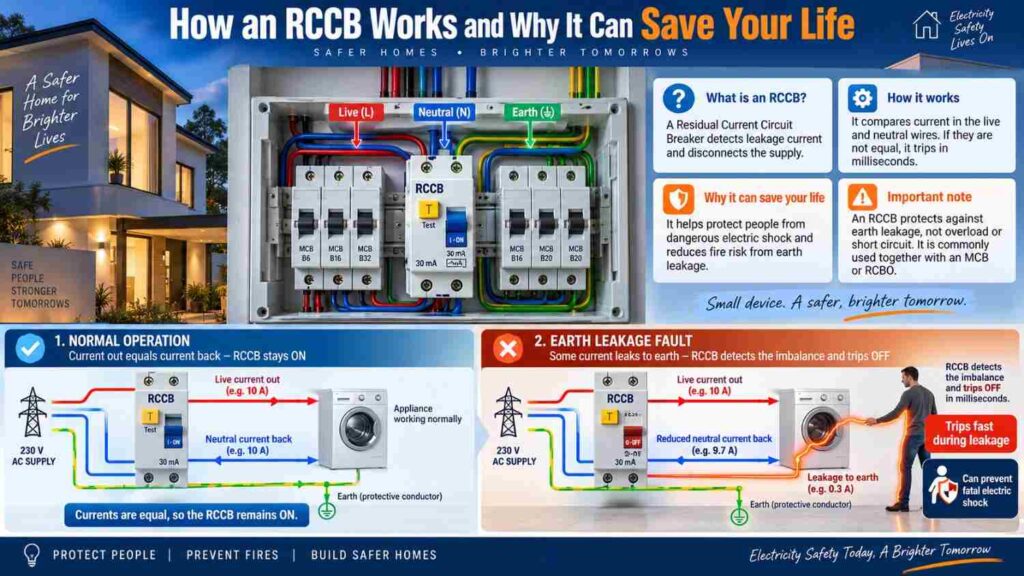
This article explains how an RCCB actually works, why that mechanism matters, and what every homeowner should know about using one properly.
The Basic Principle Behind an RCCB
An RCCB works by continuously comparing the current flowing into a circuit through the live conductor with the current returning through the neutral conductor. Under normal, healthy conditions these two values are always equal, because whatever current goes out through the live wire to power an appliance comes back through the neutral.
Inside the RCCB, both conductors pass through a small sensing coil, and as long as the currents match, their magnetic effects cancel each other out and the device stays closed.
The moment some current escapes the intended path, for example through damaged insulation, a wet appliance casing, or a person touching a live part, that balance is broken. The live current no longer matches the neutral current, because some of it is now flowing to earth through the fault instead.
This imbalance generates a small magnetic signal inside the sensing coil, which triggers a trip mechanism that opens the circuit almost instantly, typically within 30 milliseconds at the sensitivity levels used to protect people.
Why Speed and Sensitivity Matter
Both the tripping speed and the sensitivity threshold of an RCCB are chosen with the human body in mind. Research into electric shock has shown that currents as low as 30 milliamps passing through a person’s chest for more than a fraction of a second can interfere with heart rhythm, and higher currents sustained for longer can be fatal.
A standard 30mA RCCB detects leakage at this level and disconnects the supply before that duration becomes dangerous, a different job entirely from the overcurrent protection covered in our dedicated overcurrent protection article, where trip thresholds are measured in amps, not milliamps.
RCCB vs Circuit Breaker: Different Jobs, Same Board
| Feature | Circuit Breaker (MCB) | RCCB |
|---|---|---|
| Protects Against | Overload and short circuit | Earth leakage / shock risk |
| Trigger | Excess total current | Imbalance between live and neutral |
| Typical Trip Level | Rated current of the circuit, e.g. 20A, 32A | As low as 30mA for personal protection |
| Protects Equipment or People? | Primarily equipment and wiring | Primarily people |
An RCCB does not replace an MCB, and an MCB does not replace an RCCB; a well-designed distribution board uses both together, sometimes combined into a single device called an RCBO that provides both functions in one unit.
How an RCCB Can Save Your Life in Practice
- If a damaged washing machine cable exposes a live wire touching the metal casing, an RCCB detects the leakage and disconnects power before someone touching the machine receives a sustained shock.
- If floodwater or rain enters an outdoor socket, common during Nigeria’s heavy rainy season, an RCCB can cut power before the wet, energised area becomes a serious hazard.
- If a person accidentally cuts through a live cable while drilling into a wall, the sudden earth fault current triggers the RCCB far faster than a human reaction time could pull away.
- If insulation on old wiring, common in buildings that have never been rewired since the NEPA era, gradually degrades and starts leaking small amounts of current, the RCCB catches it long before it becomes a fire or shock hazard.
Testing and Maintaining Your RCCB
Every RCCB has a test button, usually marked T or Test, and pressing it should immediately trip the device, simulating an earth fault. Homeowners should test this button roughly every three months, because an RCCB that has never tripped can develop mechanical faults over time and fail silently when a real fault occurs.
If pressing the test button does not trip the device, it should be treated as a serious problem and reported to a qualified electrician for replacement, not ignored.
It is worth noting that an RCCB relies on a functioning earthing system to work as intended for many fault scenarios, so the two should always be assessed together, as covered in our dedicated earth leakage article.
Choosing the Right RCCB for a Nigerian Home
RCCBs come in different sensitivity ratings and current capacities, and matching these to the specific circuit matters. A whole-house RCCB rated at 30mA offers strong personal protection but can occasionally nuisance-trip from the combined small leakages of many appliances running together; some installations instead use a main RCCB alongside separate RCBOs on individual circuits for a more selective setup.
Given Nigeria’s mix of grid, generator, and inverter power sources, it is worth confirming with an electrician that the RCCB and the household’s change-over arrangement are compatible, since incorrectly wired change-over systems can interfere with proper earth fault detection.
Common Misconceptions
- “An RCCB will stop every kind of electrical accident.” An RCCB protects specifically against earth leakage and shock from earth faults; it does not replace overcurrent protection against overloads and short circuits.
- “Once installed, an RCCB never needs checking again.” Like any mechanical safety device, an RCCB should be tested regularly using its built-in test button to confirm it still trips correctly.
- “An RCCB will protect you even if you touch both the live and neutral wires directly.” An RCCB only detects current escaping to earth; it cannot protect against a shock received purely between live and neutral conductors.
Frequently Asked Questions
What is the difference between an RCCB and an RCBO?
An RCCB only provides earth leakage protection, while an RCBO combines earth leakage protection with standard overcurrent protection in a single device for one circuit.
Why does my RCCB trip when it rains?
This usually indicates moisture is reaching a socket, cable joint, or appliance and causing genuine leakage current, and should be investigated rather than simply reset repeatedly.
Can I install an RCCB myself?
Because it involves working inside the distribution board and connecting to the main supply, RCCB installation should always be carried out by a qualified electrician.
Final Thoughts
The RCCB is one of the few electrical devices in a home whose entire purpose is protecting the people inside it, not just the wiring or the appliances. By constantly watching for the tiny imbalance that signals current escaping to earth, it can react faster than a person can pull away from a fault, turning what could be a fatal shock into a tripped switch.
Given Nigeria’s mix of ageing wiring, variable earthing quality, and heavy seasonal rains, an RCCB is not a luxury addition but a genuinely life-saving piece of equipment. Testing it regularly and having it properly installed by a qualified electrician ensures it is ready the moment it is actually needed.