
A metal appliance casing that gives a mild tingling sensation when touched is not just uncomfortable, it is a warning sign of earth leakage, one of the most underestimated hazards in home electrical systems. Unlike a short circuit or overload, earth leakage does not always trip a breaker or blow a fuse, which means it can persist quietly for months.
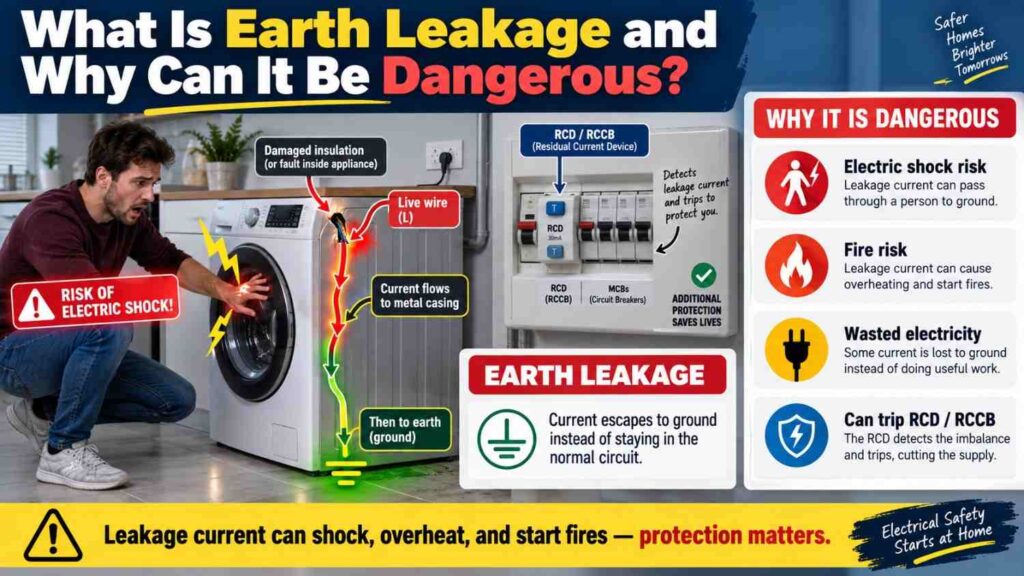
This article explains what earth leakage is, why it happens, and why it deserves far more attention than it typically gets in Nigerian homes.
What Earth Leakage Means
In a healthy electrical circuit, current flows out through the live conductor, through the appliance, and back through the neutral conductor, with both currents equal in magnitude.
Earth leakage occurs when some of that current takes an unintended path to earth instead, often through damaged insulation, moisture, or a fault inside an appliance. That leaking current might flow through the appliance’s metal casing, through a person touching it, or through damp building structure, none of which should be part of the normal circuit.
Even small amounts of leakage current, well below what would trip an ordinary overcurrent breaker, can be enough to injure or kill a person if it passes through their body, which is exactly why earth leakage needs its own dedicated form of protection rather than relying on standard breakers alone.
Common Causes of Earth Leakage
- Damaged or aged insulation on cables, especially in older buildings with wiring that has never been upgraded.
- Water ingress into sockets, junction boxes, or appliances, a frequent issue during Nigeria’s rainy season when roofs leak or floods reach ground-floor sockets.
- Faulty heating elements in appliances such as electric kettles, water heaters, and irons, where moisture and heat combine to accelerate insulation breakdown.
- Poor or missing earthing at the building level, meaning leakage current has no safe, low-resistance path back to the source, so it seeks other routes instead.
- Rodent or insect damage to cable insulation inside walls and ceilings, more common than many homeowners realise.
Why Earth Leakage Is Particularly Dangerous
The human body can be seriously harmed by currents far smaller than what a standard 20A or 32A circuit breaker is designed to detect. A breaker protects wiring and equipment from overheating and fire, but it is not sensitive enough to detect the small leakage currents that can stop a heart.
This gap is why earth leakage protection devices exist as a separate layer, monitoring the balance between live and neutral current and reacting to imbalances as small as a few milliamps.
In Nigeria, where earthing standards in many older or informally built houses fall short of what is required, this danger is amplified. A poorly earthed system means fault current has fewer safe paths to travel, increasing the chance that a person becomes the unintended path instead.
Earth Leakage vs Other Electrical Faults
| Fault Type | What It Detects | Typical Protection Device |
|---|---|---|
| Overload | Sustained excess current on a circuit | MCB (circuit breaker) |
| Short Circuit | Sudden direct live-to-neutral fault | MCB (circuit breaker) |
| Earth Leakage | Imbalance between live and neutral current | RCCB / ELCB |
This is precisely why a modern distribution board should combine both circuit breakers and a residual current device, an arrangement explained in more depth in our dedicated RCCB article, rather than relying on breakers alone.
How Earth Leakage Is Detected and Stopped
The primary device used to detect earth leakage is a residual current circuit breaker, commonly abbreviated RCCB, sometimes still called an ELCB in older terminology. It continuously compares the current flowing out through the live conductor against the current returning through the neutral.
When there is a difference beyond a set threshold, meaning current is escaping somewhere it should not, the device trips almost instantly, cutting power before the leakage can cause serious harm. This mechanism is different enough from ordinary overcurrent protection that it deserves its own detailed explanation, which our dedicated RCCB article covers thoroughly.
Good earthing at the property, connecting exposed metal parts and the earthing terminal of sockets to a proper earth electrode, works alongside this device, giving leakage current a low-resistance path back to the system so protective devices can detect and act on it reliably.
Warning Signs You Should Never Ignore
A tingling or mild shock sensation when touching a washing machine, refrigerator, or any metal-cased appliance is a clear sign of leakage current and should never be dismissed as normal.
Frequent, unexplained tripping of an RCCB, if one is installed, also points to a genuine leakage fault somewhere in the system rather than a nuisance trip, and should prompt a proper investigation rather than simply resetting it repeatedly. Any of these signs warrants a call to a qualified electrician, who can safely test individual circuits and appliances to isolate the source.
Common Misconceptions
- “A mild tingle from an appliance isn’t a big deal.” Even small leakage currents can be dangerous, especially to children, the elderly, or anyone with a heart condition, and should be investigated immediately.
- “If the breaker hasn’t tripped, there’s no earth leakage.” Ordinary circuit breakers are not designed to detect small leakage currents; only a dedicated RCCB can catch this type of fault reliably.
- “Earthing is optional if the building has never had a problem.” Poor earthing does not prevent leakage from occurring, it only removes the safe path for that leakage current, making injury more likely when a fault does happen.
Frequently Asked Questions
Can earth leakage happen even in a brand-new building?
Yes, poor workmanship, damaged materials during construction, or a single faulty appliance can introduce earth leakage even in new wiring, so testing after installation is still important.
Does a generator or inverter protect against earth leakage?
Not on its own; protection against earth leakage depends on the distribution board and earthing system of the building, regardless of whether the power source is the grid, a generator, or an inverter, as discussed in our dedicated generators and inverters articles.
How can I check if my home has an earth leakage protection device installed?
Look at your distribution board for a device usually labelled RCCB or RCD with a test button; if you are unsure whether one is present or working, ask a qualified electrician to inspect the board.
Final Thoughts
Earth leakage is dangerous precisely because it is invisible to standard protection and often gives only subtle warning signs, like a faint tingle or a flickering appliance, before something more serious happens.
Good earthing, combined with a properly installed and tested RCCB, forms the real defence against this hazard, and neither should be treated as optional extras in a Nigerian home given the state of earthing in many older buildings.
Anyone experiencing shocks from appliances, however mild, should treat it as an urgent issue rather than a minor annoyance. A qualified electrician can trace the fault and confirm the property’s earthing and leakage protection are both functioning as they should.