
Walk into any workshop, generator house, or well-wired Nigerian home and you will eventually find a small switch or lever labelled “isolator” sitting near a piece of equipment.
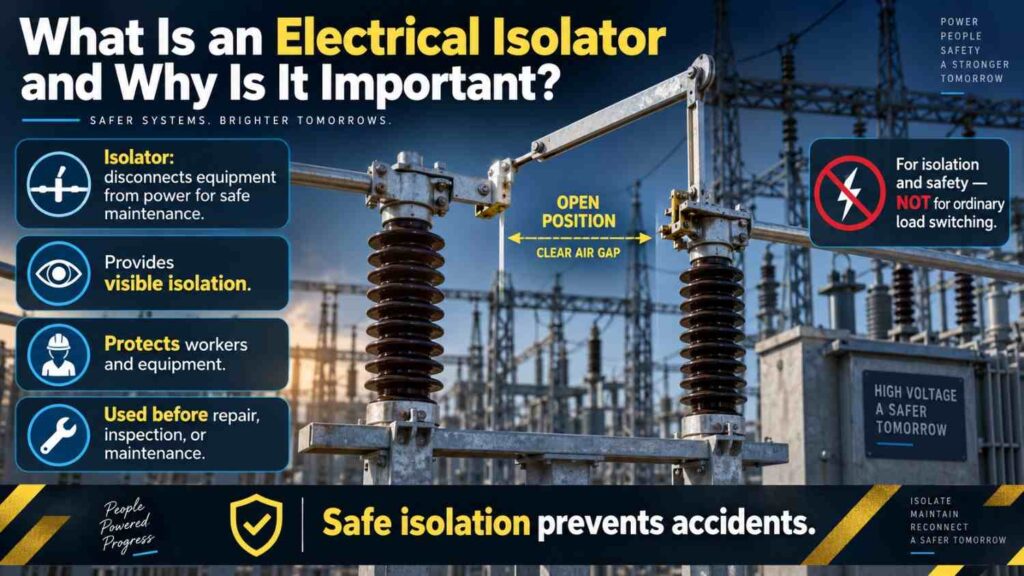
It looks unremarkable, but it does one job that can mean the difference between a routine repair and a fatal accident: it completely disconnects a circuit from its power source so that work can be done safely.
This article explains what an electrical isolator is, how it differs from an ordinary switch or breaker, and why every home, workshop, and commercial installation needs one.
What an Electrical Isolator Actually Does
An isolator is a manually operated switching device whose sole purpose is to open a circuit and keep it open, with a visible or verifiable break, so that no current can flow while someone is working on the equipment downstream. Unlike a circuit breaker, an isolator is not designed to interrupt current under load or clear a fault.
It is meant to be operated only after the load has already been switched off, and its main strength is that it creates a clear, dependable air gap between the equipment and the supply.
In practice, isolators are fitted before motors, air conditioning units, water pumps, generators, and distribution boards. When a technician needs to service any of these, the isolator is switched off first, often locked out, and only then is the equipment considered safe to touch.
Isolator vs Circuit Breaker vs Ordinary Switch
People often use these three terms loosely, but they serve different purposes. The table below sets out the key differences.
| Device | Main Purpose | Breaks Load Current? | Breaks Fault Current? |
|---|---|---|---|
| Isolator | Safe disconnection for maintenance | No (load must be off first) | No |
| Circuit Breaker | Automatic protection against overload and short circuit | Yes | Yes |
| Ordinary Switch | Everyday on/off control | Yes, within its rating | No |
This is why an isolator is typically installed alongside, not instead of, a circuit breaker. The breaker as discussed in our dedicated circuit breakers article handles automatic protection, while the isolator gives a technician a guaranteed, physical means of cutting power before hands-on work begins.
Why Isolators Matter So Much in Nigeria
In many Nigerian homes and small businesses, electrical work is still done by informal artisans without a strict permit-to-work culture, and mains supply can be unpredictable, switching between DisCo power, generator output, and inverter backup within the same day. Without a proper isolator, a technician who assumes a circuit is dead because the DisCo line is down may be shocked when a generator or inverter unexpectedly energises the same wiring.
An isolator placed correctly removes this ambiguity: once it is open, that section is dead regardless of which source feeds the rest of the building.
This is especially important for change-over systems between public supply and standby generators, where an isolator or an interlocked change-over switch prevents backfeeding into utility lines, protecting both the household and any DisCo staff working on the street transformer.
Types of Isolators You Will Encounter
- Local isolators mounted directly beside a motor, pump, or air conditioner for immediate on-site disconnection.
- Main isolators at the origin of an installation, usually near the meter or distribution board, that can disconnect the entire premises.
- Rotary or lever-operated isolators common in industrial panels, offering a clear visual indication of open or closed position.
- Fused isolators, which combine a disconnecting function with a replaceable fuse for added protection.
Whichever type is used, the key feature is a positive, visible break in the circuit, not just an indicator light that could fail or mislead.
How Isolators Fit Into a Safe Work Procedure
A properly trained electrician does not simply flip an isolator and start working. The accepted safe practice, often summarised as isolate, lock, test, involves switching off the load, opening the isolator, securing it with a lock or tag so it cannot be closed by someone else, and then testing the circuit with a suitable meter to confirm it is actually dead before touching any conductor.
Skipping the testing step is one of the most common causes of accidents, because an isolator can occasionally be wired incorrectly or a parallel feed can still be present.
This procedure should always be carried out by, or under the supervision of, a qualified electrician. Isolators reduce risk, but they do not eliminate the danger of live electrical work on their own, and any doubt about whether a circuit is truly dead should be resolved by a professional, not by assumption.
Sizing and Installing an Isolator Correctly
An isolator must be rated for the voltage and current of the circuit it protects: single-phase Nigerian household circuits typically need a device rated for 230V, while three-phase installations for pumps or workshop machinery run at 400V.
Choosing an isolator with too low a current rating can cause it to overheat or fail to make proper contact, defeating its purpose. Correct cable sizing, as discussed in our dedicated wiring and cable sizing article, also matters, since an undersized cable can overheat even when the isolator itself is fine.
Common Misconceptions
- “An isolator and a circuit breaker do the same job.” A breaker automatically clears faults and overloads, while an isolator is a manual device meant only for safe disconnection during maintenance.
- “If the isolator is off, the circuit is definitely dead, no need to test.” Wiring errors, backfeeds from generators, or parallel supplies can still leave a circuit live, so testing before touching is essential.
- “Isolators are only needed in factories, not homes.” Any home with a generator, borehole pump, or air conditioning unit benefits from isolators for safe, quick maintenance.
Frequently Asked Questions
Can I install an isolator myself?
Basic isolators for simple loads can sometimes be fitted by a competent DIYer, but connecting them into an existing distribution system is best left to a licensed electrician to avoid miswiring.
Does every appliance need its own isolator?
Not every appliance, but fixed equipment that needs regular servicing, such as pumps, air conditioners, and generators, benefits significantly from a dedicated local isolator.
Is an isolator the same as a main switch?
A main switch at the distribution board often functions as a main isolator for the whole building, but smaller local isolators are still used for individual equipment.
Final Thoughts
An electrical isolator may look like a minor component, but it is one of the most important safety devices in any installation, giving technicians and homeowners a dependable way to cut power before working on equipment.
In a country like Nigeria, where supply sources can shift between the grid, generators, and inverters within minutes, having clearly marked, correctly rated isolators removes dangerous guesswork about whether a circuit is truly dead.
Combined with proper lockout procedures and testing, isolators turn routine maintenance from a gamble into a controlled, predictable task. Anyone unsure about where isolators are needed in their home or workplace should consult a qualified electrician rather than guessing.