
Motion sensor lights have become a popular addition to Nigerian homes and compounds, switching on automatically as someone approaches and turning off once the area is clear, saving electricity while improving security. But not every installation location makes sense, and understanding how the sensors actually detect movement helps you get the placement and settings right the first time.
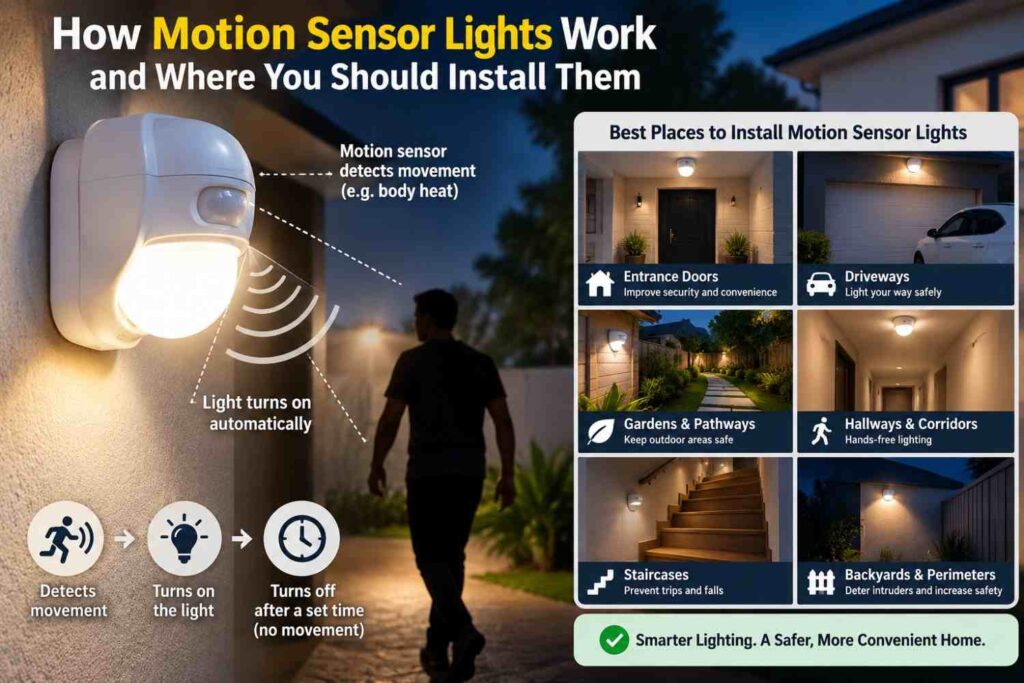
This article explains the technology behind motion sensor lights and where they deliver the most value.
How Motion Sensors Detect Movement
The most common type used in residential lighting is the passive infrared (PIR) sensor, which detects changes in infrared heat radiation within its field of view. Every moving object that is warmer or cooler than its surroundings, such as a person walking past, creates a change in the infrared pattern the sensor monitors, which triggers the light to switch on. The sensor does not emit any signal itself; it passively reads infrared changes, which is why it is called a passive sensor. Some higher-end sensors use microwave or dual-technology detection, combining infrared with microwave signals for more reliable detection, particularly useful in areas with a lot of background heat interference.
Key Components of a Motion Sensor Light Fitting
- The PIR sensor lens, which focuses infrared changes onto the detector element inside the unit.
- An adjustable sensitivity control, which sets how much infrared change is needed to trigger the light.
- A time delay setting, which determines how long the light stays on after the last detected movement.
- A light level (lux) threshold control, which prevents the sensor from triggering during daylight hours when it is not needed.
- The light source itself, almost always LED in modern fittings due to its low power draw and quick response time.
Best Locations to Install Motion Sensor Lights
| Location | Why It Works Well |
|---|---|
| Compound gate or entrance | Alerts household and deters intruders as visitors or vehicles approach |
| Backyard and perimeter walls | Illuminates blind spots that are less frequently monitored |
| Garage and carport | Provides hands-free lighting when arriving with bags or keys |
| Staircases and corridors | Improves safety when moving through dark areas at night |
| Store rooms and outbuildings | Saves energy since these spaces are used briefly and infrequently |
Step-by-Step: Installing a Motion Sensor Light
- Choose a mounting height of roughly 2.1 to 3 meters for most PIR fittings, since this range balances detection distance with a wide field of view.
- Position the sensor so its field of view faces across the path of expected movement rather than directly toward an approaching person, since sensors detect lateral movement more reliably than head-on approach.
- Isolate power at the breaker before wiring the fitting, and connect according to the manufacturer’s live, neutral, and earth markings.
- Set the light level threshold so the sensor only activates once ambient light has dropped to dusk or darker, avoiding unnecessary daytime triggering.
- Set the time delay to a practical duration, typically 1 to 5 minutes, long enough for someone to reach a door but not so long that it wastes electricity.
- Test the sensitivity setting over a few nights and adjust if it triggers too easily from passing vehicles or too rarely for approaching people.
Common Placement Mistakes to Avoid
Installing a motion sensor light too close to a busy road can cause constant false triggering from passing vehicles, which quickly reduces both its effectiveness and its lifespan due to constant switching. Placing sensors where they face direct sunlight for part of the day can interfere with detection, since the heat signature of the sun and warm surfaces can affect sensitivity. It is also worth avoiding areas with overhanging trees or plants that sway in the wind, since foliage movement can trigger false activations repeatedly through the night.
Energy Savings and Security Benefits
Motion sensor lights save electricity compared to lights left on continuously overnight, since they only draw power when triggered and for the set time delay afterward. Combined with LED bulbs, which already use far less power than older bulb types as covered in our LED versus fluorescent versus incandescent efficiency article, motion sensor fittings offer a genuinely low running cost for outdoor security lighting. Beyond savings, the sudden illumination when someone approaches is itself a deterrent, since intruders generally prefer to avoid areas that light up unexpectedly and draw attention.
Powering Motion Sensor Lights During Outages
Since security lighting is often most important during the night when grid power from the local DisCo may be unavailable, it is worth considering how your motion sensor lights are powered during outages. Connecting outdoor security fittings to an inverter or solar backup circuit ensures they continue functioning even when NEPA-supplied power, as it is still commonly called, is off. This is particularly relevant for compound gates and perimeter areas where security matters most, a setup discussed further in our inverters and batteries and solar systems articles.
Common Misconceptions
- “Motion sensors detect any kind of movement equally well.” PIR sensors specifically detect changes in infrared heat, so they respond best to warm moving objects like people and animals rather than all types of motion.
- “Installing the sensor higher always improves detection.” Mounting too high reduces the sensor’s ability to detect the infrared signature of people at ground level, so there is an optimal height range rather than higher always being better.
- “Motion sensor lights don’t need any maintenance.” Dust, spider webs, and insects on the sensor lens can cause false triggers or missed detections, so occasional cleaning keeps the sensor working reliably.
Frequently Asked Questions
How far can a typical PIR motion sensor detect movement?
Most residential PIR sensors detect movement within a range of about 6 to 12 meters, though this varies by model and can be affected by mounting height and angle.
Can motion sensor lights be triggered by rain or wind?
Heavy rain can occasionally cause false triggers due to rapid temperature changes on the sensor lens, and wind-blown foliage in the detection zone can also trigger the light unexpectedly.
Should I choose a PIR sensor or a dual-technology sensor?
Standard PIR sensors work well for most residential needs, while dual-technology sensors, which combine infrared and microwave detection, are worth the extra cost in areas with frequent false triggers or higher security requirements.
Final Thoughts
Motion sensor lights combine convenience, energy savings, and improved security when installed thoughtfully, but their effectiveness depends heavily on correct placement, mounting height, and sensitivity settings. Focusing installations on entrances, perimeters, and transition spaces like staircases delivers the most practical benefit for Nigerian homes and compounds.
Taking the time to set the light level threshold and time delay properly, and avoiding common placement mistakes like facing busy roads or swaying foliage, ensures your motion sensor lighting works reliably for years without becoming a source of constant false alarms.