
Walking into a lighting shop and picking the first LED bulb that looks bright enough is a common mistake that leaves rooms either dim and gloomy or harshly overlit. The right wattage depends on the size of the room, its purpose, and how much natural light it already receives.
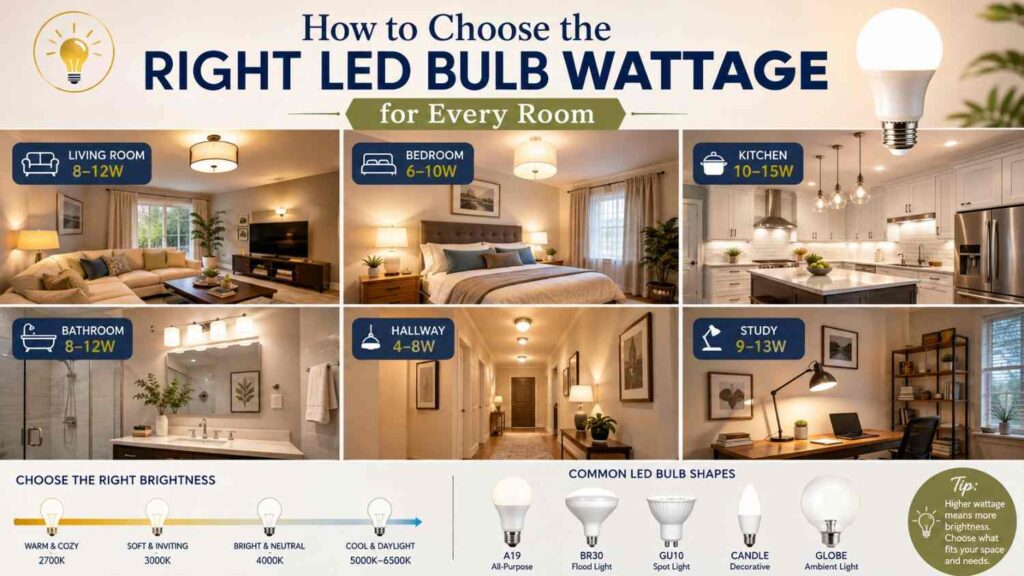
This article breaks down practical wattage guidelines for every room in a typical Nigerian home so you can shop with confidence rather than guesswork.
Why Wattage Alone Is Not the Full Story
Wattage measures how much electrical power a bulb consumes, not how bright it is. LED bulbs produce far more light per watt than incandescent bulbs, so a 9-watt LED bulb can produce roughly the same brightness as a 60-watt incandescent bulb. This means the old habit of picking bulbs purely by wattage no longer applies well to LED shopping. The better approach is to think in terms of lumens, the actual measure of brightness, while using wattage mainly as a rough guide to how much electricity the bulb will consume, a distinction explored more fully in our lumens versus watts article.
General Wattage Guidelines by Room
| Room | Recommended LED Wattage | Approximate Lumens |
|---|---|---|
| Living room (general lighting) | 9-15W per fitting | 800-1,500 lm |
| Bedroom | 7-9W | 600-800 lm |
| Kitchen (task areas) | 12-18W | 1,000-1,800 lm |
| Bathroom | 7-9W | 600-800 lm |
| Hallway or corridor | 5-7W | 400-600 lm |
| Home office or study | 12-15W | 1,000-1,300 lm |
| Outdoor security lighting | 15-30W | 1,500-3,000 lm |
Room-by-Room Practical Considerations
Living rooms typically need a mix of general and accent lighting, so a single bright central fitting combined with smaller lamps often works better than one very high wattage bulb alone. Bedrooms benefit from softer, lower wattage lighting, especially close to the bed, since overly bright light can make it harder to relax before sleep. Kitchens need brighter, more focused lighting over the cooking and preparation areas, since dim lighting in a kitchen increases the risk of cuts and accidents while cooking. Bathrooms need enough brightness for grooming tasks without being harsh, and fittings should be rated for the moisture typical in that environment.
Factoring in Room Size and Ceiling Height
- For rooms with high ceilings, choose slightly higher wattage bulbs since light intensity drops noticeably over greater distances.
- Rooms painted in dark colors absorb more light and generally need brighter bulbs than rooms with light-colored walls and ceilings.
- Rooms with limited natural window light need stronger artificial lighting during the day compared to naturally bright rooms.
- Larger open-plan spaces benefit from multiple lower wattage fittings spread evenly rather than one single very bright bulb in the center.
- Consider the number of fittings in the room; three 9W bulbs spread around a living room often light it more evenly than one 25W bulb in the middle.
Matching Wattage to Activity
The purpose of a room should guide your wattage choice as much as its size. Reading nooks, kitchens, and workspaces need brighter, more focused light to reduce eye strain during detailed tasks. Bedrooms, dining areas, and relaxation spaces do better with warmer, slightly dimmer lighting that creates a comfortable atmosphere rather than a clinical one. If a single room serves multiple purposes, such as a living room that doubles as a study space in the evening, consider installing a dimmer-compatible LED bulb so you can adjust brightness according to the activity, provided the dimmer switch itself is rated for LED loads.
Electricity Cost Implications
Choosing appropriate wattage rather than defaulting to the brightest available bulb has a direct effect on your electricity bill, especially for prepaid meter customers monitoring their unit consumption closely. Over-lighting a small bedroom with a 15W bulb when a 7W bulb would suffice wastes electricity every single night, and multiplied across several rooms and months, this adds up meaningfully. This is particularly relevant for households relying partly on inverter or solar backup during outages, since lower wattage lighting places less strain on limited battery capacity, a subject covered further in our solar systems article.
Voltage Stability and Bulb Longevity
Regardless of the wattage chosen, the lifespan of any LED bulb is affected by the stability of the power supply feeding it. In areas with frequent voltage fluctuation from the grid, even a correctly chosen bulb can fail prematurely if the driver is repeatedly exposed to spikes or dips outside its tolerance range. Pairing your lighting circuit with a stabilizer, and ensuring wiring is correctly sized for the load, helps protect your investment in good quality LED bulbs, a topic discussed in our dedicated wiring and cable sizing article.
Common Misconceptions
- “Higher wattage always means a brighter room.” With LED bulbs, brightness is determined by lumens, so a lower wattage LED can outshine a higher wattage bulb of a different type.
- “One bright central bulb is enough for any room.” Even distribution of light across a room using multiple lower wattage fittings usually produces better, more comfortable illumination than a single very bright source.
- “All rooms need the same brightness.” Different rooms serve different purposes, and the right wattage depends on the activity performed there as much as the room’s size.
Frequently Asked Questions
How many lumens does an average living room need?
Most living rooms are comfortably lit with a combined output of around 1,500 to 3,000 lumens across all fittings, depending on the room’s size and how much natural light it receives.
Can I mix different wattage LED bulbs in the same room?
Yes, mixing wattages is fine and often useful, such as using brighter bulbs over work areas and softer bulbs elsewhere in the same room for a layered lighting effect.
Does higher wattage always mean higher electricity cost?
Generally yes, since wattage directly relates to power draw, so choosing the lowest wattage that still meets your brightness needs will keep electricity costs lower over time.
Final Thoughts
Choosing the right LED wattage for each room comes down to matching brightness to room size, wall color, natural light levels, and the activities that happen there, rather than simply grabbing the highest wattage bulb on the shelf.
Using the lumen output as your real guide to brightness, while keeping wattage in mind for electricity cost, will give you better-lit rooms without wasting power. Taking a few minutes to plan wattage room by room pays off both in comfort and in a noticeably lower electricity bill over time.