
A weak or dead capacitor is one of the most common reasons a ceiling fan runs slowly, an air conditioner compressor hums but won’t start, or a motor struggles under load. Fortunately, testing a capacitor with a multimeter is a simple, safe skill once you know the correct steps and settings.
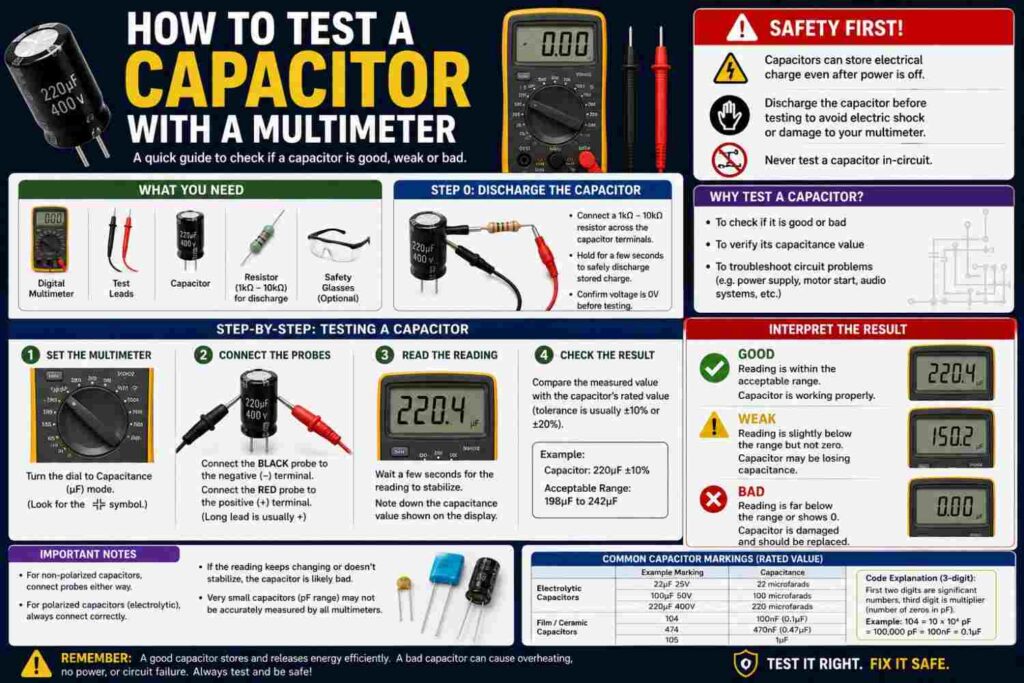
This guide walks through how capacitors fail, how to test them safely, and how to interpret the readings you get.
Why Capacitors Fail and Why Testing Matters
Capacitors, especially the start and run capacitors used in single-phase motors, ceiling fans, and air conditioner compressors, degrade over time due to heat, age, and voltage stress, common in Nigeria’s fluctuating mains supply and hot climate. A failing capacitor typically loses capacitance gradually rather than failing instantly, which is why a motor might still run, just weaker, slower, or with a noticeable humming sound, before it eventually fails to start at all. Testing the capacitor directly confirms whether it is the actual fault before you spend money replacing other components unnecessarily.
Safety First: Discharging the Capacitor
Capacitors store an electrical charge even after power is disconnected, and this stored charge can deliver a genuinely dangerous shock if you touch the terminals directly. Before any testing, always discharge the capacitor safely.
- Switch off and unplug the appliance or isolate the circuit at the breaker.
- Use an insulated screwdriver to briefly bridge the two capacitor terminals, which safely discharges any stored energy.
- For larger capacitors, a resistor (such as 2kΩ to 20kΩ, rated appropriately) held across the terminals for a few seconds is a safer discharge method than a bare screwdriver.
- Confirm the capacitor is discharged by measuring across its terminals with the multimeter on DC voltage before handling it further.
Setting Up Your Multimeter
Most modern digital multimeters include a dedicated capacitance setting, marked with the symbol for farads (F), often shown as µF (microfarads) on the display. If your meter has this function, set the dial to capacitance mode. If your meter lacks a capacitance function, you can still perform a basic resistance-based test using the ohms setting, though this only confirms rough functionality rather than giving you an exact capacitance value.
Testing With a Capacitance-Reading Multimeter
This is the most accurate and recommended method if your meter supports it. After discharging the capacitor and, ideally, disconnecting at least one leg from the circuit to avoid other components affecting the reading, set the meter to capacitance mode, touch the probes to the two terminals, and read the displayed value. Compare this reading to the microfarad (µF) rating printed on the capacitor’s label; a healthy capacitor typically reads within about 5-10% of its rated value, while a reading significantly lower, or a reading of zero, indicates a failing or dead capacitor.
Testing With the Resistance (Ohms) Method
If your multimeter lacks a capacitance function, set it to the highest ohms range and touch the probes to the capacitor’s terminals. A healthy capacitor will show the resistance value climbing steadily on the display before settling toward infinity (or overload symbol) as it charges from the meter’s internal battery; reversing the probes should repeat this climbing behavior. A capacitor that shows a constant low resistance, a constant zero, or no change at all is faulty, either shorted or open respectively.
Quick Reference: Interpreting Your Results
| Reading Behavior | Likely Condition |
|---|---|
| Capacitance value within 5-10% of rated µF | Healthy capacitor |
| Capacitance value well below rated µF | Weak or degraded capacitor, replace |
| Capacitance reads zero or “OL” | Open (dead) capacitor |
| Ohms reading stays near zero constantly | Shorted capacitor |
| Ohms shows no movement at all | Open circuit inside capacitor |
When Replacing the Capacitor Is the Right Call
If your reading confirms a faulty capacitor, always replace it with one of the same microfarad rating and equal or higher voltage rating, never a lower voltage rating, since this is a common and dangerous shortcut. Motor and fan capacitors are inexpensive and widely available in Nigerian electrical markets, and a correctly matched replacement usually restores the appliance’s performance immediately. This kind of targeted, tested diagnosis, rather than guessing, is the same practical approach discussed in our dedicated general appliance troubleshooting article.
Common Misconceptions
- “A capacitor that still allows the motor to run at all must be fine.” A weakened capacitor often still allows the motor to start or run, just inefficiently, slowly, or with excessive heat and noise.
- “Capacitors don’t hold a charge once the appliance is unplugged.” Capacitors can retain a dangerous stored charge for a significant time after power is removed and must always be discharged before handling.
- “Any replacement capacitor with a similar size will work.” The microfarad and voltage ratings must match the original specification, since a mismatched capacitor can cause poor performance or damage the motor.
Frequently Asked Questions
Can I test a capacitor while it is still connected in the circuit?
It is best to disconnect at least one terminal first, since other components in the circuit can interfere with the reading and give a misleading result.
What causes capacitors to fail faster in Nigerian homes?
Frequent voltage fluctuations, high ambient heat, and prolonged continuous running of fans and air conditioners all accelerate capacitor wear compared to more stable power environments.
Is it dangerous to test a capacitor without discharging it first?
Yes, an undischarged capacitor can deliver a real electric shock even though the appliance itself is unplugged and switched off, so discharging it first is not optional.
Final Thoughts
Testing a capacitor with a multimeter is a quick, low-cost way to confirm a suspected fault before replacing parts unnecessarily, and it is a skill well within reach of any careful beginner. The key steps are always the same: discharge safely first, use capacitance mode if available, and compare your reading against the rated value printed on the capacitor. Get comfortable with this simple test and you will save both money and guesswork the next time a fan, air conditioner, or motor starts acting up.