
Electric vehicles remain a relatively new but genuinely growing conversation in Nigeria, and prospective owners reasonably want to understand how much electricity charging an EV actually requires against a power grid many already consider unreliable. This article examines the genuine numbers involved.
Understanding EV Battery Capacity as a Starting Point
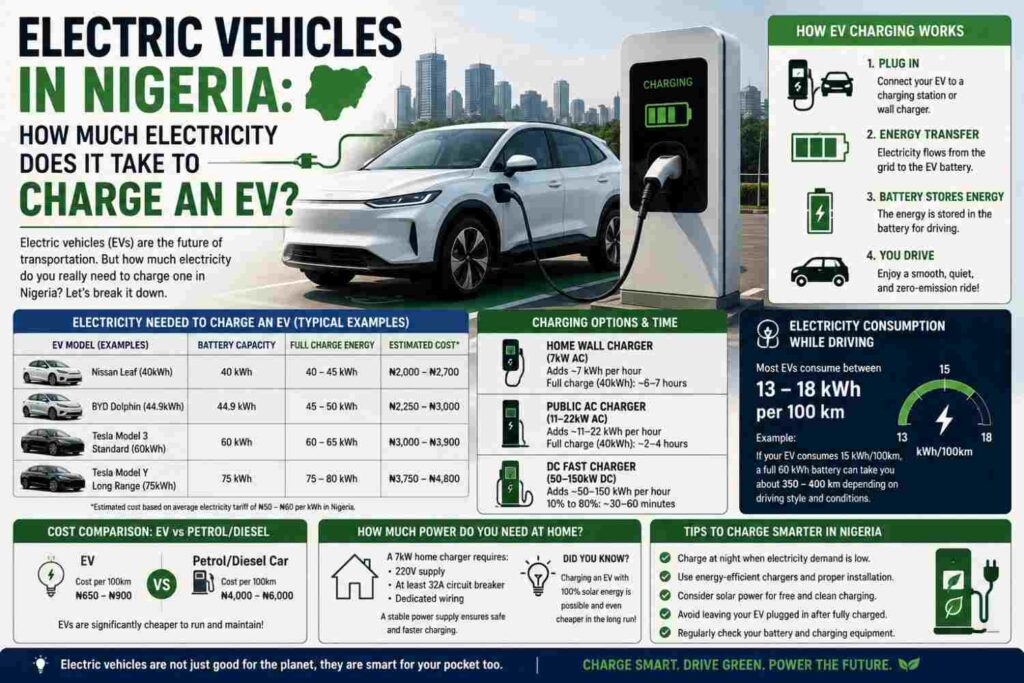
Electric vehicle batteries are rated in kilowatt-hours (kWh), representing total stored energy capacity, with typical passenger EVs ranging from smaller batteries around 30-40kWh to larger ones exceeding 80-100kWh, meaning the specific vehicle model significantly affects how much electricity a full charge genuinely requires.
Calculating Approximate Charging Energy Requirements
Charging from a significantly depleted battery to full requires roughly the battery’s rated capacity in kWh, accounting for some charging inefficiency losses (typically adding perhaps 10-15% beyond the battery’s rated capacity), meaning a 40kWh battery might genuinely require approximately 45-46kWh of grid electricity for a full charge from empty.
Comparing EV Charging to Typical Household Consumption
| Load | Approximate Daily/Charge Energy |
|---|---|
| Typical Nigerian household (moderate usage) | 5-15 kWh/day |
| Small EV full charge (40kWh battery) | ~45 kWh |
| Large EV full charge (80kWh battery) | ~90 kWh |
This comparison illustrates that a single full EV charge can genuinely represent multiple days’ worth of typical household electricity consumption, a significant additional load consideration for home charging setups.
Why Charging Speed Matters as Much as Total Energy
Beyond total energy required, the rate of charging, how many kilowatts your charging setup can deliver per hour, significantly affects practical charging time; a standard household socket might charge quite slowly (potentially many hours for a full charge), while dedicated higher-power home charging equipment charges considerably faster but requires correspondingly higher instantaneous power availability from your electrical supply.
Genuine Grid and Backup Power Implications
Given Nigeria’s grid reliability challenges, discussed throughout our grid collapse and power availability articles, EV owners genuinely need to consider how charging fits within their existing backup power setup, inverter/battery systems, discussed in our inverter articles, or generators, since an unreliable grid connection creates real practical challenges for consistently charging a vehicle you depend on for transportation.
Solar-Assisted EV Charging: A Genuinely Complementary Approach
Given Nigeria’s strong solar generation potential, discussed throughout our solar energy articles, pairing home EV charging with a solar and battery system offers genuine appeal, potentially reducing dependence on grid electricity for charging while also providing more predictable, self-generated charging capacity, though this requires meaningfully larger solar and battery capacity than a typical home-only solar setup.
Practical Charging Habits That Genuinely Help
Prospective Nigerian EV owners can genuinely ease the practical charging burden through deliberate habits, charging during off-peak periods or when solar generation is strongest if using a solar-assisted setup, avoiding unnecessarily frequent full charges when partial charging would suffice for typical daily driving needs, and planning charging schedules around known grid reliability patterns specific to their area, discussed in our dedicated street-level power availability article, all approaches that make EV ownership meaningfully more practical within Nigeria’s current power landscape.
Common Misconceptions
- “EV charging energy requirements are negligible compared to normal household usage.” A single full charge can genuinely represent several days’ worth of typical household electricity consumption.
- “Any standard household electrical setup can handle EV charging without consideration.” Charging speed and instantaneous power draw require genuine consideration of your home’s electrical capacity and setup.
- “EV ownership is currently impractical in Nigeria given grid challenges.” While genuine challenges exist, backup power solutions and solar-assisted charging offer practical paths forward for interested owners.
Frequently Asked Questions
How does EV charging cost compare to Nigeria’s fuel costs for a comparable vehicle?
This depends significantly on current electricity tariffs versus fuel prices, discussed in our prepaid meter tariff article, and specific vehicle efficiency, making a genuine cost comparison worth calculating based on current, specific pricing for an accurate picture.
Can a typical home inverter/battery system, discussed in our inverter articles, support EV charging during outages?
This depends heavily on the specific inverter and battery capacity relative to your charging equipment’s power draw; many typical home backup systems would need significant additional capacity specifically for meaningful EV charging support.
Is EV charging infrastructure currently well-developed in Nigeria for those without home charging capability?
Public charging infrastructure remains in relatively early development in Nigeria compared to home charging, making home charging capability, and reliable power access to support it, particularly important for prospective Nigerian EV owners currently.
Final Thoughts
Charging an electric vehicle represents a genuinely substantial additional electricity demand, often equivalent to several days of typical household consumption for a single full charge, requiring careful consideration of grid reliability, backup power capacity, and potentially solar-assisted charging for Nigerian EV owners. Understanding these genuine energy requirements helps prospective owners realistically plan for practical, reliable home charging.