
A genuinely common and frustrating experience across many Nigerian neighborhoods is seeing power available on one street while a neighboring street just meters away remains completely dark.
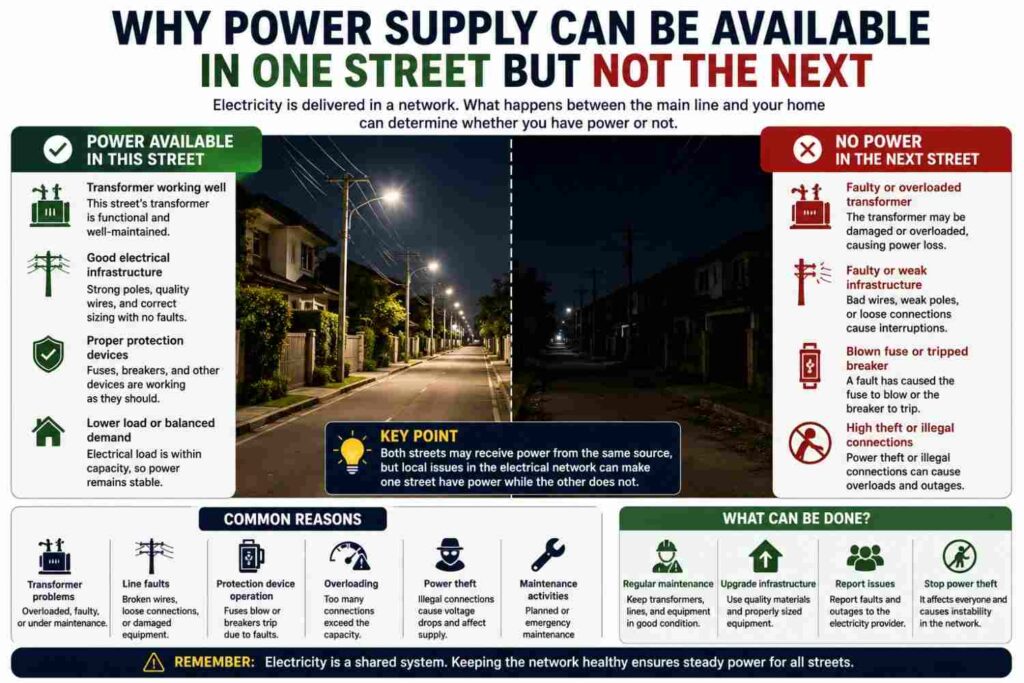
This article explains the genuine technical reasons behind this localized inconsistency.
Different Streets Often Draw From Different Feeders
Distribution networks are organized into separate feeder circuits, each serving specific groups of streets or neighborhoods from a particular distribution transformer or substation connection point; if one specific feeder experiences a fault, overload trip, or maintenance disconnection, only the streets connected to that particular feeder lose power while adjacent streets on a different feeder continue receiving supply normally.
Localized Transformer Problems
As discussed in our dedicated transformer explosion and humming sound articles, individual distribution transformers can fail, trip on protection, or require maintenance disconnection independently of neighboring transformers; since each local transformer typically serves a specific limited group of streets, a problem affecting just one transformer creates exactly this kind of localized, street-specific outage pattern.
Different Load Levels and Overload Tripping
| Factor | Why It Creates Street-Level Differences |
|---|---|
| Different feeder assignment | Faults/trips on one feeder don’t affect others |
| Different transformer serving each area | Individual transformer problems stay localized |
| Uneven load distribution | Some transformers/feeders more prone to overload |
| Illegal connections concentration | Some areas experience more unaccounted load stress |
| Maintenance scheduling | Planned work often affects specific feeders only |
Illegal Connections and Unaccounted Load
Some areas experience disproportionate illegal connection activity, adding unaccounted load that pushes local transformers or feeders toward overload conditions more frequently than areas with fewer illegal connections, meaning two genuinely similar neighborhoods can experience quite different reliability if one has significantly more unauthorized load drawing from its local infrastructure.
Planned Maintenance and Load Shedding Patterns
DisCos sometimes implement planned maintenance disconnections or load management (load shedding) that specifically targets particular feeders or areas based on operational needs, meaning some streets may experience scheduled interruptions that neighboring streets on different feeders don’t experience during the same period.
Why This Isn’t Necessarily Random or Unfair
While frustrating, this pattern generally reflects genuine underlying technical differences, feeder assignment, transformer condition, and load characteristics, rather than arbitrary or deliberately unfair treatment, though genuine infrastructure investment disparities between areas can also contribute to persistent differences in reliability over time.
What Residents Can Genuinely Do
- Report outages specifically, including your exact street and nearest transformer/pole if known, to help your DisCo diagnose the specific affected infrastructure.
- Report suspected illegal connections contributing to local overload conditions.
- Engage community/resident associations to collectively advocate for infrastructure investment in underserved areas.
How Backup Power Choices Often Reflect This Local Variation
Interestingly, this street-level inconsistency often shapes how individual households approach backup power, discussed throughout our generator, inverter, and solar articles, since a household on a genuinely unreliable feeder may reasonably invest more heavily in robust backup capacity than a neighbor just streets away on a more stable feeder, illustrating how this localized grid variation has genuine downstream effects on individual household energy decisions and spending.
Common Misconceptions
- “Power availability differences between nearby streets indicate deliberate unfairness.” They typically reflect genuine technical differences in feeder assignment, transformer condition, or load characteristics.
- “All streets in a neighborhood draw from the exact same infrastructure.” Distribution networks are organized into separate feeder circuits and transformers serving specific, often smaller groups of streets.
- “There’s nothing residents can do besides waiting for the situation to improve on its own.” Specific outage reporting and community advocacy for infrastructure investment are genuinely useful actions.
Frequently Asked Questions
How can I find out which feeder or transformer serves my specific street?
Your local DisCo’s customer service or technical office can typically provide this information, and reporting outages with specific location details often helps them respond to your specific infrastructure more effectively.
Does having a prepaid meter, discussed in our dedicated article, affect this street-level variation?
No, prepaid metering relates to how consumption is measured and billed, not to which feeder or transformer serves your street, so it doesn’t directly affect this specific reliability pattern.
Can this street-level inconsistency improve over time with infrastructure investment?
Yes, targeted infrastructure upgrades, transformer capacity increases, feeder reinforcement, and illegal connection enforcement can genuinely improve reliability in specific previously underserved areas over time.
Final Thoughts
Power availability differences between nearby streets typically stem from genuine technical factors, different feeder assignments, individual transformer conditions, and varying load characteristics, rather than arbitrary unfairness. Understanding these underlying causes, and engaging in specific, informed reporting and advocacy, provides a more constructive path forward than simply attributing the frustrating pattern to randomness alone.