
Star-delta starting remains one of the most widely used motor starting methods for larger induction motors, yet many students memorize the wiring configuration without genuinely understanding why this specific approach is used. This article explains what star-delta starting actually does and why it remains a practical, cost-effective solution.
The Core Problem Star-Delta Starting Solves
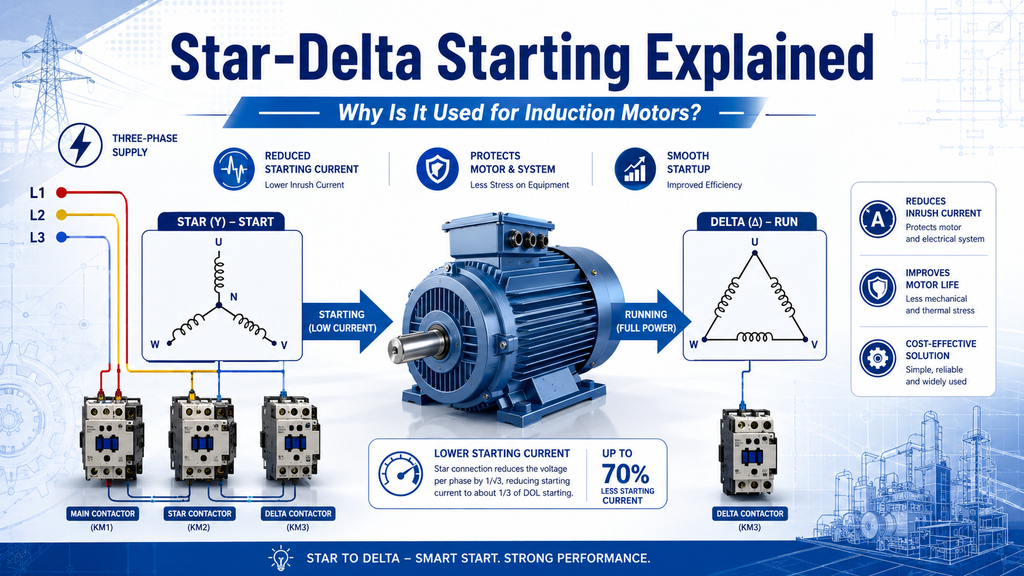
Induction motors started directly across the line (direct-on-line starting) draw significantly higher inrush current, often five to seven times normal running current, discussed further in our motor overheating and motor protection articles, creating voltage dips, mechanical stress, and potential nuisance tripping of upstream protection; star-delta starting specifically addresses this inrush current problem for larger motors.
How Star-Delta Starting Actually Works
Star-delta starting initially connects the motor windings in a star (Y) configuration during starting, which reduces the voltage across each winding to about 58% of line voltage, correspondingly reducing starting current to roughly one-third of what direct-on-line starting would draw, and then, once the motor reaches a sufficient speed, switches the connection to delta configuration for normal full-voltage running operation.
Why Reduced Starting Voltage Reduces Starting Current So Significantly
Because current draw relates directly to applied voltage in this context, and because power (and thus torque) relates to the square of voltage, the star connection’s reduced per-winding voltage produces a proportionally larger reduction in starting current than in starting torque, providing genuine inrush current reduction while still delivering sufficient starting torque for many, though not all, application types.
The Star-to-Delta Transition Moment
A genuinely important practical consideration is the transition moment itself, switching from star to delta configuration; this transition causes a brief current transient as the motor reconnects, and proper timing, allowing the motor to reach adequate speed in star configuration before switching, matters for smooth, reliable transition without excessive transient stress.
Star-Delta Compared to Other Starting Methods
| Starting Method | Starting Current Reduction | Relative Complexity/Cost |
|---|---|---|
| Direct-on-line | None (full inrush current) | Simplest, lowest cost |
| Star-delta | Significant (roughly one-third of DOL) | Moderate |
| Soft starter | Adjustable, often substantial | Higher |
| VFD | Very high, plus variable speed capability | Highest |
Why Star-Delta Remains Popular Despite Newer Alternatives
Despite soft starters and VFDs, discussed in our dedicated comparison articles, offering more sophisticated starting control, star-delta starting remains widely used because of its relatively low cost, mechanical simplicity, and proven reliability for applications where its specific starting current reduction and torque characteristics adequately meet the application’s requirements without needing the additional capability, and cost, that electronic alternatives provide.
Requirements and Limitations Worth Understanding
Star-delta starting requires motors specifically designed with all six winding terminals accessible (rather than motors with only three terminals, which can’t be reconfigured this way), and provides reduced starting torque that may be insufficient for high-inertia or high-starting-torque applications, making genuine application suitability assessment an important consideration before selecting this starting method.
Timer Settings and Common Practical Installation Mistakes
A genuinely common practical mistake in star-delta installations is incorrect timer setting for the star-to-delta transition, switching too early, before the motor has reached adequate speed, causes excessive transient current at transition, while switching too late provides no additional benefit and unnecessarily prolongs reduced-torque operation; correctly setting this transition timing based on the specific motor and load characteristics is a genuinely important commissioning detail often overlooked by less experienced installers.
Common Misconceptions
- “Star-delta starting works for any three-phase motor regardless of design.” It specifically requires motors with all six winding terminals accessible for reconfiguration, not all motor designs support this.
- “Star-delta starting is an outdated method that should always be replaced with electronic alternatives.” For applications where its specific characteristics suffice, it remains a genuinely cost-effective, reliable practical choice.
- “The star-to-delta transition doesn’t require any particular engineering attention.” Proper timing and transition management genuinely matter for smooth, reliable operation without excessive transient stress.
Frequently Asked Questions
What size of motor typically warrants star-delta starting rather than direct-on-line?
This varies by local electrical codes and utility requirements, but larger motors, often above roughly 5-7.5 kW depending on specific regulations and grid capacity, typically require reduced-current starting methods like star-delta.
Can star-delta starting be used for applications requiring high starting torque?
Given its reduced starting torque characteristics, applications with high-inertia loads or requiring high starting torque may need alternative starting methods better suited to those specific torque requirements.
Is star-delta starting still taught and used in modern electrical engineering practice?
Yes, it remains a standard topic in electrical engineering education and continues seeing genuine practical industrial use, particularly where its cost-effectiveness suits the application’s specific requirements.
Final Thoughts
Star-delta starting provides a genuinely effective, cost-conscious solution to the inrush current problem of starting larger induction motors, temporarily reducing winding voltage through star configuration before transitioning to full delta operation. Understanding why this specific approach works, and its requirements and limitations, provides valuable practical knowledge for anyone working with industrial motor control systems.