
SCADA systems quietly oversee much of the electrical infrastructure people depend on daily, from power grids to water treatment plants, yet the term remains unfamiliar to many outside industrial and utility engineering. This article explains what SCADA actually is and how it controls and monitors electrical systems at scale.
What SCADA Actually Stands For and Does
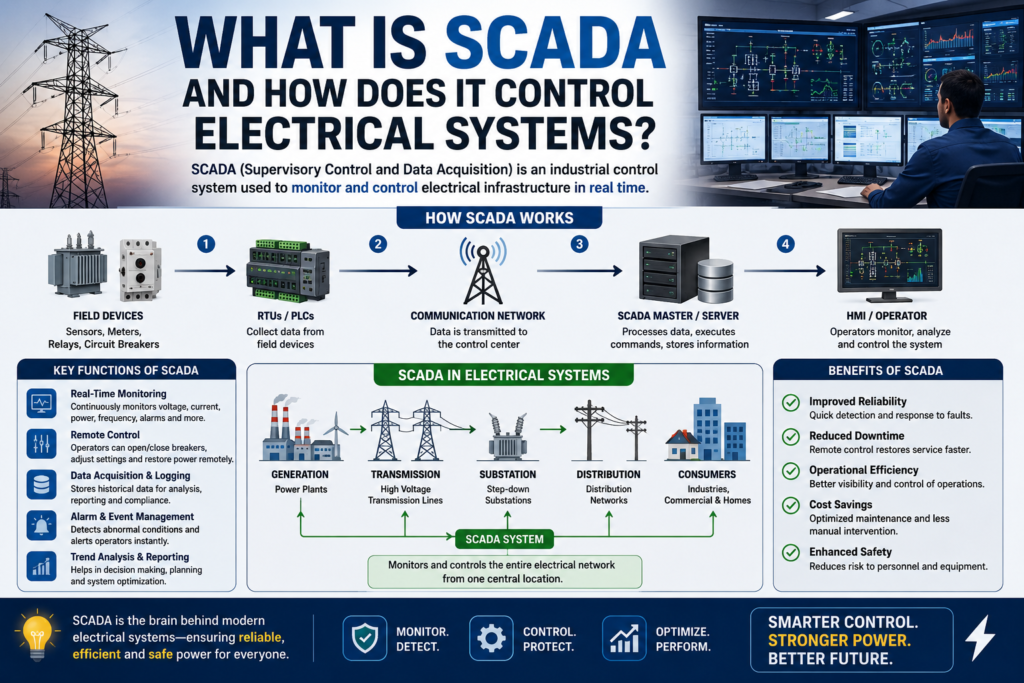
SCADA, Supervisory Control and Data Acquisition, is a software and hardware system that allows centralized monitoring and control of geographically distributed industrial processes and infrastructure, collecting real-time data from field equipment (often PLCs or dedicated remote terminal units) and presenting it to operators through centralized control room interfaces.
How SCADA Differs From a Standalone PLC System
While a single PLC, discussed in our dedicated PLC article, typically controls one local process or machine, SCADA operates at a higher, supervisory level, aggregating data and control capability across many distributed PLCs, remote terminal units, and field devices spread across a wide geographic area, giving operators centralized visibility and control they couldn’t achieve managing each local controller separately.
Core Components of a Typical SCADA System
| Component | Role |
|---|---|
| Field devices/sensors | Measure real-world conditions (voltage, flow, temperature) |
| RTUs/PLCs | Local control and data collection at each site |
| Communication network | Transmits data between field sites and control center |
| SCADA master/server | Aggregates data, runs supervisory logic |
| Human-Machine Interface (HMI) | Operator-facing screens for monitoring and control |
SCADA’s Central Role in Electrical Power Systems
Electrical utilities rely extensively on SCADA to monitor and control generation, transmission, and distribution infrastructure across wide geographic areas, tracking voltage levels, load conditions, and equipment status in real time, and enabling remote switching operations that would otherwise require dispatching personnel to physically operate equipment at distant substations.
How SCADA Supports Grid Reliability and Fault Response
By providing real-time visibility into grid conditions, SCADA systems allow operators to detect abnormal conditions quickly, isolate faults remotely by opening or closing switches without physical site visits, and coordinate broader system responses during disturbances, playing a genuinely important role in minimizing outage duration and preventing localized problems from cascading into wider grid instability.
Communication Technologies SCADA Systems Rely On
SCADA systems use various communication methods depending on distance and infrastructure availability, including dedicated fiber optic networks, radio communication, cellular networks, and satellite links for particularly remote installations, with system architects choosing communication technology based on reliability requirements, distance, and cost considerations specific to each installation.
Growing Cybersecurity Considerations for SCADA Systems
As SCADA systems increasingly connect to broader networks for remote access and integration with other business systems, genuine cybersecurity considerations, protecting critical infrastructure from unauthorized access or malicious interference, have become an increasingly important dimension of SCADA system design and operation, alongside the traditional focus on reliability and functionality.
Historical Data and Trending: SCADA’s Analytical Value
Beyond real-time monitoring and control, SCADA systems typically log historical data over time, allowing operators and engineers to analyze trends, identify recurring problems, and support longer-term planning decisions; this historical trending capability, reviewing how voltage, load, or equipment performance has changed over weeks, months, or years, provides genuinely valuable analytical insight beyond SCADA’s immediate supervisory control function alone.
Common Misconceptions
- “SCADA and PLC are essentially the same technology with different names.” SCADA operates at a supervisory level across distributed systems, while PLCs handle local control at individual sites, with SCADA typically incorporating and coordinating multiple PLCs.
- “SCADA systems only apply to very large national infrastructure.” SCADA scales down to smaller applications too, including individual industrial facilities or municipal utility systems.
- “Once implemented, SCADA systems require minimal ongoing engineering attention.” SCADA systems require ongoing maintenance, security updates, and adaptation as underlying infrastructure and requirements evolve.
Frequently Asked Questions
Is SCADA used only in electrical power systems, or in other industries too?
SCADA is used broadly across water treatment, oil and gas, manufacturing, and transportation infrastructure, with electrical power systems being just one significant application area among many.
What skills do engineers need to work with SCADA systems?
Genuine understanding of the underlying industrial processes being monitored, PLC and control systems knowledge, networking fundamentals, and increasingly, cybersecurity awareness, all contribute to effective SCADA engineering work.
How does SCADA relate to the broader concept of a “smart grid”?
SCADA forms a foundational technology underlying smart grid capabilities, with modern smart grid initiatives generally extending and enhancing traditional SCADA functionality with additional data analytics and automation capability.
Final Thoughts
SCADA systems provide the centralized monitoring and control backbone behind much of the electrical infrastructure modern life depends on, aggregating data and enabling remote control across geographically distributed equipment that would otherwise require constant physical site presence. Understanding SCADA’s role, components, and growing cybersecurity considerations provides valuable context for anyone working in or studying power systems and industrial automation.