
Programmable Logic Controllers sit at the heart of nearly every modern industrial automation system, from small packaging lines to entire factory floors, yet many people outside the field have only a vague sense of what a PLC actually does. This article explains what a PLC is, how it works, and why it became the standard tool for controlling industrial processes.
What a PLC Actually Is
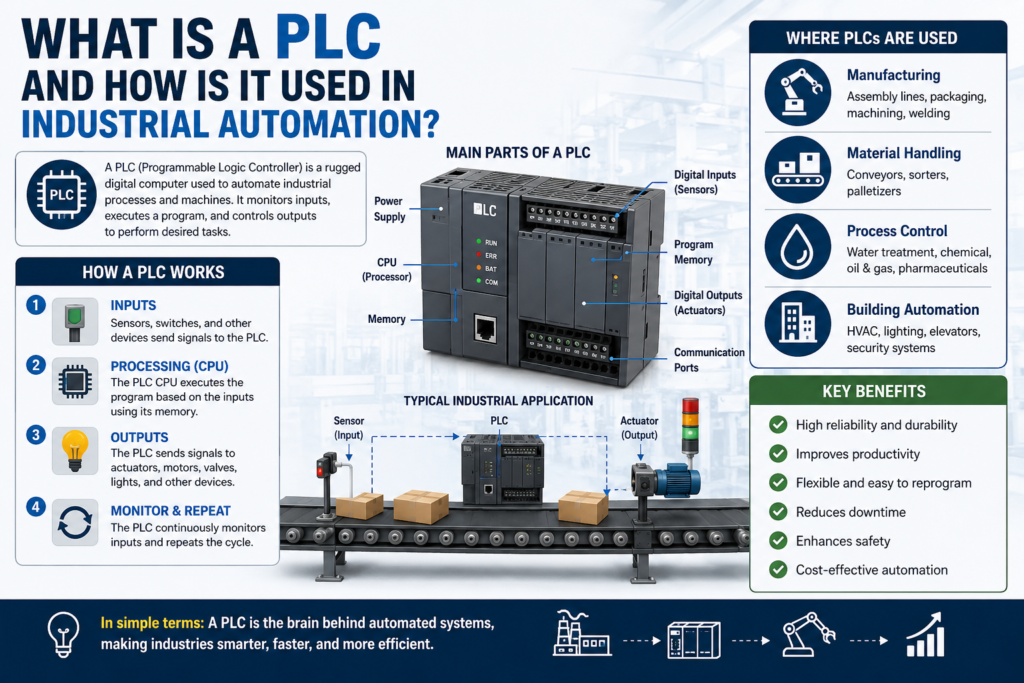
A Programmable Logic Controller is a ruggedized industrial computer specifically designed to monitor inputs (sensors, switches, limit switches), execute a stored logic program, and control outputs (motors, valves, indicator lights, contactors) accordingly, built to withstand vibration, temperature swings, dust, and electrical noise that would quickly damage an ordinary office computer.
The Basic Scan Cycle: How a PLC Actually Operates
PLCs operate through a continuous “scan cycle”: reading the current state of all inputs, executing the stored logic program against those inputs, updating outputs based on the results, and repeating this cycle continuously, often many times per second, giving the appearance of instantaneous, continuous control even though it’s technically a rapid repeating loop.
Ladder Logic: The Dominant Programming Language
Most PLCs are programmed using ladder logic, a visual programming language deliberately designed to resemble electrical relay wiring diagrams, making it genuinely accessible to electricians and technicians with circuit background even without formal software programming training, discussed further in our dedicated beginner’s guide to PLC programming.
Why Industry Moved From Relay Panels to PLCs
Before PLCs became standard, industrial control relied on large panels of physical relays wired together, systems that were bulky, difficult to modify (requiring physical rewiring for any logic change), and prone to mechanical wear; PLCs replaced this with software-based logic that can be reprogrammed without touching wiring, dramatically improving flexibility, reliability, and maintenance ease.
Typical Industrial Applications
| Application Area | What the PLC Controls |
|---|---|
| Manufacturing/assembly lines | Conveyor sequencing, robotic coordination, quality checks |
| Water and wastewater treatment | Pump control, chemical dosing, level monitoring |
| Oil and gas processing | Process control, safety shutdown systems |
| Building automation | HVAC control, lighting systems, access control |
| Power generation | Generator control, protection system logic |
Key Components of a Typical PLC System
- CPU (processor): executes the stored logic program
- Input modules: interface with sensors and switches
- Output modules: interface with motors, valves, and other actuators
- Power supply: provides regulated power to the PLC system
- Programming software: used to write, upload, and monitor the control logic
How PLCs Fit Into Larger Automation Systems
Individual PLCs rarely operate in complete isolation in modern industrial settings; they typically communicate with SCADA systems for centralized monitoring and control, discussed in our dedicated SCADA article, with Human-Machine Interfaces (HMIs) allowing operators to interact with and monitor processes, and increasingly with other PLCs and industrial devices through standardized communication protocols, forming integrated automation architectures rather than standalone controllers.
Why PLC Skills Remain Genuinely Valuable for Engineers
Given how central PLCs remain to industrial automation across virtually every manufacturing and process industry sector, genuine PLC programming competency remains one of the most consistently valuable, in-demand practical skills for electrical engineering students and early-career engineers, discussed further in our dedicated career-focused PLC beginner’s guide.
Reliability and Redundancy Considerations in Critical Applications
For applications where PLC failure would cause significant safety risk or costly downtime, engineers often design in redundancy, backup PLCs that can take over automatically if a primary unit fails, or redundant power supplies and communication paths, adding genuine system resilience beyond what a single PLC installation provides, particularly important for safety-critical processes like those found in oil and gas or power generation facilities where unplanned shutdowns carry substantial consequences.
Common Misconceptions
- “PLCs are essentially the same as ordinary computers running special software.” PLCs are purpose-built industrial hardware, ruggedized for harsh environments, with real-time operating characteristics ordinary computers don’t reliably provide.
- “Ladder logic programming requires the same skills as general software development.” Ladder logic’s visual, relay-based format is genuinely distinct from and more accessible than typical text-based programming languages.
- “Once installed, a PLC system rarely needs modification.” Reprogramming flexibility is actually one of PLCs’ core advantages, and industrial processes are frequently updated and optimized over their operational lifetime.
Frequently Asked Questions
How is a PLC different from a microcontroller used in embedded electronics projects?
While both execute programmed logic, PLCs are specifically ruggedized for harsh industrial environments and designed for straightforward reprogramming and diagnostics by technicians, whereas microcontrollers are typically embedded permanently within a specific product’s circuit design.
Do different manufacturers’ PLCs work fundamentally differently from each other?
Core ladder logic concepts transfer reasonably well between manufacturers (Siemens, Allen-Bradley, and others), though each has its own specific programming software and some platform-specific features and terminology.
Is PLC technology being replaced by newer control approaches?
PLCs remain the dominant industrial control standard and continue evolving with added networking, cybersecurity, and integration capabilities rather than being replaced outright by alternative technologies.
Final Thoughts
PLCs represent the foundational technology behind modern industrial automation, replacing bulky relay panels with flexible, reprogrammable logic control that now underlies manufacturing, process industries, and building automation worldwide. Understanding how PLCs work, their scan cycle, ladder logic programming, and their role within larger automation systems, provides genuinely valuable context for anyone working in or studying industrial electrical engineering.