
Inverter air conditioners are increasingly marketed as the energy-efficient choice, but understanding exactly how they achieve genuine savings, and how much you can realistically expect, deserves a closer, more technical look than marketing claims alone provide. This article explains the real mechanism behind inverter AC savings.
How Traditional Fixed-Speed AC Units Actually Operate
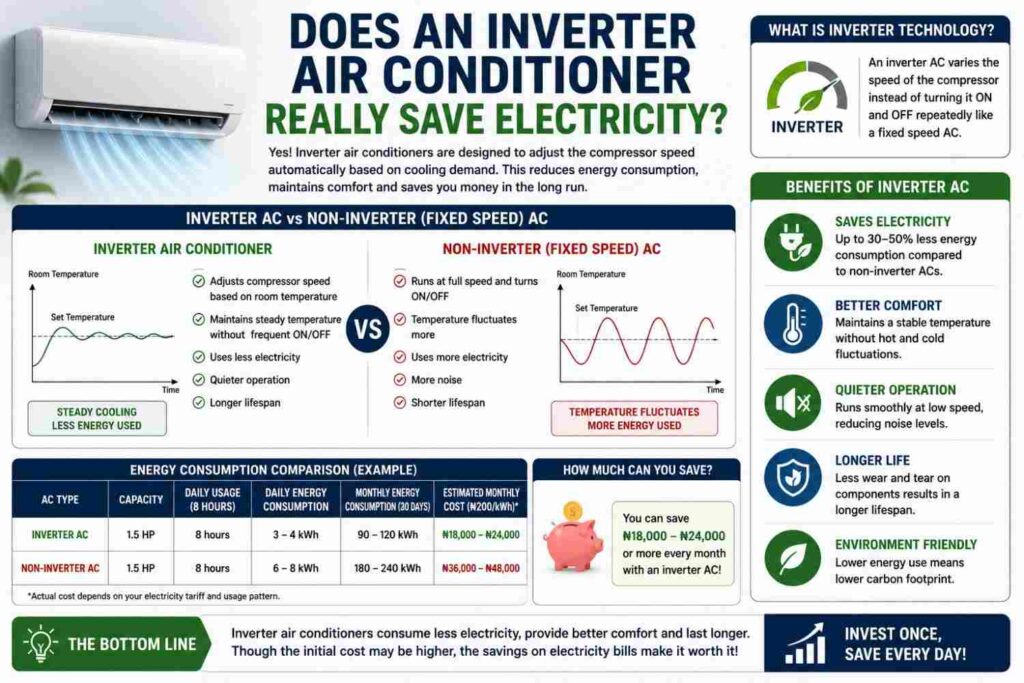
A conventional, non-inverter AC unit’s compressor operates in a simple on-off pattern: running at full power until the room reaches your set temperature, then switching off completely, and switching back on at full power again once the temperature drifts back up past your threshold, a cycling pattern that involves repeated full-power startup surges, discussed in our dedicated AC-and-inverter-power article, and periods of either full-power operation or no cooling at all.
How Inverter-Type AC Units Genuinely Differ
An inverter-type AC unit’s compressor uses variable-speed technology, adjusting its speed and power draw continuously to precisely match the room’s actual, current cooling need, rather than cycling fully on and off; once the target temperature is reached, the compressor slows to a lower, efficient speed to maintain that temperature, rather than switching off completely and later restarting at full power.
Why This Genuinely Saves Electricity
This continuous, matched-speed operation avoids the energy waste inherent in repeated full-power startups (each restart briefly draws substantially more power than steady-state operation) and avoids the inefficiency of overshooting and undershooting your target temperature that fixed-speed cycling naturally produces, together typically delivering genuine electricity savings of roughly 20-40% compared to an equivalent fixed-speed unit providing the same cooling capacity.
A Comparison Table
| Factor | Fixed-Speed AC | Inverter-Type AC |
|---|---|---|
| Compressor operation | Full on/off cycling | Continuous variable speed |
| Startup surge frequency | Frequent (each restart) | Rare (mainly initial startup) |
| Temperature consistency | Fluctuates within a range | More stable, precise |
| Typical electricity savings | Baseline | ~20-40% less for equivalent cooling |
| Upfront cost | Generally lower | Generally higher |
Why Upfront Cost Difference Often Pays Back Over Time
Inverter-type units typically cost more upfront than comparable fixed-speed units, but given how significant AC electricity consumption typically is within total household usage, discussed in our dedicated appliance ranking article, the ongoing electricity savings often recover this additional upfront cost within a reasonable timeframe, particularly for units used extensively, making inverter technology a genuinely worthwhile investment for households using AC regularly rather than only occasionally.
Additional Benefits Beyond Pure Electricity Savings
Inverter-type units generally provide more consistent, stable room temperature (avoiding the noticeable fluctuation of fixed-speed cycling), operate more quietly since they avoid the abrupt full-power restarts and often run at lower speeds during steady-state operation, and, as discussed in our generator-and-AC article, place gentler demand on backup power sources like generators and inverters, additional genuine advantages beyond the headline electricity savings figure.
When the Savings Matter Most
The electricity savings from inverter technology are most pronounced for units used extensively, running for many hours daily over extended periods, since the cumulative avoided startup surges and improved steady-state efficiency compound over more operating hours; for very occasional, brief AC use, the relative savings, while still genuine, represent a smaller absolute electricity cost difference.
How to Verify Genuine Inverter Technology When Purchasing
Given the marketing appeal of the term, it’s worth specifically confirming a unit’s genuine variable-speed inverter compressor technology through its official specification sheet or by checking recognized model naming conventions from reputable manufacturers, rather than assuming any unit labeled with “inverter” somewhere in its marketing materials necessarily delivers the full efficiency benefits discussed throughout this article, since terminology use can occasionally be inconsistent or misleading in some markets.
Common Misconceptions
- “Inverter” in “inverter AC” refers to the same power inverters used for battery backup. This is a genuinely common point of confusion; inverter-type AC refers to the compressor’s variable-speed technology, an entirely different concept from the power inverters discussed elsewhere on this site.
- “Inverter AC units cool rooms faster than fixed-speed units.” Initial cooling speed is often comparable; the genuine advantage is in efficient temperature maintenance and reduced cycling losses, not necessarily faster initial cooldown.
- “The electricity savings are only marginal and don’t justify the higher upfront cost.” For units used extensively, the cumulative savings are often genuinely substantial and can meaningfully offset or exceed the higher initial purchase price over the unit’s service life.
Frequently Asked Questions
Do inverter AC units require any different maintenance than fixed-speed units?
Generally similar basic maintenance, filter cleaning and periodic professional servicing, applies to both types, though inverter units’ more complex electronic control systems may involve somewhat different, sometimes more specialized, repair considerations if a fault develops.
Is the electricity savings figure consistent across all climates and usage patterns?
The general 20-40% savings range is a reasonable typical estimate, though actual savings vary based on your specific usage pattern, climate conditions, and how significantly your fixed-speed alternative would have cycled under your particular circumstances.
Can I retrofit my existing fixed-speed AC with inverter technology?
No, inverter technology is built into the unit’s compressor and control system from manufacture; achieving these savings requires purchasing a genuine inverter-type unit rather than modifying an existing fixed-speed unit.
Final Thoughts
Inverter-type air conditioners deliver genuine, substantial electricity savings through their variable-speed compressor technology, avoiding the energy waste inherent in traditional fixed-speed cycling, making them a worthwhile consideration for any household using AC regularly despite their higher upfront cost. Understanding the actual mechanism behind these savings helps you evaluate this investment based on genuine technical merit rather than marketing claims alone.