
Understanding exactly which appliances actually drive your household’s electricity consumption, rather than relying on assumption or focusing energy-saving efforts on the wrong targets, is genuinely valuable for any household trying to manage electricity costs effectively. This article ranks common household appliances by their typical real-world consumption impact.
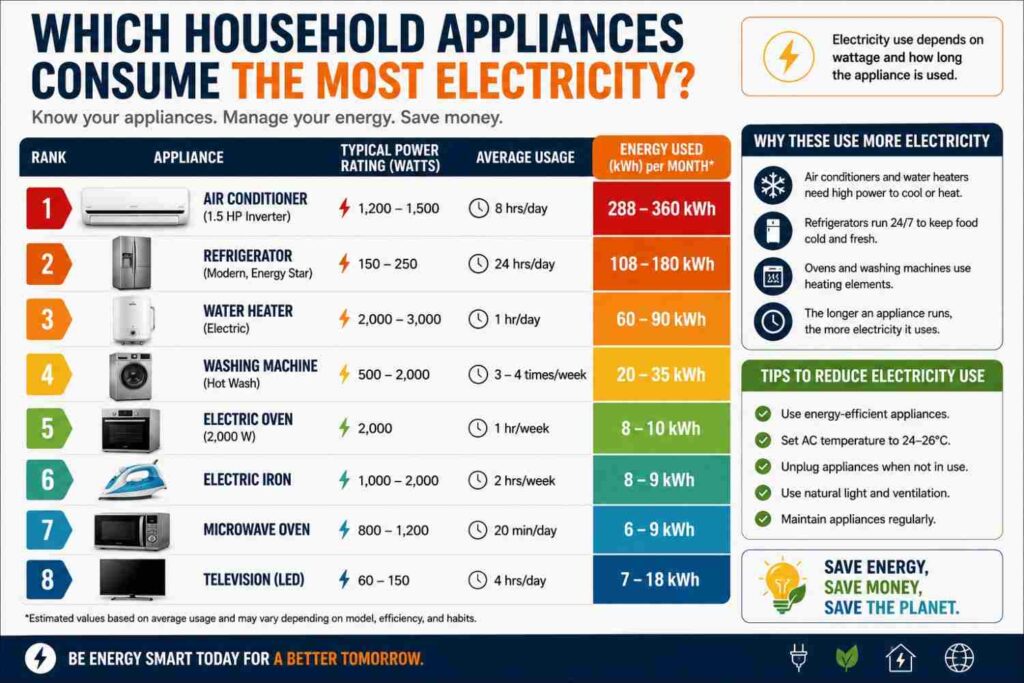
The Biggest Consumers: Heating and Cooling Appliances
Air conditioners, discussed in depth in our dedicated AC consumption article, are typically the single largest electricity consumer in households that use them regularly, often consuming more electricity than several other major appliances combined given their substantial power draw and typically extended daily operation during hot periods. Electric water heaters, when present, are similarly significant, since heating water requires substantial, sustained energy input.
Major but Somewhat Smaller Consumers
Refrigerators, despite their modest instantaneous power draw, rank as genuinely significant consumers due to their continuous 24-hour operation, discussed in our dedicated refrigerator article, while electric kettles, irons, and similar high-wattage but brief-use appliances consume meaningful energy per use but typically far less in cumulative daily or monthly terms than continuously or extensively operating appliances like AC and refrigeration.
A Rough Ranking Table
| Appliance | Typical Relative Consumption Impact |
|---|---|
| Air conditioner (regular use) | Very high |
| Electric water heater | Very high (if used regularly) |
| Refrigerator | High (due to continuous operation) |
| Electric iron | Moderate (high wattage, limited duration) |
| Washing machine | Moderate |
| Television/entertainment electronics | Low-moderate |
| Lighting (LED) | Low |
| Phone/laptop chargers | Very low |
Why Usage Pattern Matters as Much as Appliance Type
An appliance’s actual impact on your total consumption depends not just on its power rating but genuinely on how much you actually use it; a high-wattage appliance used briefly and infrequently can consume less total electricity than a moderate-wattage appliance used extensively, meaning your own household’s specific usage pattern, not just generic appliance rankings, ultimately determines your actual consumption breakdown.
Why Understanding This Ranking Helps You Prioritize Effectively
Households genuinely wanting to reduce electricity costs benefit from focusing conservation efforts on their actual biggest consumers, typically AC usage patterns and water heating if present, rather than spending disproportionate effort on genuinely minor consumption sources like phantom charger draw, discussed in our dedicated charger article, which, while real, represents a comparatively tiny fraction of most households’ total consumption.
How to Determine Your Own Household’s Specific Breakdown
Rather than relying solely on general rankings, calculating your own household’s specific consumption using the method in our dedicated appliance electricity cost article, applied to your actual major appliances and their real usage patterns, gives you a personalized breakdown that may differ from general assumptions based on your specific appliance mix and habits.
Seasonal Variation Worth Considering
Your household’s biggest consumer can shift seasonally: AC usage typically peaks during the hottest, driest periods, while other consumption patterns remain relatively constant year-round, meaning a genuinely complete understanding of your consumption pattern accounts for this seasonal variation rather than assuming a fixed, unchanging breakdown throughout the year.
Why Comparing Your Bill Against This Ranking Is a Useful Sanity Check
If your actual electricity bill seems disproportionately high relative to what this general ranking would predict for your household’s appliance mix, this discrepancy itself is a useful diagnostic signal, potentially pointing toward an aging, inefficient appliance discussed in our dedicated aging-appliances article, an appliance running more extensively than you realize, or in some cases, an electrical fault worth investigating through the troubleshooting resources elsewhere on this site.
Common Misconceptions
- “The appliance with the highest wattage rating is always your biggest consumer.” Actual usage duration matters as much as instantaneous wattage; a lower-wattage appliance used extensively can consume more total electricity than a higher-wattage appliance used briefly.
- “Every household’s consumption breakdown looks essentially the same.” Your specific appliance mix, usage habits, and even climate and home insulation genuinely affect your particular breakdown.
- “Small appliances like phone chargers are worth significant conservation effort.” Their actual consumption impact is typically negligible compared to major appliances like AC, water heating, and refrigeration.
Frequently Asked Questions
Does having a large household with many people significantly change this ranking?
Household size can increase overall usage of several categories, including water heating, laundry, and general appliance use, though the relative ranking of major consumers like AC and refrigeration typically remains broadly similar.
How can I identify my own household’s actual biggest consumer without specialized equipment?
Estimating using appliance wattage ratings and realistic usage hours, following the calculation method in our appliance cost article, gives a reasonable approximation even without a dedicated energy monitor.
Is it worth investing in a whole-home energy monitoring system to get precise data?
For households genuinely motivated to optimize consumption in detail, this can provide valuable precise data; for most households, reasonable estimation using the methods discussed throughout this series is sufficient to identify and address the most impactful consumption sources.
Final Thoughts
Understanding which appliances genuinely drive your household’s electricity consumption, typically led by air conditioning and water heating where present, followed by refrigeration’s continuous operation, helps you direct energy-saving efforts where they’ll actually make a meaningful financial difference, rather than focusing disproportionately on genuinely minor consumption sources.