
Boiling water is one of the most frequent small energy tasks in any household, and comparing electric kettle and gas stove costs for this specific task, with actual numbers rather than assumption, reveals a genuinely useful, practical answer for cost-conscious households. This article works through the real comparison.
Electric Kettle Energy Consumption
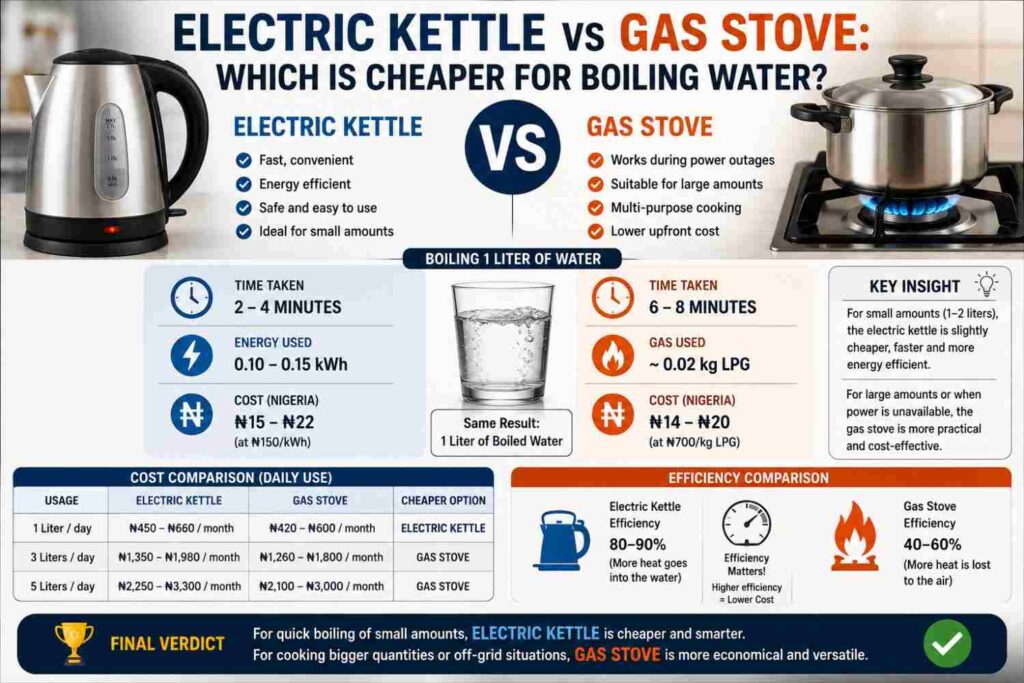
A typical electric kettle draws substantial power, often 1,500-2,200W, but for a genuinely brief period, typically just 2-4 minutes to boil roughly a liter of water from room temperature, meaning total energy consumption per use is actually quite modest, often somewhere around 0.05-0.1 kWh for a single liter boiled, despite the kettle’s high instantaneous wattage.
Gas Stove Energy Consumption for the Same Task
Comparing gas stove cost for boiling the same volume of water requires converting gas consumption to a comparable cost basis, since gas is typically priced per kilogram or liter of LPG rather than per kWh; a typical gas burner boiling a liter of water takes somewhat longer than an electric kettle, generally 5-8 minutes, and consumes a modest but genuine amount of gas during that period.
Why Electric Kettles Are Generally More Energy-Efficient for This Specific Task
Electric kettles are specifically designed to transfer heat directly and efficiently into water through a submerged or closely coupled heating element, while gas stoves lose a meaningful portion of their heat output to the surrounding air rather than directly into the pot, making gas generally less efficient specifically for the focused task of boiling a modest amount of water, even though gas can be genuinely cost-competitive or cheaper for larger volumes or extended cooking tasks where this efficiency gap matters less proportionally.
A Rough Cost Comparison Table
| Method | Time to Boil 1L | Approx. Energy/Fuel Used |
|---|---|---|
| Electric kettle | 2-4 minutes | ~0.05-0.1 kWh |
| Gas stove | 5-8 minutes | Modest gas consumption, generally less efficient for this specific small-volume task |
Exact cost comparison depends on your specific local electricity tariff and gas prices, both of which fluctuate; calculating your own specific comparison using current local prices, following the method in our appliance electricity cost article, gives the most accurate personal answer.
Why This Changes for Larger Volumes or Different Tasks
For boiling larger volumes of water, or for cooking tasks beyond simply reaching boiling point, gas stoves’ relative efficiency disadvantage matters less proportionally, and gas’s typically lower cost per unit of heat energy delivered (though this varies by local pricing) can make it more cost-competitive or even cheaper than electric kettles for larger-scale or extended cooking needs, meaning the “kettle is more efficient” conclusion applies most clearly and consistently to the specific, focused task of boiling a modest amount of water quickly, not to cooking generally.
Practical Factors Beyond Pure Cost Comparison
Speed matters genuinely too: an electric kettle’s faster boiling time offers real convenience value beyond pure energy cost, particularly relevant during Nigeria’s frequent grid instability, when running an electric kettle also depends on having reliable power available (whether grid, generator, or inverter), while a gas stove remains functional regardless of electricity availability, a genuine practical consideration independent of the cost comparison itself.
Kettle Quality and Efficiency Differences
Not all electric kettles perform identically; kettles with proper insulation, efficient heating elements, and features like auto-shutoff at boiling point (avoiding wasted energy from continued heating past the boiling point) are generally more efficient than basic, uninsulated units, making kettle quality a worthwhile consideration alongside the broader kettle-versus-gas comparison itself.
Why Running the Kettle on Inverter or Generator Power Changes the Calculation
If your electric kettle runs on inverter battery power during an outage rather than grid electricity, its substantial instantaneous wattage, discussed above, represents a genuinely significant draw on your battery system relative to gentler, lower-wattage appliances, worth factoring into your backup power planning discussed in our dedicated inverter sizing articles; in this specific scenario, a gas stove’s independence from your electrical backup system becomes a more meaningful practical advantage than the pure efficiency comparison alone would suggest.
Common Misconceptions
- “Gas is always cheaper than electricity for any cooking task.” For the specific, focused task of boiling a modest volume of water, electric kettles are often genuinely more efficient and cost-competitive despite gas’s typically lower per-unit energy cost.
- “A kettle’s high wattage rating means it’s expensive to run.” Because kettles operate for such a brief period, their total energy consumption per use is modest despite the high instantaneous wattage.
- “The comparison result is the same regardless of what you’re actually boiling water for.” Boiling a small amount for tea or coffee versus boiling a large pot for cooking changes the relative efficiency comparison meaningfully.
Frequently Asked Questions
Does boiling water on an induction stove change this comparison?
Induction stoves are generally more efficient than traditional gas burners for this task, since they transfer heat more directly to the pot similar in principle to how an electric kettle operates, potentially narrowing or reversing the efficiency gap compared to standard gas stoves.
Is it worth using a kettle even if I’ll then transfer the water to a pot for cooking?
Often yes, if you’re specifically reaching boiling point as an initial step, since using a kettle for that initial boiling phase and then transferring to a pot for the remaining cooking process can combine the kettle’s boiling efficiency with the stove’s suitability for extended cooking.
How can I calculate the exact cost difference for my specific electricity tariff and gas price?
Using the kWh consumption figures discussed above alongside your specific electricity tariff, and estimating gas consumption based on your burner’s typical usage and current local gas prices, following the calculation method in our dedicated appliance cost article, gives you a personalized, accurate comparison.
Final Thoughts
For the specific, common task of boiling a modest amount of water quickly, electric kettles are generally more energy-efficient than gas stoves, though the full picture depends on your specific electricity and gas costs, the volume involved, and practical considerations like power availability. Understanding this nuanced comparison, rather than assuming one method is universally cheaper, helps you make genuinely informed choices about your household’s everyday energy use.