
When trying to stay cool while managing electricity costs, the choice between running a ceiling fan and an air conditioner represents one of the most impactful decisions a Nigerian household can make, given how dramatically these two cooling approaches differ in actual electricity consumption. This article compares them directly with real numbers.
The Fundamental Difference: Air Movement vs Actual Cooling
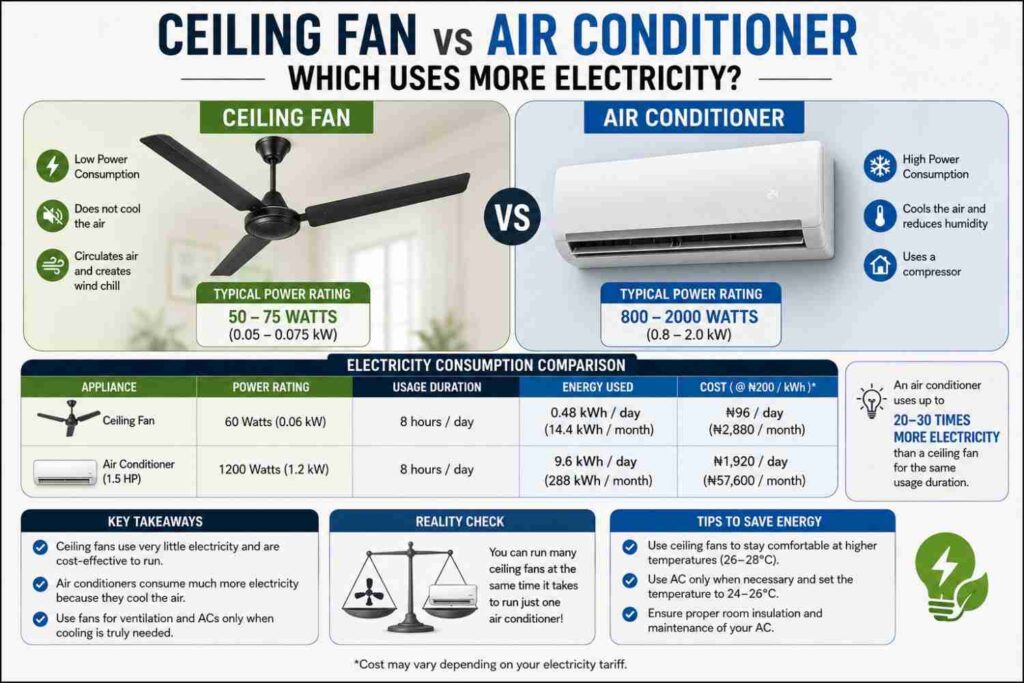
It’s worth understanding upfront that ceiling fans and air conditioners don’t actually do the same thing: a fan moves air around a room without reducing its actual temperature, creating a cooling sensation on your skin through increased evaporation and convective heat loss, while an air conditioner genuinely reduces the room’s actual air temperature through refrigeration. This fundamental difference explains much of the consumption gap discussed below.
Ceiling Fan Electricity Consumption
A typical ceiling fan draws remarkably little power, generally in the range of 60-80W, meaning even continuous use throughout an entire day consumes only around 1.4-1.9 kWh, a small fraction of what an air conditioner would consume operating for the same duration.
Air Conditioner Electricity Consumption, for Comparison
As detailed in our dedicated AC consumption article, even a modest 1HP unit typically consumes somewhere around 4.5-5.5 kWh over an 8-hour period, meaning an air conditioner can easily consume 10-20 times more electricity than a ceiling fan running for a comparable duration, a genuinely dramatic difference worth factoring into your cooling strategy.
A Direct Consumption Comparison Table
| Cooling Method | Typical Power Draw | Approx. 8-Hour Consumption |
|---|---|---|
| Ceiling fan | 60-80W | ~0.5-0.65 kWh |
| Standing/pedestal fan | 50-100W | ~0.4-0.8 kWh |
| 1HP split AC unit | ~750-900W (with cycling) | ~4.5-5.5 kWh |
| 1.5HP split AC unit | ~1,100-1,300W (with cycling) | ~6.5-8 kWh |
Why the Right Answer Isn’t Simply “Always Use Fans”
Despite the dramatic consumption difference, fans and AC units aren’t fully interchangeable: fans don’t reduce actual temperature or humidity, meaning during Nigeria’s hottest, most humid periods, a fan alone may not provide adequate comfort or the genuine heat-stress relief an AC provides, particularly for vulnerable individuals like infants, elderly household members, or those with certain health conditions where actual temperature reduction, not just air movement, genuinely matters.
The Genuinely Effective Hybrid Approach: Using Both Together
Running a ceiling fan alongside an air conditioner, rather than choosing one exclusively, allows you to set your AC’s thermostat a few degrees higher than you otherwise would while maintaining comparable comfort, since the fan’s air movement enhances the perceived cooling effect of the AC’s actual temperature reduction, a combination that can meaningfully reduce AC electricity consumption while maintaining genuine comfort, a strategy worth considering rather than treating fans and AC as strictly competing alternatives.
When Fans Alone Are Genuinely Sufficient
For moderate temperature conditions, well-ventilated spaces, and individuals without particular heat sensitivity, ceiling fans alone often provide entirely adequate comfort at a small fraction of AC’s electricity cost, making them a genuinely sensible default choice for many rooms and situations, reserving AC specifically for the most intense heat periods or specific rooms where enhanced comfort is particularly valued.
Why Fan Placement and Room Layout Affect Real-World Effectiveness
Beyond simply owning a fan, its actual cooling effectiveness depends meaningfully on placement and room airflow: a fan positioned to create genuine cross-ventilation, ideally with some airflow path between an open window or door, tends to feel considerably more effective than one simply circulating already-still air within a sealed room, making thoughtful placement a low-cost way to maximize a fan’s comfort benefit before considering AC as a supplementary or alternative solution.
Common Misconceptions
- “Fans actually cool the air, just less effectively than AC.” Fans don’t reduce air temperature at all; they create a cooling sensation through air movement across skin, a fundamentally different mechanism than AC’s actual refrigeration.
- “Running a fan in an empty room helps cool it for when you return.” Since fans don’t reduce air temperature, running one in an unoccupied room provides no benefit and simply wastes the modest electricity it does consume.
- “Combining a fan with AC doesn’t provide any additional benefit beyond AC alone.” The combination genuinely allows a higher, more efficient AC thermostat setting while maintaining comparable comfort, a real, practical benefit.
Frequently Asked Questions
Is a standing fan more or less efficient than a ceiling fan?
Both consume broadly similar, modest amounts of power; ceiling fans are often somewhat more effective at circulating air throughout a whole room, while standing fans offer more targeted, adjustable airflow, making the choice more about your specific comfort preference than a significant efficiency difference.
Does fan blade size or speed setting significantly affect consumption?
Higher speed settings do increase consumption somewhat, though the overall power draw remains modest compared to AC regardless of speed setting, meaning this is a relatively minor consideration compared to the fan-versus-AC choice itself.
Should I turn my fan off when leaving a room, the way I would with lights?
Yes, since fans only provide cooling benefit to people actually present to feel the air movement, leaving one running in an empty room provides no benefit and simply wastes electricity, however modest the amount.
Final Thoughts
The electricity consumption gap between ceiling fans and air conditioners is genuinely dramatic, often a full order of magnitude, making thoughtful use of fans, either alone during moderate conditions or combined with AC during more intense heat, one of the most impactful and accessible ways to manage your household’s cooling-related electricity costs without sacrificing genuine comfort.