
Air conditioners are consistently among the biggest contributors to high electricity bills in Nigerian households, yet many people have only a vague sense of exactly how much power theirs actually consumes. This article breaks down the real numbers so you can understand and estimate your own AC’s actual electricity cost.
Understanding the Basic Consumption Figure
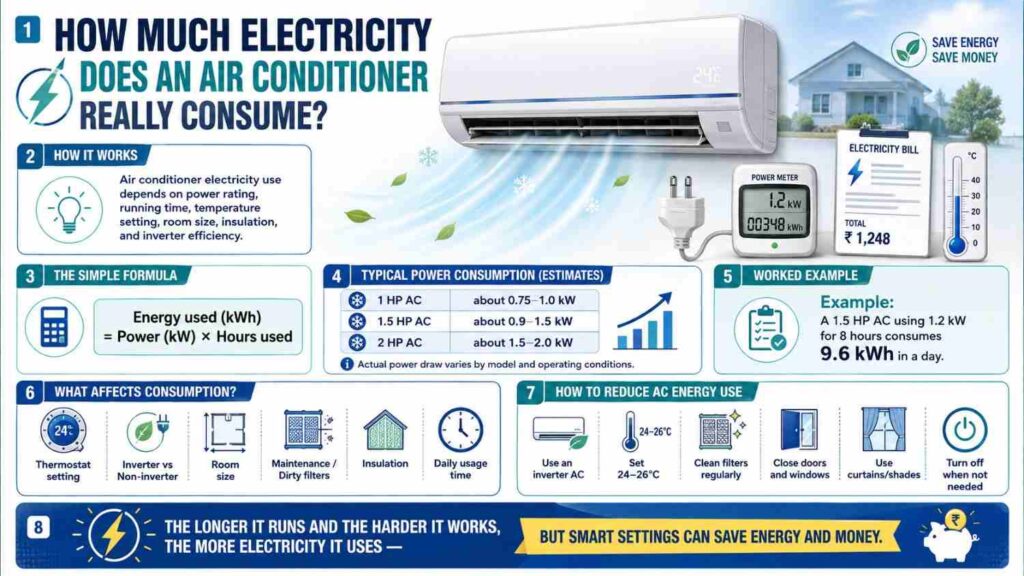
An air conditioner’s electricity consumption is measured in kilowatt-hours (kWh), calculated by multiplying its power draw in kilowatts by the number of hours it runs, following the same basic principle covered in our dedicated kWh explainer; a typical 1HP split unit drawing around 750-900W running continuously for 8 hours consumes roughly 6-7.2kWh in that period.
Why “Running Wattage” Isn’t the Whole Story
Unlike simple resistive appliances that draw constant power throughout operation, air conditioners cycle their compressor on and off (or, for inverter-type units discussed below, vary compressor speed) to maintain your set temperature, meaning actual average consumption over time is typically somewhat lower than the nameplate running wattage would suggest if you assumed continuous full-power operation throughout.
Key Factors That Affect Real-World Consumption
1. Unit Size and Room Size Matching
An AC unit significantly oversized or undersized for its room works less efficiently, either short-cycling wastefully (oversized) or running continuously at full capacity without adequately cooling (undersized), both increasing actual consumption relative to a properly matched unit.
2. Set Temperature
Each degree lower you set your thermostat below the outdoor ambient temperature increases both how hard your compressor works and how long it runs to maintain that temperature, meaning even modest temperature setting changes can meaningfully affect total consumption over time.
3. Insulation and Room Sealing
Poor insulation, gaps around doors and windows, and heat gain from direct sunlight all force your AC to work harder and longer to maintain your set temperature, directly increasing actual consumption beyond what the unit’s specifications alone would suggest.
4. Unit Age and Maintenance
As discussed in our dedicated aging appliances article, older or poorly maintained units, with dirty filters, low refrigerant, or worn components, typically consume more electricity to deliver the same cooling output compared to a well-maintained unit.
A Rough Consumption Reference Table
| AC Unit Size | Approx. Running Watts | Approx. Daily kWh (8 hrs/day use) |
|---|---|---|
| 1HP split unit | ~750-900W | ~4.5-5.5 kWh (accounting for cycling) |
| 1.5HP split unit | ~1,100-1,300W | ~6.5-8 kWh |
| 2HP split unit | ~1,500-1,800W | ~9-11 kWh |
These are approximate reference figures; actual consumption varies based on the factors discussed above, and calculating your specific unit’s actual cost using our dedicated appliance cost calculation article gives a more precise, personalized figure.
Why Inverter-Type AC Units Consume Meaningfully Less
As mentioned in our dedicated inverter-AC-savings article, inverter-type units with variable-speed compressors adjust their power draw continuously to match actual cooling need, rather than cycling fully on and off, typically consuming 20-40% less electricity than equivalent fixed-speed units for the same cooling output, a genuinely significant difference worth factoring into any AC purchase decision.
Practical Steps to Reduce Your AC’s Actual Consumption
- Set a reasonable temperature rather than the coldest setting; each degree matters for consumption.
- Ensure proper room sealing and insulation to reduce how hard your AC needs to work.
- Maintain your unit regularly, including filter cleaning, to preserve efficiency.
- Use timers or smart controls to avoid unnecessary continuous operation when not needed.
- Consider unit size carefully when purchasing, ensuring proper match to your room rather than assuming bigger is always better.
How Multiple AC Units Compound Total Household Consumption
Households running several AC units simultaneously, common in larger homes with multiple bedrooms cooled independently, should recognize that consumption scales roughly linearly with each additional unit running, meaning a household running three 1HP units for 8 hours daily consumes roughly three times the single-unit figures discussed above, a genuinely significant cumulative cost worth calculating explicitly using our appliance cost article rather than underestimating based on any single unit’s individual consumption alone.
Common Misconceptions
- “AC electricity consumption is simply the nameplate wattage multiplied by hours run.” Compressor cycling means actual average consumption is typically lower than this simplified calculation would suggest.
- “Setting the AC colder cools the room faster without using more electricity.” A colder setting means the compressor runs longer and harder to reach and maintain that temperature, genuinely increasing consumption.
- “All AC units of the same HP rating consume identical electricity.” Efficiency ratings, inverter versus fixed-speed technology, and unit condition all cause real consumption differences between units of nominally the same capacity.
Frequently Asked Questions
Does running my AC continuously use less electricity than switching it on and off repeatedly?
Generally, avoiding frequent complete shutdowns and restarts (which involve their own startup surge and initial cooling effort) in favor of a consistent, reasonable temperature setting tends to be more efficient than repeatedly switching fully off and on within the same day.
How can I get a precise consumption figure for my specific unit?
Checking your unit’s specific nameplate rating and using our dedicated appliance electricity cost calculation guide, or using a plug-in energy monitor if available, gives a more precise, personalized figure than general reference tables.
Does ceiling fan use alongside AC reduce overall consumption?
Yes, using a ceiling fan alongside your AC, discussed in our dedicated fan-vs-AC comparison, can allow a slightly higher, more efficient thermostat setting while maintaining comparable comfort, since the fan’s air movement enhances perceived cooling.
Final Thoughts
Understanding your air conditioner’s real electricity consumption, beyond just its nameplate rating, requires accounting for compressor cycling, your specific usage pattern, and factors like insulation and maintenance that genuinely affect actual power draw. Armed with this understanding, you can make more informed decisions about both AC usage habits and future purchase decisions that meaningfully affect your electricity costs.