
Generator overloading, running your generator beyond its rated capacity, is a genuinely common issue that causes real, sometimes expensive damage to both the generator itself and the appliances connected to it, yet many households don’t fully appreciate how this happens or why it matters until damage has already occurred. This article explains the actual mechanisms behind overload damage.
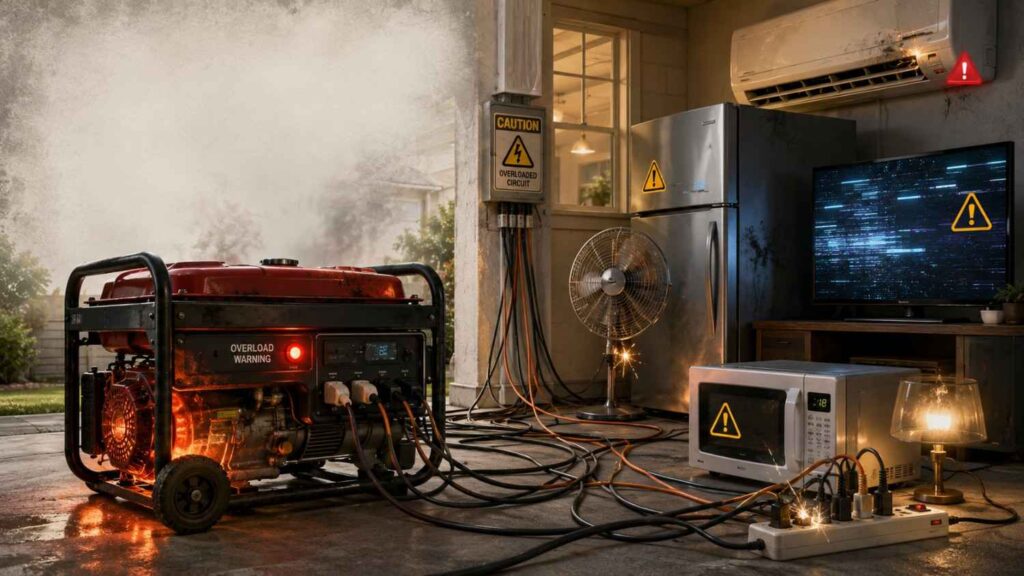
What Overloading Actually Means Electrically
Every generator has a rated capacity, expressed in kVA or watts, representing the maximum electrical load it’s designed to safely deliver continuously; overloading occurs when connected appliances’ combined demand, whether continuous running load or a starting surge discussed in our dedicated sizing article, exceeds this rated capacity, forcing the generator to attempt delivering more power than it was engineered to provide.
How Overloading Damages the Generator Itself
1. Engine Strain
An overloaded generator’s engine works harder than designed, generating excess heat and mechanical stress, which over time accelerates wear on engine components and can shorten the generator’s overall operational lifespan considerably compared to one consistently operated within its rated capacity.
2. Alternator Overheating
The alternator, the component actually generating electrical output, experiences excess current flow during overload, generating heat beyond its design tolerance; sustained overheating can damage winding insulation and other internal components, potentially causing permanent alternator damage requiring costly repair or replacement.
3. Voltage and Frequency Instability
As discussed in our dedicated voltage fluctuation article, an overloaded generator struggles to maintain stable voltage and frequency output, itself both a symptom of overload and a contributing cause of the appliance damage discussed below.
How Overloading Damages Connected Appliances
Unstable, reduced voltage from an overloaded generator can cause motor-driven appliances to draw excess current trying to compensate, generating heat and stress beyond normal operating conditions, while voltage spikes that can occur as an overloaded generator struggles to respond to load changes can damage sensitive electronic components not designed for such fluctuation, a genuinely two-directional damage risk affecting both the generator and everything connected to it simultaneously.
Why Overload Doesn’t Always Cause Immediate, Obvious Failure
Unlike a dramatic single event, overload damage often accumulates gradually through repeated instances of moderate overloading, meaning a generator or its connected appliances might continue functioning for some time after an overload event, masking the accumulating damage until it eventually manifests as reduced performance, more frequent unexplained faults, or eventual outright failure, well after the specific overload incidents that actually caused the underlying damage.
Common Overload Scenarios in Nigerian Households
| Scenario | Why It Causes Overload |
|---|---|
| Adding appliances over time without reassessing generator capacity | Original sizing no longer matches actual current load |
| Multiple motor-driven appliances starting simultaneously | Combined starting surge exceeds capacity |
| Using a generator borrowed or purchased without proper sizing calculation | Generator was never matched to actual household needs |
| Running a generator in high ambient temperature without accounting for derating | Actual safe capacity is lower than nameplate rating in extreme heat |
Protective Devices and Their Limits
Many generators include overload protection, circuit breakers or similar devices designed to automatically disconnect load or shut down the unit before overload causes serious damage; while genuinely valuable, these protective devices aren’t infallible, and repeated triggering of overload protection is itself a clear sign your actual load exceeds your generator’s capacity and needs addressing, rather than a problem solved simply by resetting the breaker and continuing as before.
How to Prevent Overload Damage
- Properly calculate your actual load, including starting surge, as detailed in our dedicated generator sizing article, and ensure your generator’s rated capacity provides adequate margin.
- Reassess your generator’s adequacy whenever you add significant new appliances to your household, rather than assuming your original sizing remains adequate indefinitely.
- Stagger the startup of multiple motor-driven appliances rather than starting them simultaneously.
- Pay attention to overload protection triggering as a genuine signal to reduce load or reassess generator capacity, not simply an inconvenience to work around.
- Have your generator serviced regularly by a qualified technician, who can also advise if your actual usage pattern suggests capacity concerns.
Why Overload Damage Often Costs More Than Proper Sizing Would Have
Repairing or replacing an overload-damaged alternator or engine component frequently costs considerably more than the price difference between an undersized generator and one properly sized from the start would have been, meaning the short-term savings some households pursue by under-buying generator capacity often gets erased, and sometimes exceeded, by the eventual repair costs overloading tends to produce over time.
Common Misconceptions
- “Brief overloading doesn’t cause any real damage.” Even brief, repeated overload events contribute to cumulative wear and damage over time, even without an immediate, dramatic failure.
- “If the generator’s protective breaker hasn’t tripped, I’m not overloading it.” Some damage can occur even below the exact threshold that triggers protective shutdown, particularly from voltage instability affecting connected appliances.
- “Overload only matters for the generator, not connected appliances.” Voltage instability from an overloaded generator genuinely stresses and can damage the appliances it’s powering, not just the generator itself.
Frequently Asked Questions
How can I tell if my generator is being regularly overloaded?
Signs include frequent triggering of overload protection, noticeable voltage fluctuation or dimming when multiple appliances run, unusual engine strain sounds, or appliances behaving unusually when powered by the generator compared to grid power.
Does overload risk change with generator age?
Yes, an aging generator may have somewhat reduced actual capacity compared to its original rating, meaning a load it handled comfortably when new might begin causing overload symptoms as the unit ages, even without any change in your actual connected load.
Is it worth having a technician assess whether my current generator is adequately sized for my household?
Yes, particularly if you’ve added appliances since your original purchase or are experiencing any of the warning signs discussed above; a proper professional assessment gives a more reliable answer than guesswork.
Final Thoughts
Generator overloading causes genuine, sometimes cumulative and hard-to-notice damage to both the generator itself and everything connected to it, making proper sizing and attentiveness to overload warning signs a genuinely important part of responsible generator ownership. Understanding these mechanisms helps you avoid the costly cycle of repeated damage and premature equipment failure that chronic, unaddressed overloading can cause.