
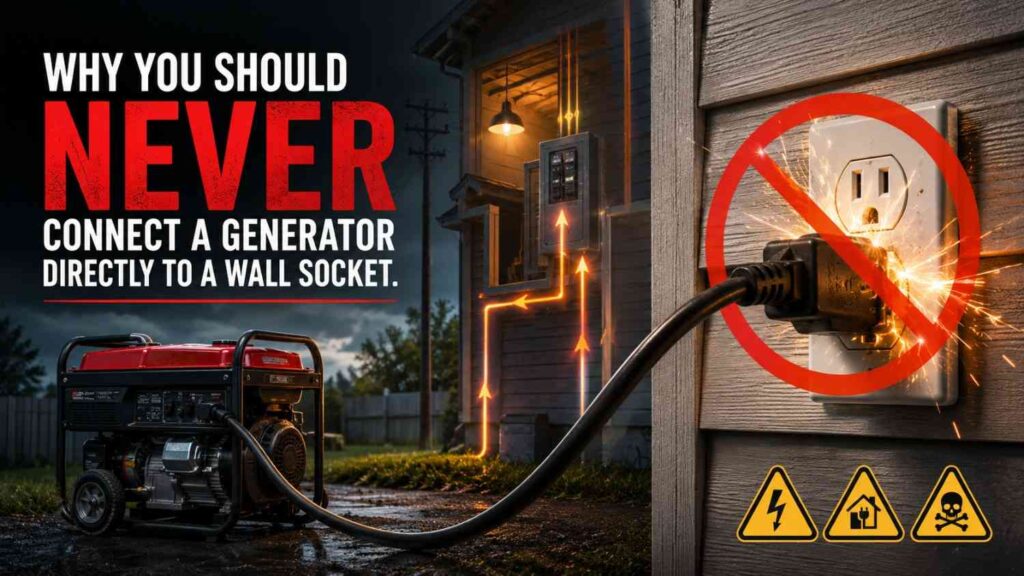
Connecting a generator directly to a wall socket using a makeshift “suicide cord” or similar improvised setup is a genuinely dangerous practice still seen in some Nigerian households, and understanding exactly why this is so hazardous is important safety knowledge, particularly since the practice can seem like a convenient shortcut to someone unaware of the real risks involved.
What This Practice Actually Involves
Connecting a generator directly to a wall socket typically involves a cable with male plugs on both ends, one plugged into the generator’s output socket, the other plugged into a standard wall socket inside the home, intending to backfeed the generator’s power through the home’s wiring to reach other sockets and circuits without going through a proper changeover switch or transfer switch.
The Core Danger: Backfeeding Onto Grid Lines
The single most serious danger of this practice is that your generator’s power doesn’t just flow into your home’s internal circuits, it can also flow backward through your home’s wiring, out through your electrical meter, and onto the shared grid distribution lines serving your street, since standard household wiring doesn’t inherently prevent this backward flow without a proper isolating switch in place.
Why This Specifically Endangers Utility Workers
Utility workers responding to an outage in your area, the very outage that likely prompted you to use your generator in the first place, reasonably expect de-energized lines during their repair work; backfed power from your generator can re-energize supposedly dead lines, creating a genuine, potentially fatal electrocution hazard for workers who have no way of knowing your generator is feeding power backward into the system they believe is safely de-energized.
Additional Dangers Beyond Backfeeding
1. Overloading Your Home’s Wiring
A generator connected this way isn’t properly matched to your home’s circuit protection, potentially overloading wiring not designed for the specific load pattern this improvised connection creates, a fire risk beyond the backfeeding danger already discussed.
2. No Proper Isolation From Grid Power
If grid power is restored while your generator remains connected this way, without proper isolation, you risk two unsynchronized power sources meeting within your home’s wiring, potentially causing serious equipment damage or fire, the same fundamental synchronization danger discussed in our generator-and-inverter compatibility article.
3. Voltage and Safety Device Incompatibility
This improvised connection bypasses your home’s normal circuit protection design, meaning protective devices may not function as intended to catch faults specifically arising from this non-standard power path.
Why This Practice Persists Despite the Dangers
The practice often persists simply because it seems like a quick, cheap way to power more of the home than a single extension cord from the generator would allow, without the perceived expense and effort of installing a proper changeover switch or transfer switch; this apparent convenience, however, comes at a genuinely serious safety cost that far outweighs the modest inconvenience of proper installation.
The Safe, Proper Alternative
A properly installed manual changeover switch or automatic transfer switch, discussed in depth in our dedicated articles on both options, achieves the same goal, powering multiple circuits throughout your home from generator power, through a properly isolated, code-compliant connection that eliminates the backfeeding danger entirely, at a cost that, given the genuine safety stakes, represents a worthwhile investment rather than an expense to avoid through risky shortcuts.
A Risk Comparison Table
| Approach | Backfeeding Risk | Recommendation |
|---|---|---|
| Direct generator-to-wall-socket connection | Severe, genuine danger to utility workers and equipment | Never do this |
| Extension cords directly from generator to individual appliances | None (no connection to home wiring) | Safe, though limited in reach and convenience |
| Properly installed manual changeover switch | None, when correctly used | Safe, recommended |
| Properly installed automatic transfer switch | None | Safe, recommended, most convenient |
What to Do If You’ve Been Using This Practice
If your household has been using a direct generator-to-wall-socket connection, discontinuing this practice immediately and having a qualified electrician install a proper changeover switch or transfer switch is a genuinely important safety upgrade, not an optional improvement, given the serious risks discussed throughout this article.
Talking to Neighbors and Household Members About This Risk
Given how this practice sometimes spreads through informal advice between neighbors or household members unaware of the genuine danger involved, sharing accurate information about why it’s unsafe, rather than assuming everyone already understands the risk, is a genuinely worthwhile contribution to broader household and community electrical safety, particularly in areas where this practice may be more commonly, if unknowingly, used.
Common Misconceptions
- “This is safe as long as I remember to switch off the main breaker first.” While switching off the main breaker reduces some risk, it doesn’t reliably eliminate backfeeding risk given the potential for human error, forgetting, or the breaker not fully isolating all relevant paths, making proper equipment the only genuinely reliable solution.
- “This practice is fine for occasional, brief use.” The danger exists every single time this connection is made, regardless of duration or frequency of use.
- “Only very large generators pose a genuine backfeeding risk.” Even smaller generators can backfeed dangerous voltage onto grid lines, since the danger relates to voltage present on the lines, not the generator’s total power capacity.
Frequently Asked Questions
Is it safe to power individual appliances directly from a generator using its own output sockets and standard extension cords?
Yes, this approach, powering appliances directly without connecting to your home’s internal wiring at all, avoids the backfeeding danger entirely and is a genuinely safe way to use generator power without a changeover switch installed.
How much does proper changeover switch installation typically cost compared to the risk involved?
While costs vary, proper installation represents a modest investment compared to the severe, potentially fatal consequences of backfeeding-related accidents, making it a clearly worthwhile safety investment rather than an expense to avoid.
Can utility companies detect this kind of unsafe practice?
Backfed power can sometimes be detected through unusual line conditions, and beyond the safety issue itself, this practice may also violate utility regulations or your service agreement, adding a legal and regulatory dimension to the safety concerns already discussed.
Final Thoughts
Directly connecting a generator to a wall socket is a genuinely dangerous practice that risks utility worker safety, equipment damage, and fire hazard, all to avoid the modest cost and effort of proper changeover switch installation. Understanding the real backfeeding danger involved, and choosing proper equipment instead, is one of the most important electrical safety decisions any generator-owning household can make.