
For many Nigerian households weighing backup power options, the choice between a fuel generator and a solar inverter system often comes down to cost, but comparing them fairly requires looking well beyond just the upfront purchase price. This article breaks down the real, ongoing cost picture for both options over a realistic multi-year horizon.
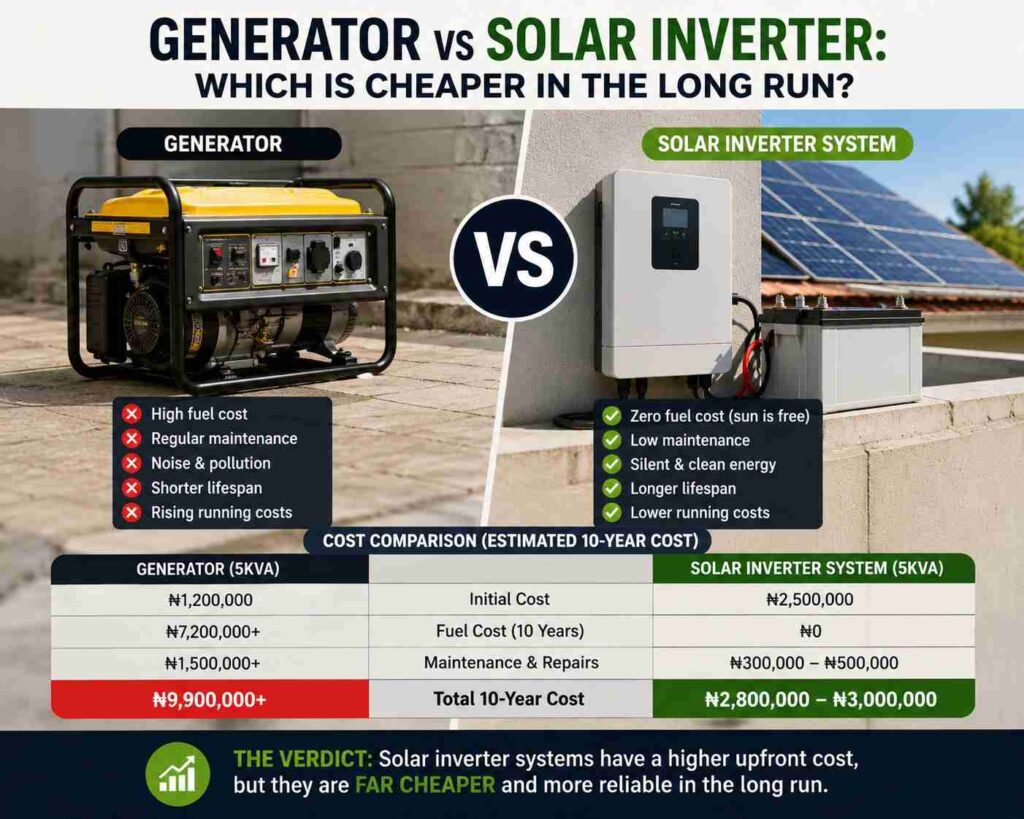
Upfront Cost: Generators Usually Win Initially
A generator with sufficient capacity to power a typical Nigerian household is generally considerably cheaper to purchase upfront than a comparable solar inverter system with adequate panel and battery capacity, often by a wide margin, making generators the more accessible initial option for households prioritizing lower immediate cash outlay over long-term cost.
Fuel Costs: Where the Real Ongoing Expense Lives
Generators require continuous fuel purchases throughout their operating life, and given Nigeria’s fuel price volatility and the sheer frequency many households run generators due to unreliable grid supply, this ongoing fuel expense accumulates substantially over time, often becoming the single largest component of a generator’s true total cost when calculated honestly over several years of regular use.
Solar’s Inverted Cost Structure: High Upfront, Low Ongoing
Solar inverter systems flip this cost structure: after the substantial upfront investment in panels, batteries, and inverter equipment, ongoing costs are relatively minimal, limited mainly to periodic battery replacement (discussed in our dedicated battery articles), occasional panel cleaning, and infrequent component maintenance, with no ongoing fuel expense at all.
Maintenance Cost Comparison
Generators require regular maintenance, oil changes, filter replacements, and periodic servicing, alongside a genuinely finite mechanical lifespan that typically requires full replacement or major overhaul after several years of regular use, particularly for lower-cost units run frequently rather than occasionally. Solar systems require comparatively minimal maintenance, primarily battery replacement on a multi-year cycle and occasional panel cleaning, discussed in our dedicated solar maintenance articles, with panels themselves typically lasting decades, as covered in our panel lifespan article.
A Rough Multi-Year Cost Comparison Table
| Cost Category | Generator | Solar Inverter System |
|---|---|---|
| Upfront cost | Lower | Higher |
| Ongoing fuel cost | Substantial, recurring | None |
| Maintenance | Regular servicing required | Minimal |
| Major replacement cycle | Every several years (engine wear) | Batteries every 3-15 years depending on type; panels decades |
| Noise and emissions | Significant | None during operation |
Why Usage Pattern Dramatically Changes the Comparison
A household running a generator only occasionally, for a few hours during rare, brief outages, faces a very different cost picture than one running a generator many hours daily due to consistently unreliable grid supply; the more a generator is used, the faster fuel and maintenance costs accumulate, and the more attractive solar’s low-ongoing-cost structure becomes by comparison over any reasonable multi-year timeframe.
Noise, Convenience and Non-Financial Factors Worth Weighing
Beyond pure financial cost, generators involve genuine noise pollution, exhaust fumes, the ongoing hassle of fuel sourcing and storage, and mechanical failure risk, while solar systems operate silently with essentially no daily hassle once installed, factors that, while harder to quantify financially, genuinely matter for many households’ overall satisfaction with their chosen backup power solution.
Why Many Households End Up Choosing Both
Rather than treating this as a strict either-or decision, many Nigerian households find a hybrid approach genuinely optimal: solar and battery for typical daily needs and shorter outages, with a generator retained specifically as backup for extended periods, particularly during rainy season’s reduced solar generation discussed in our dedicated rainy weather article, or for occasional high-demand situations solar alone can’t adequately cover.
Environmental and Health Costs Rarely Included in the Financial Comparison
Generator exhaust fumes contain pollutants with genuine air quality and health implications, particularly relevant for generators run in poorly ventilated areas close to living spaces, a cost rarely factored into financial comparisons but worth genuine consideration alongside the purely monetary calculation, especially for households running generators for extended hours regularly rather than only occasionally.
Common Misconceptions
- “Solar is always cheaper overall regardless of usage pattern.” For households using backup power only rarely, a generator’s lower upfront cost may never be overtaken by solar’s savings within a reasonable timeframe.
- “Generators are always cheaper since solar has such high upfront cost.” For households with frequent, heavy backup power needs, generator fuel costs alone can exceed solar’s total cost within just a few years.
- “You must choose one or the other exclusively.” A hybrid approach, using each technology where it’s genuinely most cost-effective, is a common and often financially sensible strategy.
Frequently Asked Questions
How many years does it typically take for solar to become cheaper than an equivalent generator setup?
This varies considerably based on your specific usage pattern and local fuel prices, but for households using backup power several hours daily, solar often becomes the more cost-effective choice within roughly 3-7 years, factoring in generator fuel and maintenance costs saved.
Does generator resale value factor meaningfully into this comparison?
Generators do retain some resale value, though this is typically a relatively minor factor compared to the cumulative fuel and maintenance costs over the unit’s operating life.
Is it worth calculating my own specific comparison rather than relying on general figures?
Yes, since your specific usage pattern, local fuel prices, and system sizing needs all meaningfully affect the real numbers; working through your own realistic calculation, ideally with a solar installer’s input, gives a far more accurate personal answer than general comparisons alone.
Final Thoughts
Comparing generator and solar inverter costs fairly requires looking well beyond upfront price to the full picture of fuel, maintenance, and replacement costs accumulated over a realistic multi-year horizon, a comparison that increasingly favors solar for households with substantial, regular backup power needs. Understanding your own actual usage pattern is the key to determining which option, or combination of both, genuinely makes the most financial sense for your specific household.