
Knowing when your inverter battery genuinely needs replacement, rather than continuing to nurse a failing unit or prematurely replacing one with useful life remaining, saves both money and the frustration of unreliable backup power.
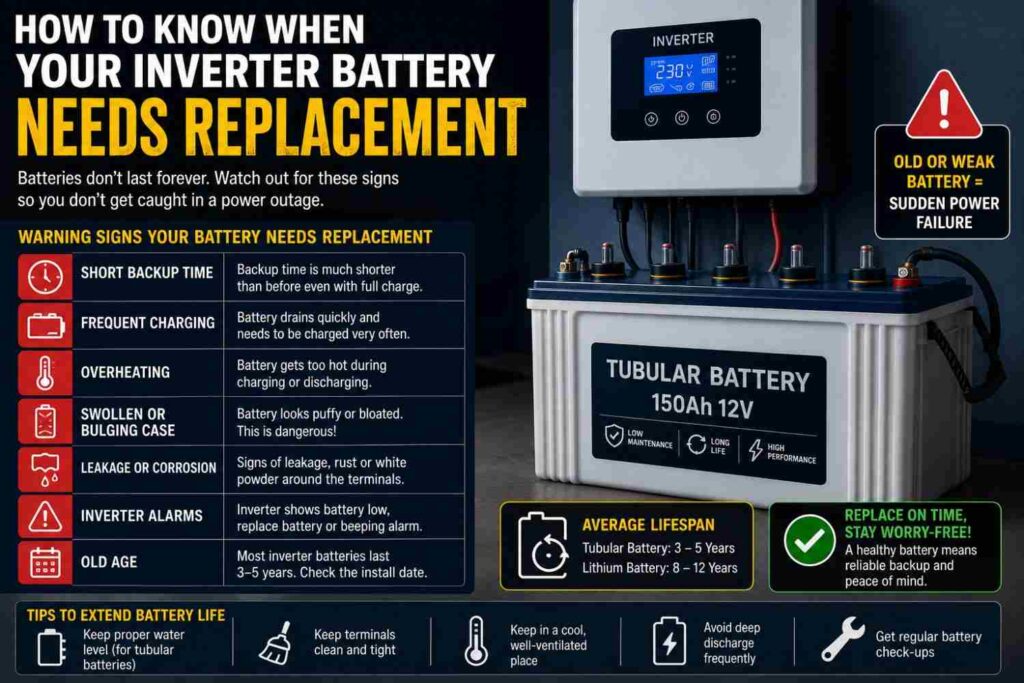
This article walks through the real signs worth watching for and how to interpret them accurately.
Why Battery Replacement Timing Isn’t Always Obvious
Unlike some equipment that fails abruptly and obviously, batteries typically degrade gradually, meaning the transition from “still functional but aging” to “genuinely needs replacement” isn’t always a clear, single moment, making it useful to understand the specific warning signs that collectively indicate a battery has reached the point where replacement is the sensible choice.
1. Significantly Reduced Runtime
If your battery now sustains your typical load for noticeably less time than it did when newer, despite no significant change in your usage pattern, this is one of the clearest and most direct signs of genuine capacity loss, the natural result of the gradual internal degradation that affects all batteries over their service life.
2. Unexpected Shutdowns Despite Apparently Adequate Charge
As discussed in our dedicated article on this exact symptom, a battery that increasingly struggles to sustain voltage under load, causing shutdowns despite showing a seemingly reasonable charge reading, is a strong and common indicator of aging battery cells no longer performing to their original specification.
3. Physical Signs: Swelling, Leakage, or Corrosion
Any visible swelling, discussed in depth in our dedicated swelling article, electrolyte leakage, or significant terminal corrosion are unambiguous physical signs that replacement is necessary, not optional, given the genuine safety concerns these symptoms represent beyond simply reduced performance.
4. Battery Age Relative to Expected Lifespan
Even without dramatic symptoms, a battery approaching or exceeding its chemistry’s typical expected lifespan, roughly 3-5 years for tubular lead-acid or 8-15+ years for quality lithium as discussed in our battery comparison articles, warrants closer monitoring and planning for replacement, since age-related degradation, even without dramatic symptoms yet, is a near-certainty as batteries approach and exceed these typical service life ranges.
5. Excessively Long Charging Times
A battery that takes noticeably longer to reach full charge than it used to, despite consistent charging conditions and source, often indicates increased internal resistance associated with aging and degradation, reducing the battery’s ability to efficiently accept charge compared to when it was newer.
6. Visible Reduction in Maximum Voltage Reached
If you have access to voltage monitoring, a battery consistently failing to reach its expected full-charge voltage, even after a complete charging cycle under good conditions, indicates genuine capacity and health decline worth taking seriously as a replacement indicator.
A Symptom Reference Table
| Symptom | Severity | Recommended Action |
|---|---|---|
| Mild runtime reduction | Early warning | Monitor; start planning for eventual replacement |
| Unexpected shutdowns under load | Moderate-serious | Have battery tested; replacement likely needed soon |
| Visible swelling or leakage | Serious, safety concern | Stop use immediately; replace promptly |
| Age exceeds typical expected lifespan | Proactive concern | Plan replacement even without dramatic symptoms yet |
Getting a Professional Battery Health Assessment
Rather than relying solely on subjective symptom observation, a qualified technician can perform a proper load test or use specialized battery testing equipment to measure your battery’s actual remaining capacity and internal resistance objectively, giving you a more precise, data-driven answer than symptom-watching alone, particularly valuable when trying to decide between continued use and replacement for a battery showing borderline or ambiguous signs.
Why Waiting Too Long to Replace Carries Real Costs
Continuing to use a significantly degraded battery doesn’t just risk inconvenient unexpected shutdowns; it can also mean your charging system works harder and less efficiently trying to charge an increasingly inefficient battery, and in cases involving swelling or leakage, introduces genuine safety risk, meaning the cost of premature caution around replacement timing is usually far lower than the cost, inconvenience, and risk of waiting too long.
Budgeting Ahead for Replacement Rather Than Treating It as a Surprise Expense
Since battery replacement is a predictable, recurring cost given known typical lifespans discussed throughout this article, setting aside funds gradually toward an anticipated replacement, rather than treating it as an unplanned emergency expense when it eventually arrives, makes the transition considerably less financially disruptive, particularly relevant for tubular lead-acid systems where replacement occurs more frequently than with longer-lived lithium alternatives.
Common Misconceptions
- “A battery either works or it doesn’t; there’s no in-between state worth worrying about.” Gradual degradation means batteries pass through a meaningful period of reduced but still partially functional performance worth recognizing and planning around.
- “If my battery still holds some charge, it doesn’t need replacement yet.” Significantly reduced capacity, even if some charge is still held, can mean the battery is no longer adequately meeting your actual backup power needs.
- “Replacement timing is purely about the battery’s calendar age.” While age matters, actual usage pattern, discharge depth history, and observed symptoms are equally, if not more, important than calendar age alone.
Frequently Asked Questions
Can I extend a battery’s life once I notice early warning signs?
Sometimes modestly, through more conservative depth of discharge practices and ensuring proper charging, though this typically only slows further degradation rather than reversing damage already done.
Is it worth replacing just one battery in a multi-battery bank, or should they all be replaced together?
Generally, batteries in a bank should be replaced together as a matched set, since mixing batteries of significantly different age and condition within the same bank can cause imbalanced charging and accelerate degradation of the newer battery as well.
How much notice does a battery typically give before complete failure?
This varies, but most batteries show at least some gradual warning signs, discussed throughout this article, over weeks to months before complete failure, making regular attentiveness to these signs genuinely valuable for avoiding a surprise complete failure.
Final Thoughts
Knowing when to replace your inverter battery comes down to recognizing a combination of performance symptoms, physical warning signs, and age relative to expected lifespan, rather than waiting for complete failure or replacing prematurely out of uncertainty. Paying attention to these signs and acting on them promptly keeps your backup power system genuinely reliable while getting full, appropriate value from each battery before its replacement becomes necessary.