
Choosing between a 12V, 24V, or 48V inverter and battery system configuration is a foundational decision in system design that affects cabling costs, efficiency, and how easily your system can scale, yet it’s a decision many first-time buyers don’t fully understand when making their purchase.
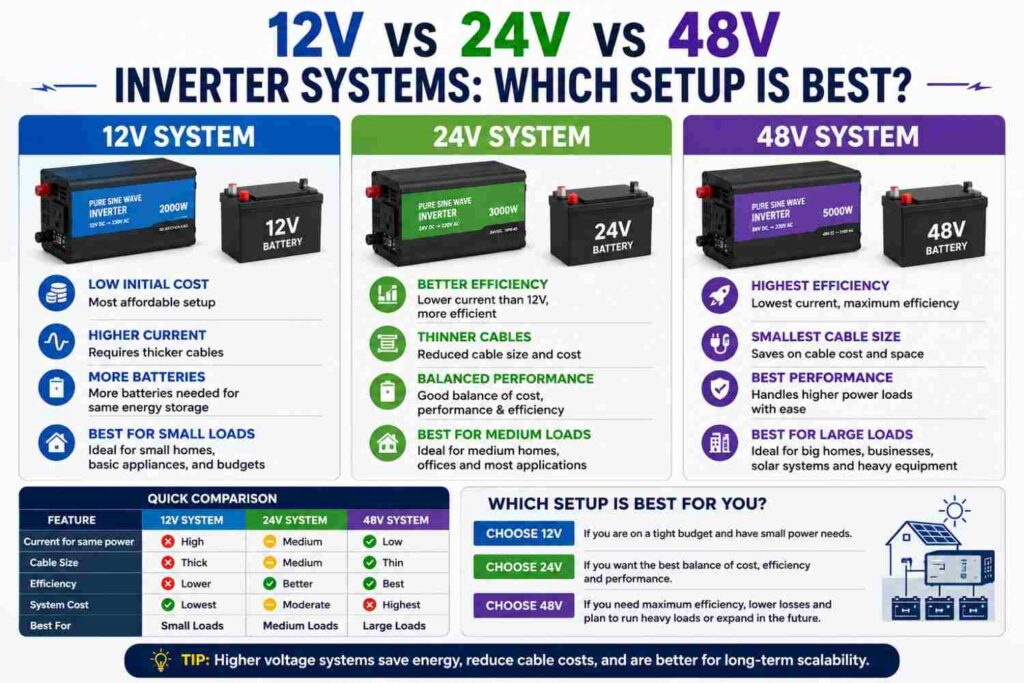
This article explains the practical differences and how to choose the right voltage for your needs.
The Fundamental Relationship: Power, Voltage and Current
As covered in our voltage, current, resistance and power article, for any given power level, higher system voltage means proportionally lower current, following the relationship power equals voltage times current. This relationship is the foundation for why voltage system choice matters so much: lower current at higher voltage means less resistive loss and heating in cabling, allowing thinner, cheaper cables to safely carry the same total power compared to a lower-voltage system delivering identical wattage.
Why 12V Systems Are Common for Smaller Setups
12V systems remain popular for smaller inverter setups, typically up to around 1-1.5kVA, where the current involved remains manageable with reasonably priced cabling, and where the simplicity and wide availability of 12V batteries and components keeps costs accessible for budget-conscious, lower-power backup needs like basic lighting, phone charging, and small electronics.
Why 24V Systems Suit Mid-Range Needs
24V systems generally become the more practical choice as power requirements grow into the 1.5-3kVA range, since the doubled voltage compared to 12V halves the current for the same power delivered, meaningfully reducing cable size and cost requirements while still using widely available, moderately priced components, striking a reasonable balance for typical mid-size Nigerian household backup needs.
Why 48V Systems Dominate Larger Installations
Beyond roughly 3kVA, and especially for larger whole-home systems or those intending to run substantial loads like air conditioning discussed in our dedicated AC-on-inverter article, 48V systems become increasingly advantageous, since the further reduced current at this higher voltage allows practical cabling for genuinely high-power systems that would otherwise require impractically thick, expensive cable at lower system voltages.
A Comparison Table
| Voltage | Typical Power Range | Cabling Requirement | Best Suited For |
|---|---|---|---|
| 12V | Up to ~1-1.5kVA | Manageable with standard cable at this power level | Basic lighting, small electronics, budget setups |
| 24V | ~1.5-3kVA | Moderate, more manageable than 12V at same power | Typical mid-size household backup |
| 48V | 3kVA+ | Most practical for high power levels | Whole-home systems, AC units, larger installations |
How This Choice Affects Battery Bank Configuration
Your chosen system voltage directly determines how your individual batteries, commonly available as 12V units, must be wired together: a 24V system requires two 12V batteries wired in series, and a 48V system requires four, following the same series-wiring voltage-addition principle discussed in our solar panel series vs parallel article, meaning your voltage choice also shapes your minimum practical battery bank size and configuration.
Why Retrofitting Voltage Later Is Genuinely Disruptive
Changing your system voltage after initial installation typically requires replacing not just your inverter but your entire battery bank and associated wiring and components, making this a decision worth getting right from the start rather than treating it as easily adjustable later, particularly if you anticipate your power needs growing meaningfully over the coming years and want to avoid a costly, disruptive full system replacement.
Planning for Future Growth When Choosing Voltage
If you anticipate your household’s power needs growing over the next several years, whether through adding air conditioning, expanding your home, or simply increasing appliance usage, choosing a somewhat higher voltage system than your current strict minimum need suggests can provide valuable headroom for future expansion without requiring the disruptive, costly voltage change discussed above.
Why This Decision Benefits From Professional Load Calculation
Given how directly voltage choice ties into cabling cost, component compatibility, and future expansion capacity, having a qualified installer perform a proper load calculation covering both your current needs and reasonably anticipated future growth, rather than choosing voltage based on a rough guess or simply matching whatever a particular seller has readily in stock, is a worthwhile investment of time before committing to what is, as discussed above, a genuinely difficult decision to reverse later.
Common Misconceptions
- “Higher voltage systems are always better regardless of actual power needs.” For genuinely small, low-power needs, the added complexity and minimum battery bank size of higher voltage systems isn’t necessarily justified.
- “Voltage choice only affects the battery bank, not overall system cost.” Cabling costs, component availability, and efficiency are all meaningfully affected by voltage choice, not just the battery configuration itself.
- “You can easily upgrade your system voltage later without major cost.” Voltage changes typically require replacing the inverter, entire battery bank, and much of the associated wiring, a genuinely disruptive and costly undertaking.
Frequently Asked Questions
Does voltage choice affect solar panel integration if I add solar later?
Your charge controller, particularly if MPPT as discussed in our dedicated MPPT article, generally handles converting panel voltage to your battery bank’s voltage, meaning your inverter voltage choice doesn’t rigidly dictate panel configuration, though it’s still worth planning your complete system, including future solar plans, together from the start.
Is a 48V system more dangerous to work with than 12V or 24V?
Higher voltage DC systems do warrant more careful handling and proper installation by qualified technicians, though when properly installed with correct components and safety practices, 48V systems are safely used in countless residential and commercial installations worldwide.
Can I mix different voltage components within one system?
Generally not directly; your inverter, battery bank, and any DC-coupled components need to be matched to the same system voltage, though appropriate converters can sometimes bridge specific voltage differences for particular components if genuinely necessary.
Final Thoughts
Choosing between 12V, 24V, and 48V inverter systems is a genuine engineering decision balancing your actual power needs, cabling costs, and future growth plans, not an arbitrary specification to overlook. Taking the time to properly size this choice around both your current and reasonably anticipated future needs, ideally with a qualified installer’s input, helps avoid the costly, disruptive voltage change that comes from outgrowing an undersized initial choice.