
Air conditioners are among the most power-hungry common household appliances, and whether an inverter can genuinely power one is a question worth answering carefully with actual numbers rather than a simple yes-or-no assumption.
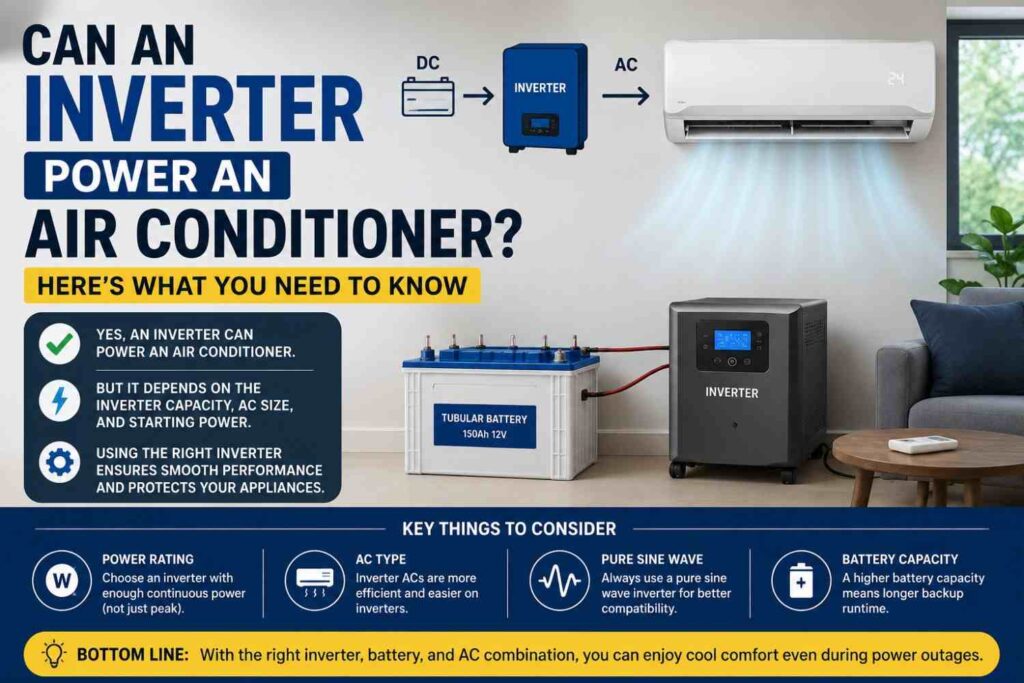
This article walks through exactly what’s required to run an AC unit on inverter power successfully.
Why Air Conditioners Are a Genuinely Demanding Load
Air conditioners draw significant continuous power during normal operation, but more importantly, their compressor motor draws a substantial startup surge, often 3-5 times the unit’s rated running wattage for a brief moment when the compressor first engages, a demand your inverter must be able to handle even if only for a second or two, following the same startup-surge principle discussed in our inverter shutdown article.
Step 1: Know Your AC Unit’s Actual Power Requirements
Check your AC unit’s rated running wattage and, if available, its starting wattage or locked rotor amperage (LRA) rating, usually found on the unit’s nameplate or in its documentation; a typical 1HP split AC might draw roughly 750-900W running and considerably more at startup, while larger units draw proportionally more in both categories.
Step 2: Match Your Inverter’s Rated and Surge Capacity
Your inverter must have both sufficient continuous rated capacity to handle the AC’s running wattage alongside your other typical loads, and sufficient surge or peak capacity, usually specified separately from continuous rating, to handle that brief but substantial startup surge without triggering a protective shutdown or overload fault, discussed in our dedicated beeping and shutdown articles.
Step 3: Consider Your Battery Bank’s Capacity for Sustained Runtime
Beyond simply being able to start and briefly run an AC unit, sustaining meaningful runtime, particularly overnight, requires substantial battery capacity given how much energy air conditioning consumes over hours of continuous operation, meaning even an inverter technically capable of starting your AC may only sustain it for a limited time before battery depletion, an important distinction between “can technically power it” and “can power it for as long as you actually need.”
A Rough Sizing Reference Table
| AC Unit Size | Typical Running Watts | Approx. Starting Surge | Suggested Inverter Capacity |
|---|---|---|---|
| 1HP split unit | ~750-900W | ~2,500-3,500W briefly | 2.5-3.5kVA+ with adequate surge rating |
| 1.5HP split unit | ~1,100-1,300W | ~3,500-5,000W briefly | 3.5-5kVA+ with adequate surge rating |
| 2HP split unit | ~1,500-1,800W | ~4,500-6,500W briefly | 5kVA+ with adequate surge rating |
These figures are approximate references; always check your specific unit’s actual nameplate ratings rather than relying solely on general HP-based estimates, since efficiency and exact power draw vary between models and brands.
Inverter-Type Air Conditioners: A Genuinely Relevant Distinction
Modern “inverter-type” air conditioners, a somewhat confusing naming overlap with power inverters discussed throughout this article, use variable-speed compressor technology that draws power more gradually and consistently rather than the abrupt full-power startup surge of older fixed-speed AC units, making inverter-type AC units genuinely easier and more efficient to run on battery inverter power, both reducing the surge capacity required and improving overall energy efficiency during sustained operation.
Why Undersizing Your Inverter for AC Use Causes Repeated Problems
An inverter marginally undersized for your AC’s actual surge requirements may appear to work sometimes, particularly when the compressor happens to start under favorable conditions, while failing or shutting down other times, an inconsistent, frustrating pattern that often gets misdiagnosed as a battery or wiring problem rather than correctly identified as fundamental inverter undersizing for the specific load involved.
Practical Steps Before Committing to AC on Inverter Power
- Get your AC unit’s exact nameplate ratings, both running and starting, rather than relying on general HP-based assumptions.
- Confirm your inverter’s continuous and surge capacity specifically, not just its general kVA rating, since these can differ meaningfully between models.
- Calculate realistic runtime based on your actual battery capacity and the AC’s continuous power draw, discussed further in our depth of discharge article.
- Consider inverter-type AC units if purchasing new equipment specifically for battery-backed operation, given their gentler startup and better overall efficiency.
- Consult a qualified installer to properly size your complete system, inverter, battery, and if relevant solar capacity, around your specific AC unit’s requirements alongside your other household loads.
Staggering Startup When Running Multiple Motor-Driven Appliances
If your household runs an AC unit alongside other motor-driven appliances like a refrigerator or water pump on the same inverter, staggering their startup times, avoiding starting multiple motor-driven devices simultaneously, meaningfully reduces peak surge demand on your inverter, since each device’s startup surge is brief but significant, and overlapping surges from multiple devices can exceed even a well-sized inverter’s surge capacity even when each device individually would start without issue.
Common Misconceptions
- “Any inverter rated above my AC’s running wattage will work fine.” The brief but substantial startup surge, not just continuous running wattage, is often the actual limiting factor.
- “All air conditioners of the same HP rating draw identical power.” Actual power draw varies by brand, model, efficiency rating, and whether the unit uses inverter-type variable-speed technology.
- “If my inverter can start the AC once, it will always work reliably.” Marginal sizing can produce inconsistent results depending on battery charge level, other simultaneous loads, and specific startup conditions each time.
Frequently Asked Questions
Is it worth buying an inverter-type AC unit specifically for battery-backed use?
Generally yes, if you’re purchasing new equipment specifically for inverter-powered operation, given their gentler startup surge and better overall energy efficiency during sustained running compared to older fixed-speed units.
Can solar panels alone, without significant battery backup, run an AC unit during the day?
This depends on your panel array’s total capacity relative to the AC’s running wattage and how your specific system handles the startup surge, worth discussing explicitly with a qualified solar installer given the substantial power air conditioning requires.
Does running an AC unit on inverter power shorten the AC’s own lifespan?
Properly sized inverter power delivering genuine sine wave output, discussed in our dedicated sine wave comparison, shouldn’t meaningfully affect AC lifespan differently than grid power; undersized inverters or modified sine wave power are more likely sources of any accelerated wear.
Final Thoughts
An inverter can genuinely power an air conditioner, but doing so reliably requires proper sizing that accounts specifically for the substantial startup surge AC compressors demand, not just their continuous running wattage, along with sufficient battery capacity for your actual desired runtime. Getting these numbers right before purchasing, rather than discovering a mismatch through repeated frustrating failures, is the key to a genuinely functional AC-on-inverter setup.