
The distinction between pure sine wave and modified sine wave inverters is one of the more technically substantive choices in selecting an inverter, with real consequences for which appliances will run safely and efficiently on your system.
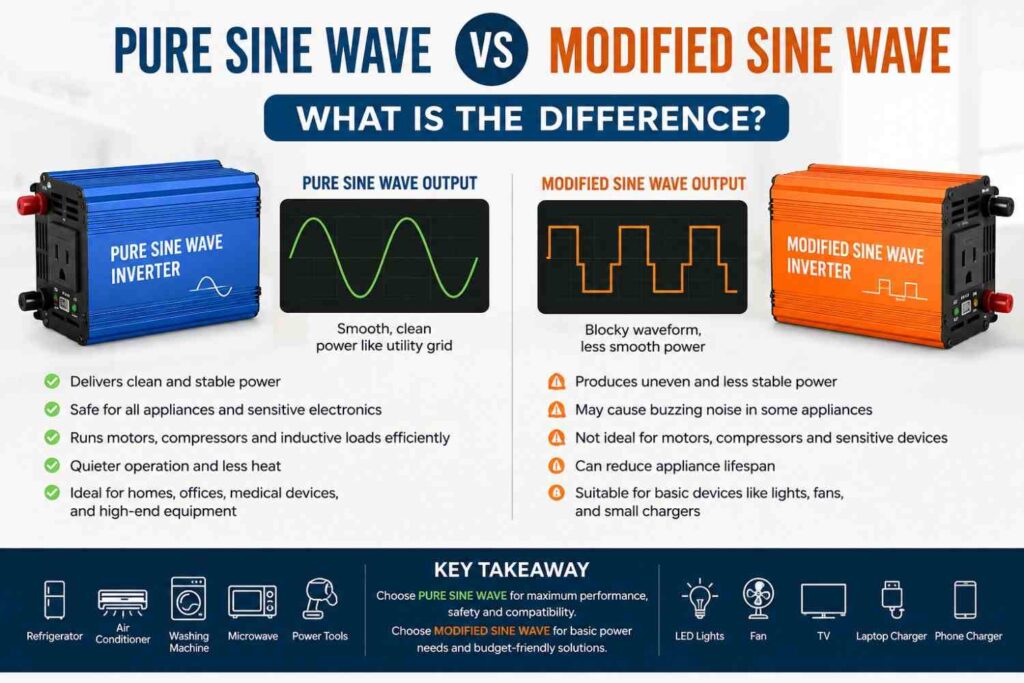
This article explains what these terms actually mean electrically and why the choice matters more for some households than others.
What a Sine Wave Actually Is, and Why It Matters
Grid electricity in Nigeria, and in most of the world, is delivered as alternating current following a smooth, continuous sine wave pattern, the same waveform shape referenced in our dedicated electrical frequency article, and virtually every appliance designed for grid power is engineered to run on this specific smooth waveform. A pure sine wave inverter reproduces this same smooth waveform when converting your battery’s DC power to AC power, meaning connected appliances essentially can’t distinguish pure sine wave inverter power from genuine grid power in terms of waveform quality.
What a Modified Sine Wave Actually Looks Like
A modified sine wave inverter, by contrast, produces a cruder, stepped approximation of a sine wave, essentially a simplified square-wave-like pattern designed to roughly approximate the real thing using simpler, cheaper electronics, but without the smooth, continuous curve genuine sine wave power has. This simpler approach makes modified sine wave inverters considerably cheaper to manufacture and purchase, at the cost of power quality delivered to connected appliances.
Why the Difference Matters for Some Appliances More Than Others
Simple resistive appliances, incandescent bulbs, basic heating elements, and similar devices that just convert electricity directly to heat or light, generally run acceptably on modified sine wave power without significant issue, since these devices don’t particularly care about waveform smoothness. Appliances with motors, particularly induction motors found in refrigerators, air conditioners, fans, and pumps, along with sensitive electronics like some laptop chargers, audio equipment, and certain medical devices, can run less efficiently, generate more heat, produce audible buzzing, or in some cases experience reduced lifespan when run on modified sine wave power for extended periods.
A Practical Appliance Compatibility Table
| Appliance Type | Modified Sine Wave Suitability |
|---|---|
| Incandescent bulbs, basic resistive heaters | Generally fine |
| LED bulbs, chargers (most modern ones) | Usually fine, some minor efficiency loss possible |
| Refrigerators, air conditioners, fans (motor-driven) | Can run less efficiently, more heat, possible reduced lifespan |
| Audio/video equipment | May experience audible buzzing or interference |
| Sensitive medical or precision electronic equipment | Generally not recommended; pure sine wave strongly advised |
Why Motors Specifically Struggle With Modified Sine Wave Power
Motors, particularly induction motors common in refrigeration and air conditioning compressors, are designed around the assumption of smooth, continuous sine wave power; the abrupt voltage transitions in modified sine wave power can cause less efficient magnetic field generation within the motor, translating to more wasted energy as heat, potentially louder operation, and over extended periods, accelerated wear on motor components compared to genuine sine wave operation.
Cost Comparison and the Real Tradeoff
Modified sine wave inverters are typically considerably cheaper than pure sine wave units of equivalent power rating, making them tempting for budget-conscious buyers, particularly for basic lighting and simple device charging needs where compatibility concerns are minimal. Pure sine wave inverters cost more upfront but avoid the efficiency losses, potential appliance stress, and compatibility limitations discussed throughout this article, a genuinely important consideration for any household planning to run motor-driven appliances or sensitive electronics on inverter power regularly.
Why Most Modern Nigerian Households Should Lean Toward Pure Sine Wave
Given how central refrigeration, fans, and increasingly air conditioning are to typical Nigerian household power needs, and how much of daily inverter usage in a typical home involves exactly the motor-driven and electronics-heavy appliance categories most affected by modified sine wave limitations, pure sine wave has become the generally recommended default for most residential inverter purchases, with modified sine wave reserved for genuinely simple, limited backup needs where budget is the overriding constraint.
How to Check What Type of Inverter You Currently Own
If you’re uncertain whether your existing inverter produces pure or modified sine wave output, checking the specification label, manual, or manufacturer’s product page for your specific model is the most reliable approach, since this isn’t always obvious from the unit’s external appearance or price point alone; some mid-range units are also marketed with ambiguous terms worth clarifying directly with the manufacturer or a knowledgeable technician if the documentation isn’t clear.
Common Misconceptions
- “Modified sine wave inverters will damage any appliance connected to them.” Many appliances run acceptably on modified sine wave power; the concern is specifically with motor-driven and sensitive electronic devices, not universal damage risk.
- “Pure sine wave is only necessary for large or commercial systems.” Even modest residential systems benefit from pure sine wave if they’ll power refrigeration, fans, or sensitive electronics, which describes most typical households.
- “You can’t tell the difference without specialized equipment, so it doesn’t matter.” While you may not visually see the waveform difference, the real-world effects, heat, noise, efficiency, appliance longevity, are genuinely measurable and noticeable over time.
Frequently Asked Questions
Can I mix modified and pure sine wave inverters for different circuits in my home?
Technically possible with proper electrical setup, using modified sine wave for genuinely simple loads and pure sine wave for sensitive or motor-driven appliances, though this adds complexity and most households find a single pure sine wave inverter simpler and more broadly compatible.
Will a modified sine wave inverter show any immediate visible sign of a problem with a sensitive appliance?
Not always immediately; some effects, like reduced motor lifespan, develop gradually over time rather than causing an immediate, obvious failure, making the issue easy to overlook until a problem eventually develops.
Is there a middle-ground option between modified and pure sine wave?
Some manufacturers market “quasi-sine wave” or similar intermediate products with more steps approximating the curve than basic modified sine wave, offering some improvement, though genuine pure sine wave remains the standard for full compatibility assurance.
Final Thoughts
The choice between pure sine wave and modified sine wave inverters is a genuine tradeoff between upfront cost and appliance compatibility, efficiency, and equipment longevity, with the right answer depending on what you actually intend to power. For most Nigerian households running refrigeration, fans, and modern electronics on their inverter regularly, pure sine wave’s additional upfront cost is generally a worthwhile investment in avoiding the efficiency losses and potential appliance stress modified sine wave power can introduce.