
While our tubular vs lithium comparison focused specifically on tubular lead-acid batteries, the broader lithium versus lead-acid decision spans a wider range of lead-acid variants, including tubular, flat-plate, and sealed maintenance-free (AGM/gel) options, each with its own characteristics.
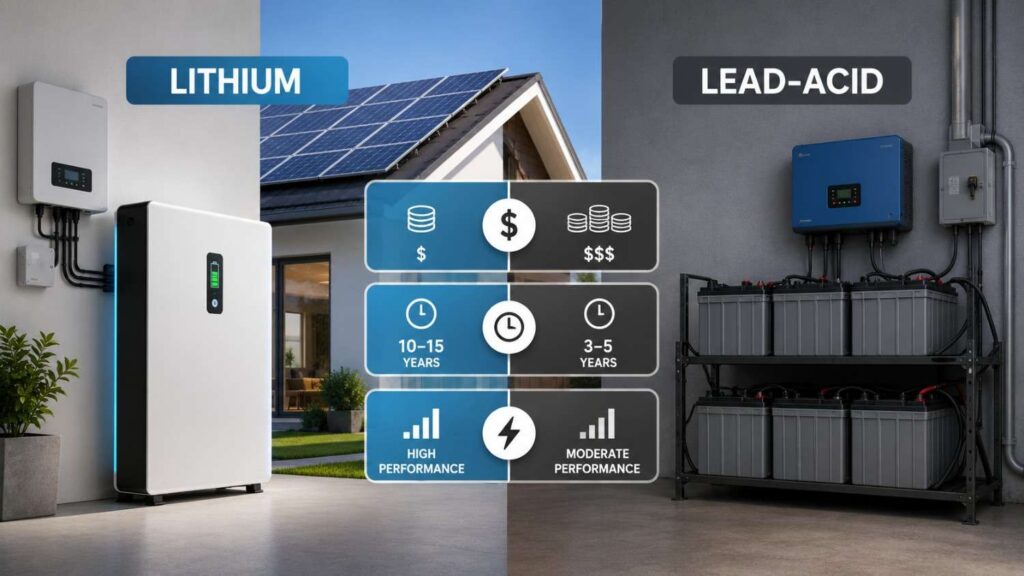
This article takes a broader look at lithium versus lead-acid batteries as complete chemistry categories, focusing on cost, lifespan and real-world performance.
Lead-Acid as a Category: More Than Just Tubular
Lead-acid batteries for inverter and solar applications come in several common variants: tubular (discussed in depth in our dedicated comparison), flat-plate flooded batteries (generally cheaper but shorter-lived and more maintenance-intensive than tubular), and sealed AGM or gel batteries (maintenance-free but typically more expensive than flooded variants and often with somewhat shorter cycle life than tubular). Understanding which specific lead-acid variant you’re actually comparing against lithium matters, since performance and cost characteristics vary meaningfully within the lead-acid category itself.
Total Cost of Ownership: The Calculation That Actually Matters
Comparing lithium and lead-acid purely on upfront purchase price is genuinely misleading; a proper comparison requires calculating cost per cycle or cost per year of expected service, accounting for lead-acid’s shorter lifespan and the resulting need for more frequent replacement. A lead-acid battery costing roughly a third of an equivalent lithium battery but lasting only a third as long delivers essentially the same total cost over that period, before even accounting for lithium’s typically superior usable capacity at a given rated Ah, discussed further below.
Usable Capacity Differences
As covered in our depth of discharge article, lead-acid batteries are generally recommended to discharge only to around 50% of rated capacity to preserve reasonable lifespan, while lithium tolerates much deeper discharge, often 80-90%, without significantly compromising longevity. This means a 200Ah lead-acid battery delivers roughly 100Ah of genuinely usable capacity in practice, while a 200Ah lithium battery delivers closer to 160-180Ah usable, a meaningful practical difference when sizing a system for actual household needs.
Efficiency and Energy Loss During Charge/Discharge Cycles
Lithium batteries generally offer higher round-trip efficiency, meaning less energy is lost as heat during charging and discharging compared to lead-acid, translating to more of the power your inverter or solar system generates actually reaching your appliances rather than being lost within the battery’s own internal charging and discharging process.
A Comprehensive Comparison Table
| Factor | Lead-Acid (general) | Lithium (LiFePO4) |
|---|---|---|
| Upfront cost per kWh capacity | Lower | Higher |
| Typical cycle life | 500-2,000 (varies by type) | 3,000-6,000+ |
| Usable depth of discharge | ~50% | ~80-90% |
| Round-trip efficiency | ~80-85% | ~95%+ |
| Weight per kWh | Heavy | Light (roughly 1/3) |
| Maintenance | Varies by type; flooded needs regular attention | Minimal to none |
Environmental and Safety Considerations
Lead-acid batteries contain toxic lead and sulfuric acid, requiring responsible disposal or recycling at end of life through appropriate channels rather than informal disposal, an environmental consideration worth taking seriously given lead’s well-documented health and environmental hazards. Lithium batteries, particularly LiFePO4 chemistry, are generally considered more environmentally manageable and, when properly manufactured with appropriate battery management systems, present a strong safety profile, though they also require proper end-of-life recycling rather than informal disposal.
Why Lithium’s Total Value Proposition Has Improved Over Time
Lithium battery prices, following broader global trends driven partly by electric vehicle industry scaling, have declined meaningfully in recent years, narrowing what was once a much larger upfront cost gap between lithium and lead-acid options. This trend, combined with lithium’s substantially longer lifespan and superior usable capacity, has shifted the total-cost calculation increasingly in lithium’s favor for many buyers who can manage the higher upfront investment, even as lead-acid remains a legitimate lower-barrier entry point for tighter budgets.
Making the Decision for Your Specific Household
If your primary constraint is upfront cash availability and you’re comfortable with periodic replacement and maintenance, lead-acid, particularly quality tubular variants, remains a reasonable choice. If you can access the higher upfront investment, whether through savings, financing, or phased purchasing, lithium’s combination of longer lifespan, higher usable capacity, and minimal maintenance generally delivers better long-term value for most households seeking a durable, low-hassle backup power solution.
A Simple Framework for Estimating Your Own Total Cost Comparison
To roughly estimate which option is genuinely cheaper for your specific situation, divide each battery’s upfront cost by its expected total cycle life to get a rough cost-per-cycle figure, then compare these figures directly rather than comparing upfront prices alone; while this simplified calculation ignores some factors like efficiency and usable capacity differences discussed above, it provides a considerably more accurate starting comparison than upfront cost alone, and is worth doing explicitly with real quoted prices for your specific situation before committing to either technology.
Common Misconceptions
- “All lead-acid batteries perform the same regardless of type.” Tubular, flooded flat-plate, and sealed AGM/gel variants differ meaningfully in cost, maintenance, and lifespan within the broader lead-acid category.
- “Lithium batteries are still prohibitively expensive for typical households.” While still costing more upfront, price declines have made lithium considerably more accessible than in previous years.
- “Comparing rated Ah capacity directly between the two chemistries gives an accurate comparison.” Usable capacity differs significantly due to differing safe depth of discharge recommendations, making rated capacity alone a misleading comparison point.
Frequently Asked Questions
Is it worth mixing lithium and lead-acid batteries in the same system?
Generally not recommended, since the two chemistries have different charging profiles and voltage characteristics; most installations should use one consistent battery chemistry throughout a given battery bank.
Does my choice between lithium and lead-acid affect what inverter I need?
Potentially yes; ensure your inverter’s charging profile is compatible with or configurable for your chosen battery chemistry, particularly important when selecting or switching to lithium.
How does battery choice interact with solar panel sizing discussed elsewhere on this site?
Lithium’s higher usable capacity and efficiency mean a given battery bank can store and deliver more genuinely usable energy from the same solar generation, a relevant factor when sizing your overall system together rather than considering panels and batteries in isolation.
Final Thoughts
Lithium and lead-acid batteries represent a genuine, multi-dimensional tradeoff spanning upfront cost, usable capacity, maintenance, and long-term value, not a simple case of one technology being universally superior. Calculating true total cost of ownership over your realistic planning horizon, rather than comparing sticker prices alone, is the key to making a genuinely informed choice that fits both your budget and your long-term reliability needs.