
It’s a frustrating discovery for many new solar system owners: your panels are rated for a certain wattage, yet your actual measured output consistently falls short of that number, sometimes considerably.
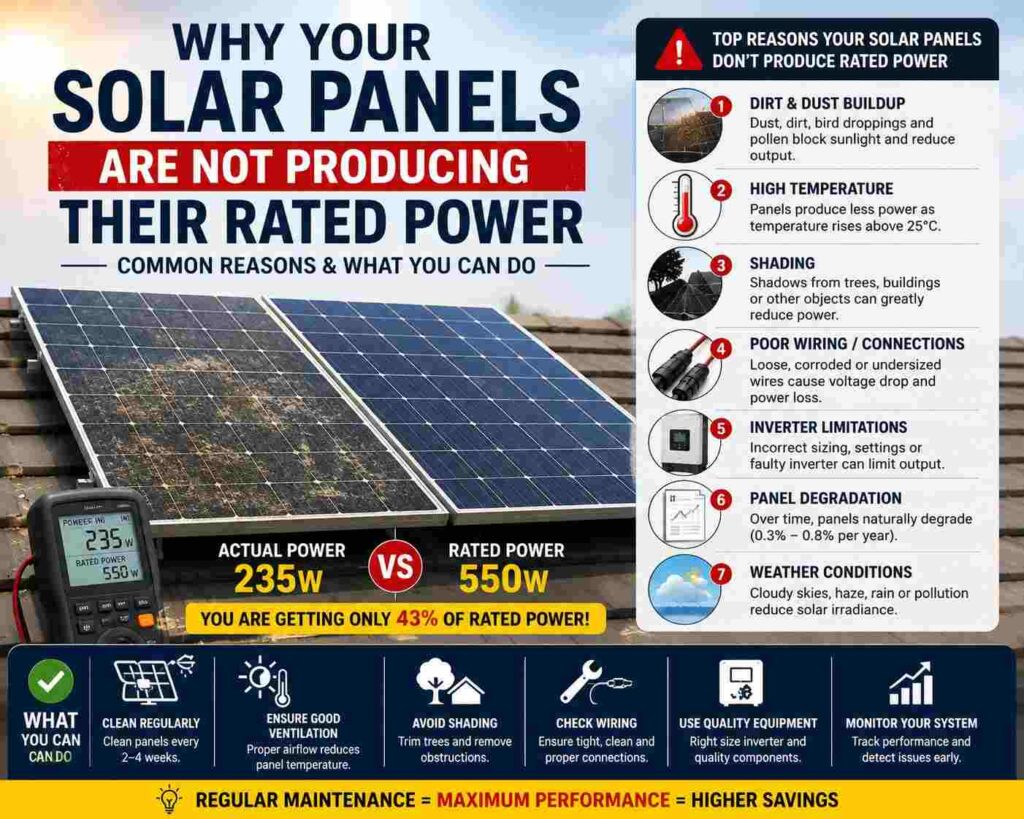
This article walks through why this is actually normal to some degree, and how to distinguish expected, unavoidable losses from a genuine fault worth investigating.
Understanding What “Rated Power” Actually Means
A panel’s rated wattage, printed on its label, is measured under Standard Test Conditions: a specific temperature (25°C), a specific light intensity (1000 W/m²), and a specific light spectrum, conditions that rarely, if ever, match real-world outdoor operating conditions exactly. This means some gap between rated and actual output is completely normal and expected under real deployment conditions, not automatically evidence of a fault or defective equipment.
1. Temperature: The Single Biggest Factor
Solar panels lose efficiency as their operating temperature rises above the 25°C standard test condition, typically by roughly 0.3-0.5% per degree Celsius above that baseline, depending on the specific panel technology, a relationship touched on in our monocrystalline vs polycrystalline comparison. Given Nigeria’s consistently high ambient temperatures, and panels themselves often running considerably hotter than ambient air temperature under direct sun, a 15-25% reduction from rated output due to temperature alone is genuinely normal and expected, not a sign of malfunction.
2. Angle and Orientation Losses
Panels not positioned at their optimal tilt angle and compass orientation for your specific latitude receive less than maximum possible sunlight throughout the day, an entirely normal real-world installation constraint (roof shape, available space, aesthetic considerations) rather than a fault, though it does mean actual output will fall meaningfully below what the same panels would achieve under ideally optimized positioning.
3. Dust, Dirt and Soiling
Accumulated dust, particularly relevant during Nigeria’s harmattan season, physically blocks a portion of incoming sunlight from reaching the solar cells, and can reduce output by anywhere from a few percent to over 20% for heavily soiled panels that haven’t been cleaned in a long time, a topic covered in depth in our dedicated panel cleaning article.
4. Shading, Even Partial
As explained in our dedicated shading article, even small, partial shading from nearby trees, buildings, or overhead cables can disproportionately reduce output, particularly for series-wired panel strings where one shaded panel drags down the output of the entire string rather than just its own individual contribution.
5. Cable and Connection Losses
Resistive losses in cabling between panels, charge controller, and battery, along with any loose, corroded or poor-quality connections along the way, reduce the power that actually reaches your battery compared to what your panels generated at the array itself, an effect minimized by proper cable sizing (discussed in our cable sizing article) but never entirely eliminated.
6. Controller and Inverter Conversion Losses
Charge controllers and inverters are not perfectly efficient; even quality MPPT controllers typically operate at 95-98% efficiency rather than 100%, and inverters converting DC to AC introduce their own additional conversion losses, both entirely normal and expected parts of any real solar system’s total energy chain.
A Realistic Expectation Table
| Loss Factor | Typical Impact |
|---|---|
| Temperature | 15-25% reduction, unavoidable in Nigeria’s climate |
| Suboptimal angle/orientation | 5-15%, depending on installation constraints |
| Dust and soiling | 2-20%+, depending on cleaning frequency |
| Shading (even partial) | Highly variable, can be severe in series strings |
| Cabling and connections | Typically 1-3% with properly sized cable |
| Controller/inverter conversion | Typically 2-8% combined |
When the Shortfall Points to a Genuine Fault
While the factors above explain why real-world output reasonably falls below rated capacity, a shortfall considerably beyond what these combined factors would predict, particularly a sudden drop in output compared to your system’s previous established performance, points toward a genuine fault rather than normal losses: a failing panel, a loose connection, a malfunctioning controller, or in more concerning cases, a degrading battery bank no longer accepting a full charge. Comparing current output against your own system’s historical performance under similar conditions is a more reliable diagnostic approach than comparing against the theoretical rated capacity alone.
How to Reasonably Estimate Your Expected Real-World Output
Rather than expecting rated capacity, a more realistic planning benchmark multiplies rated wattage by a combined “derate factor” typically in the range of 0.65-0.80 depending on your specific installation’s temperature exposure, angle, cleanliness, and equipment quality, giving a genuinely useful real-world expectation to compare against rather than the unrealistic standard-test-condition number printed on the panel label.
How to Systematically Investigate a Suspected Shortfall
Rather than guessing at which factor explains a disappointing output reading, a systematic approach checks each contributor roughly in order of ease of investigation: first confirm panels are visibly clean and unshaded at the time of measurement, then check that the measurement itself was taken under reasonably clear, sunny conditions rather than during passing cloud cover, then compare against your system’s own historical output logs (if available) under similar conditions, and finally, if the shortfall remains unexplained, have a qualified installer test individual panels, connections, and your controller’s actual tracking performance directly.
Why Keeping Basic Output Records Pays Off Over Time
Many quality inverters and charge controllers include basic monitoring or logging features, and even a simple habit of periodically noting your system’s output alongside rough weather conditions creates a genuinely useful personal baseline for distinguishing normal seasonal and weather-driven variation from an emerging fault. Without this kind of baseline, every observation of “lower than expected” output requires comparing against the unrealistic rated-capacity figure rather than your own system’s realistic, established performance pattern, making genuine problems considerably harder to reliably identify.
Setting Realistic Expectations Before Installation, Not After
Much of the frustration around underperforming panels stems from unrealistic expectations set before installation rather than actual system problems discovered afterward; a reputable installer should walk you through realistic, derated output expectations for your specific site during the sales and planning process, not leave you to discover the gap between rated and real-world performance on your own after the system is already installed and running.
Common Misconceptions
- “Any output below rated wattage means something is wrong.” A meaningful, predictable gap between rated and real-world output is normal and expected for every solar installation.
- “All panels lose exactly the same amount to heat regardless of type.” Temperature coefficients vary somewhat by panel technology and quality, meaning the exact percentage loss differs between products.
- “Once installed, panel output should stay completely constant day to day.” Weather, temperature, dust accumulation, and sun angle all cause genuine, expected daily and seasonal variation in actual output.
Frequently Asked Questions
How can I tell if my system’s output shortfall is normal or a genuine problem?
Track your system’s output over time under similar weather conditions; a sudden, unexplained drop compared to your own historical baseline is a stronger signal of a fault than simply falling short of the rated label figure.
Does panel age affect this gap over time?
Yes, panels degrade gradually over their lifespan, typically around 0.5-0.8% per year, meaning a portion of any output shortfall in an older system reflects normal, expected long-term degradation, covered further in our dedicated panel lifespan article.
Should I ask my installer to calculate my expected real-world output before installation?
Yes, a reputable installer should be able to explain their expected derate factor and realistic output projection for your specific site, rather than simply quoting the rated panel wattage as your expected performance.
Final Thoughts
A gap between your solar panels’ rated wattage and their actual real-world output is expected and normal, driven by temperature, angle, dust, shading, and equipment conversion losses that affect every real installation to some degree. Understanding this distinction between normal, predictable losses and a genuine developing fault is the key to correctly interpreting your system’s performance rather than either dismissing a real problem or worrying unnecessarily about entirely expected behavior.