
Choosing between an MPPT and a PWM charge controller is one of the most consequential decisions in designing a solar system, directly affecting how much of your panels’ potential output you actually get to use.
This article compares the two technologies directly, building on the fundamentals covered in our dedicated MPPT explainer, to help you understand exactly what you gain and give up with each choice.
How PWM Controllers Actually Work
PWM, standing for Pulse Width Modulation, controllers work by rapidly switching the connection between panel and battery on and off, effectively pulling the panel’s operating voltage down toward the battery’s voltage rather than converting between the two. This is a simpler, older technology that works adequately when panel voltage is already reasonably close to battery voltage, but becomes increasingly inefficient as the gap between panel voltage and battery voltage grows, since the panel is essentially forced to operate away from its own optimal voltage point rather than being allowed to operate optimally while a separate conversion stage handles the voltage difference.
How MPPT Controllers Differ Fundamentally
As explained in our dedicated MPPT article, MPPT controllers actively track a panel’s true maximum power point and use power electronics to convert that optimal voltage and current combination down to whatever the battery bank actually needs, similar in principle to how a DC-DC converter operates, capturing power the panel is capable of producing rather than forcing the panel to operate at a suboptimal, battery-dictated voltage.
The Real-World Efficiency Gap
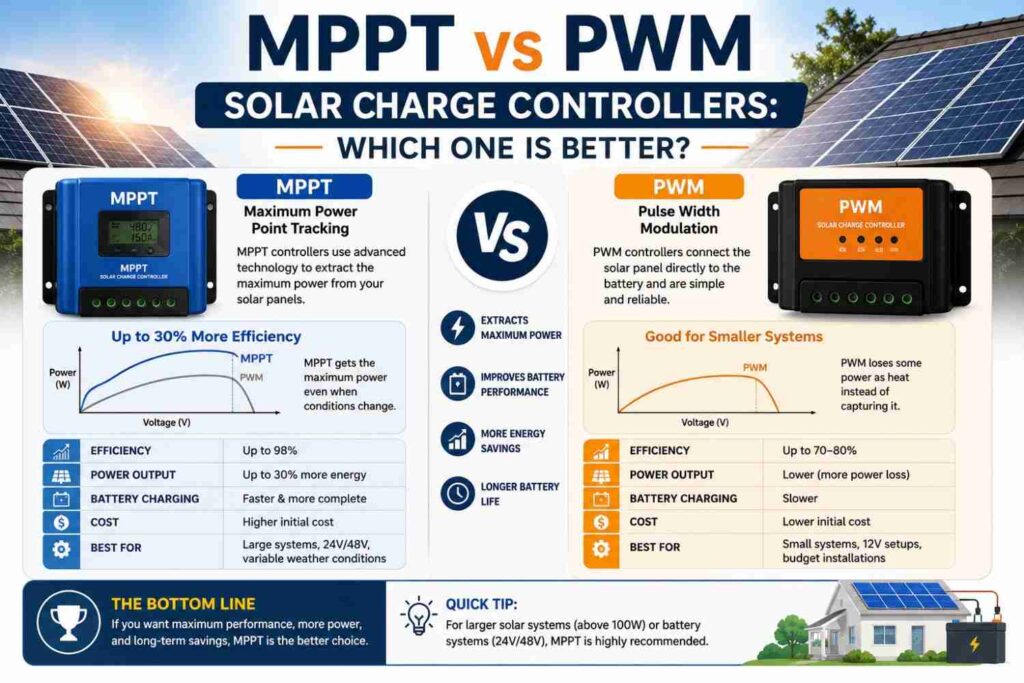
In situations where panel voltage closely matches battery voltage, PWM and MPPT controllers perform relatively similarly, with MPPT offering only a modest advantage. But in situations with any meaningful voltage mismatch, common when panels are wired in series to reduce cabling costs, discussed in our series vs parallel wiring article, MPPT can capture 20-30% more usable power than PWM under otherwise identical conditions, a genuinely significant difference over a system’s operating lifetime.
Cost Comparison
PWM controllers are considerably cheaper than MPPT controllers of equivalent current rating, making them attractive for smaller budgets or very simple, closely-voltage-matched systems where the efficiency gap matters less. MPPT controllers cost more upfront but, for most system configurations beyond the simplest setups, generally pay for this additional cost back through additional captured energy over a relatively modest period, particularly for systems using series-wired panel strings at higher voltage than the battery bank.
A Direct Comparison Table
| Factor | PWM | MPPT |
|---|---|---|
| Technology | Direct switching connection | Active voltage/current conversion |
| Efficiency with matched voltage | Reasonably good | Slightly better |
| Efficiency with voltage mismatch | Poor, significant losses | Excellent, captures near-maximum power |
| Cost | Lower | Higher |
| Best suited for | Small, simple, closely-matched systems | Most residential and larger systems |
When PWM Genuinely Makes Sense
PWM isn’t universally the wrong choice: for very small systems, such as a single panel closely matched in voltage to a small battery, where budget is the primary constraint and the efficiency gap matters less in absolute terms, PWM remains a reasonable, functional option. Small off-grid applications like a single security light or a small cabin setup are common legitimate use cases where PWM’s lower cost outweighs its efficiency disadvantage relative to the modest power involved.
Why Most Nigerian Home Systems Benefit From MPPT
Typical Nigerian residential solar systems, sized to meaningfully offset grid and generator dependence, generally involve multiple panels, often wired in series strings for cabling cost efficiency, feeding into a battery bank at a different voltage, precisely the scenario where MPPT’s efficiency advantage is most pronounced and valuable. For anything beyond the smallest, simplest installations, the additional upfront cost of MPPT is generally a sound investment given the real, ongoing efficiency gains it delivers across the system’s entire operating lifetime.
A Practical Way to Estimate Which Option Saves You More Money
To roughly estimate whether MPPT’s higher upfront cost is worthwhile for your specific situation, compare your intended panel array’s voltage (particularly if wired in series) against your battery bank’s voltage; the larger this gap, the more pronounced MPPT’s efficiency advantage becomes, and the faster its additional cost is recovered through genuinely captured extra energy. For a rough sense of payback timeframe, many Nigerian residential systems with meaningful series-string voltage recover MPPT’s price premium, compared to an equivalent PWM setup, within one to three years through the additional usable energy captured, after which the ongoing efficiency advantage continues delivering value for the remainder of the system’s operating life.
Retrofitting Existing PWM Systems
Homeowners with an existing PWM-based system who are considering an upgrade should evaluate whether their current panel wiring configuration, if redesigned around an MPPT controller’s more flexible voltage handling, could unlock meaningfully more usable power from panels already installed, sometimes making an MPPT retrofit an attractive way to boost an existing system’s output without purchasing additional panels at all. This is worth discussing with a qualified installer familiar with your specific existing equipment before assuming a full system replacement is necessary to capture MPPT’s benefits.
Reading Between the Lines of Marketing Claims
Because MPPT commands a price premium, some products marketed as MPPT-capable are, in practice, only modestly better than well-designed PWM controllers, using simplified or limited tracking algorithms that don’t deliver the full efficiency gains genuine, well-implemented MPPT technology offers. Checking for a clearly stated tracking efficiency specification, and favoring established, reputable brands with verifiable track records, helps avoid paying MPPT prices for a controller that doesn’t fully deliver MPPT-level real-world performance.
Common Misconceptions
- “PWM controllers are simply an inferior, obsolete technology to avoid entirely.” PWM remains appropriate for specific smaller, closely-matched applications where its lower cost outweighs the modest efficiency gap.
- “The efficiency difference between MPPT and PWM is only theoretical.” Under real voltage-mismatch conditions common in typical system designs, the difference translates into genuinely more usable energy reaching your battery.
- “You can easily tell which type you need without any calculation.” Properly comparing your specific panel voltage to your battery bank voltage is necessary to accurately assess how much the efficiency gap would matter for your particular system.
Frequently Asked Questions
Can I mix MPPT and PWM controllers in the same system?
Technically possible if managing separate panel arrays or battery banks, but this adds complexity; most installations use a single controller type matched to the whole system for simplicity.
Does controller choice affect how many panels I need, as discussed in our panel count article?
Yes, since MPPT’s better efficiency at capturing usable power can mean slightly fewer panels are needed to meet the same energy target compared to a PWM-based system with the same panel voltage mismatch.
Is MPPT more prone to failure or more complex to maintain than PWM?
MPPT controllers are more electronically complex internally, but from reputable manufacturers are generally reliable; neither type typically requires significant ongoing maintenance beyond periodic visual inspection and dust removal.
Final Thoughts
The choice between MPPT and PWM charge controllers comes down to a genuine cost-versus-efficiency tradeoff that depends heavily on your specific panel and battery voltage configuration, not a simple universal answer. For most Nigerian residential solar systems, particularly those using series-wired panels, MPPT’s efficiency advantage generally justifies its higher upfront cost, but understanding the underlying reasoning, rather than accepting either choice on faith, helps you evaluate your own system’s specific needs more accurately.