
If you’ve researched solar systems even briefly, you’ve likely encountered the term MPPT, often presented as an essential feature without much explanation of what it actually does or why it matters so much for real-world solar performance.
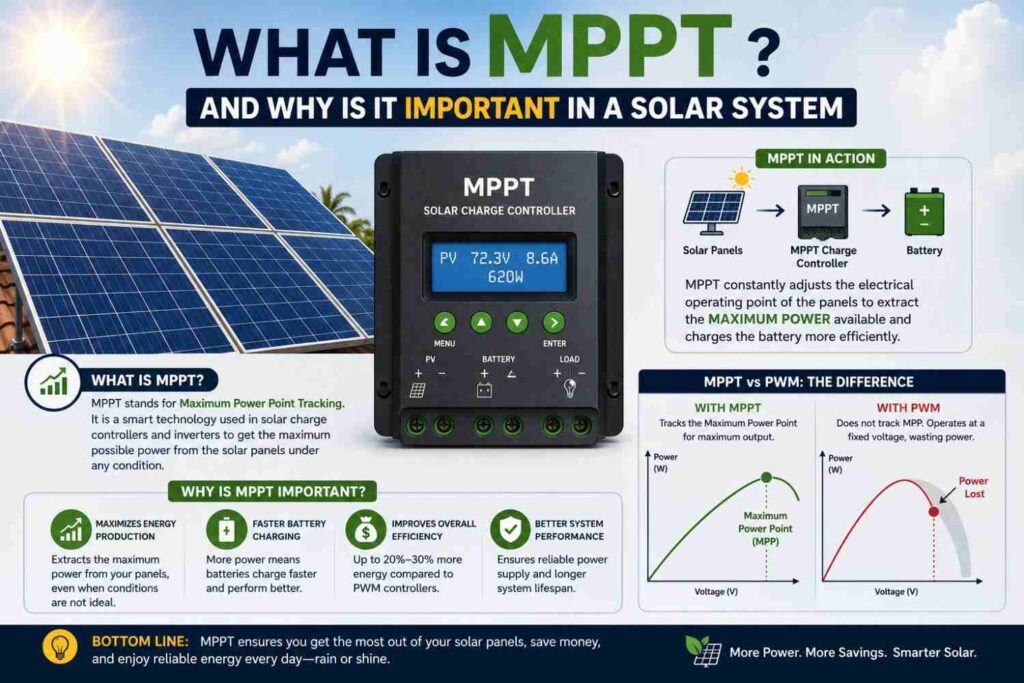
This article explains MPPT in genuinely practical terms, why it exists, and why it makes a measurable difference to how much usable power your solar system actually delivers.
The Problem MPPT Was Designed to Solve
A solar panel’s power output varies continuously depending on sunlight intensity, temperature, and shading, and for any given set of conditions, there’s a specific combination of voltage and current at which the panel produces its maximum possible power, known as the Maximum Power Point. This optimal point shifts constantly throughout the day as conditions change, and a simple, non-optimizing charge controller connected directly to a panel and battery doesn’t automatically find or track this shifting optimal point, potentially leaving significant power on the table, power the panel was fully capable of producing but that never actually reaches your battery.
What MPPT Actually Stands For and Does
MPPT stands for Maximum Power Point Tracking, and it describes a charge controller’s ability to continuously monitor a solar panel’s voltage and current output, calculate where the current Maximum Power Point sits under present conditions, and adjust its own electrical operating point to extract power at that optimal combination, then convert it to whatever voltage your battery bank actually needs. This continuous, real-time tracking and conversion is what distinguishes an MPPT controller from a simpler PWM controller, discussed in depth in our dedicated MPPT vs PWM comparison.
Why This Translates to Real, Measurable Gains
In practical terms, MPPT controllers typically deliver 20-30% more usable power from the same physical panels compared to simpler, non-tracking charge controllers, particularly in situations where a panel’s voltage doesn’t naturally match the battery bank’s voltage, a very common scenario in real installations. This isn’t a marginal, theoretical improvement; it represents genuinely more energy actually reaching your battery from panels you’ve already paid for and installed, making MPPT one of the more cost-effective upgrades available in solar system design relative to its price.
How MPPT Handles Changing Conditions Throughout the Day
As the sun moves across the sky, clouds pass overhead, or temperature rises through the day, a panel’s optimal operating voltage and current shift continuously, sometimes significantly. An MPPT controller re-evaluates and adjusts its tracking many times per second, meaning your system captures close to the maximum available power continuously throughout changing conditions, rather than only under the specific conditions a fixed, non-adaptive setup happened to be tuned for.
MPPT and Voltage Mismatch Specifically
One of MPPT’s most valuable practical functions is efficiently handling voltage mismatches between your panel array and battery bank, converting excess panel voltage into additional current delivered to the battery rather than simply wasting it, following the same power-conservation principle (power equals voltage times current) covered in our voltage, current, resistance and power article. This capability is specifically why MPPT enables more flexible system design, including the series-wired panel configurations discussed in our series vs parallel panel wiring article, since MPPT can efficiently convert a higher series-string voltage down to whatever your specific battery bank actually requires.
Is MPPT Always Worth the Extra Cost?
MPPT controllers cost more than simpler PWM alternatives, and for very small systems with panel voltage already closely matched to battery voltage, the practical benefit is smaller than in larger or mismatched systems. For most residential Nigerian solar installations, particularly anything beyond a small single-panel setup, the efficiency gains MPPT provides generally justify its additional upfront cost within a relatively short period, through the additional usable energy captured over the system’s lifetime.
How MPPT Algorithms Actually Search for the Optimal Point
Most MPPT controllers use a technique broadly known as “perturb and observe,” repeatedly making small adjustments to the operating voltage and measuring whether power output increased or decreased as a result, then continuing to adjust in whichever direction improves output, converging on the maximum power point and continuously re-checking as conditions shift. More advanced controllers use faster or more sophisticated variations of this basic approach to track changing conditions, such as rapidly moving clouds, more responsively, an important practical difference between budget and premium MPPT controllers that isn’t always obvious from the basic wattage and voltage specifications alone.
What to Look for Beyond the “MPPT” Label When Buying a Controller
Simply seeing “MPPT” on a product doesn’t guarantee equal performance across different manufacturers and price points; tracking efficiency (how close the controller actually gets to the true maximum power point in practice), conversion efficiency (how much power is lost in the process of converting and delivering power to the battery), and build quality all vary meaningfully between products. Checking independent reviews or specifications for tracking efficiency percentage, typically expressed as being above 99% for quality controllers, is a more reliable way to compare MPPT products than assuming the MPPT label alone guarantees comparable performance.
MPPT’s Role Alongside Battery Charging Stages
Beyond tracking a panel’s maximum power point, quality MPPT controllers also typically manage proper multi-stage battery charging, bulk, absorption, and float stages appropriate to your specific battery chemistry, meaning MPPT’s benefit extends beyond raw power capture into also protecting and extending your battery bank’s usable life through correctly regulated charging, a secondary but genuinely valuable function worth understanding as part of the full value MPPT delivers to a system.
Common Misconceptions
- “MPPT increases the total power a panel is physically capable of producing.” MPPT extracts more of a panel’s existing rated capability under real conditions; it doesn’t increase the panel’s fundamental maximum output beyond its own rating.
- “MPPT and PWM controllers produce basically the same results.” The efficiency difference, especially under voltage mismatch conditions, is often substantial rather than marginal.
- “MPPT is only relevant for very large commercial systems.” Most residential systems benefit meaningfully from MPPT, not just large-scale installations.
Frequently Asked Questions
Can I upgrade an existing PWM system to MPPT later?
In many cases yes, since MPPT controllers are generally compatible with the same panels and batteries, though it’s worth confirming compatibility with your specific existing equipment before purchasing an upgrade.
Does MPPT require any special panel type to work properly?
No, MPPT works with standard solar panels of any type, including both monocrystalline and polycrystalline, discussed in our dedicated comparison article; it’s the controller’s tracking behavior that differs, not a requirement on the panel itself.
How do I know if my current controller is MPPT or PWM?
This is typically stated clearly on the controller’s casing or in its documentation; if uncertain, checking the model number against the manufacturer’s specifications, or asking your installer directly, will confirm which type you have.
Final Thoughts
MPPT is not simply a marketing buzzword but a genuinely functional technology that meaningfully increases how much of your solar panels’ potential output actually reaches your battery bank under Nigeria’s real, constantly changing sunlight and temperature conditions. Understanding what MPPT does, rather than treating it as an unexplained feature on a spec sheet, helps you evaluate solar system quotes more critically and make a more informed investment in equipment that will actually deliver on its rated capacity.