How you physically wire your solar panels together, in series, in parallel, or in some combination of both, has a real and sometimes underappreciated impact on your system’s performance, safety, and resilience to shading.
This article explains the practical differences between these wiring configurations and how to think about which approach suits your installation.
The Basic Electrical Difference
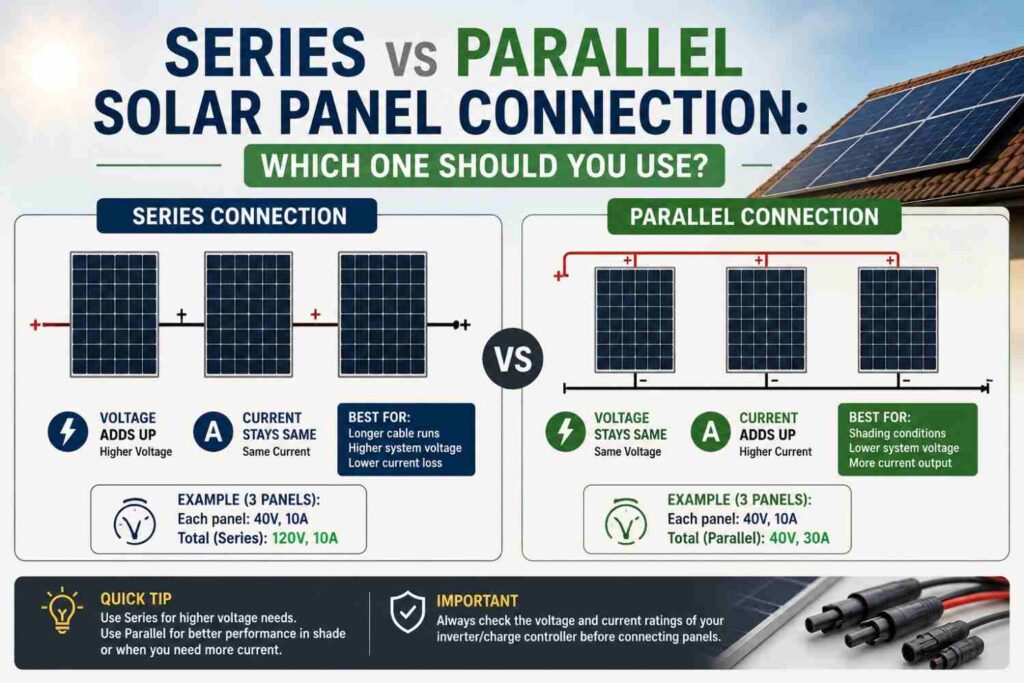
Wiring panels in series, connecting the positive terminal of one panel to the negative terminal of the next, adds their voltages together while keeping current the same as a single panel, similar to the general series circuit principles covered in our dedicated series vs parallel circuits article. Wiring panels in parallel, connecting all positive terminals together and all negative terminals together, adds their currents together while keeping voltage the same as a single panel. Most real solar installations use some combination of both, series strings of panels connected in parallel with other strings, to achieve a target voltage and current combination suited to the inverter or charge controller being used.
Why Voltage and Current Targets Matter
Your charge controller or inverter has a specific acceptable input voltage and current range, and your panel wiring configuration must be designed to fall within that range for the system to function safely and efficiently. Series wiring, by increasing voltage, is often used to reach a charge controller’s required input voltage range using fewer, thinner (and therefore cheaper) cables, since higher voltage at the same power level means lower current, and lower current allows thinner wiring without excessive resistive losses or heating, a relationship following the same underlying principles covered in our cable sizing article.
Series Wiring: Advantages and a Key Vulnerability
Series wiring’s main advantages are simpler, cheaper cabling and reaching higher voltage targets efficiently. Its key vulnerability, however, is shading sensitivity: because current in a series string is limited by the weakest-performing panel in that string, a single shaded, dirty, or underperforming panel can significantly reduce the output of the entire series string, not just its own individual contribution, an effect covered in more depth in our dedicated shading article.
Parallel Wiring: Advantages and Tradeoffs
Parallel wiring’s main advantage is shading resilience: since each panel’s current in a parallel configuration is largely independent of its neighbors, a shaded or underperforming panel affects only its own output rather than dragging down the entire array. The tradeoff is that parallel wiring keeps voltage low while increasing current, which for a given power level requires thicker, more expensive cabling to safely handle that higher current without excessive resistive losses or overheating risk.
A Comparison Table
| Factor | Series Wiring | Parallel Wiring |
|---|---|---|
| Voltage | Adds together | Stays the same as one panel |
| Current | Stays the same as one panel | Adds together |
| Cable requirement | Thinner, cheaper | Thicker, more expensive |
| Shading impact | Whole string affected by one shaded panel | Only the shaded panel’s own output affected |
| Typical use | Reaching target voltage for inverter/controller | Reaching target current, improving shade resilience |
Why Most Real Systems Combine Both Approaches
A typical residential solar array wires panels into series strings to reach an appropriate voltage for the inverter or charge controller, then connects multiple such strings in parallel to reach the total power capacity needed, balancing the cable-cost advantage of series wiring against the shading resilience advantage of parallel wiring. This series-parallel hybrid approach, properly designed, gives you reasonable protection against partial shading affecting your entire system while still keeping overall cabling costs manageable.
The Role of Bypass Diodes in Reducing Series Vulnerability
Quality solar panels include built-in bypass diodes, small components that allow current to route around a significantly shaded or underperforming cell or section within a panel, reducing (though not entirely eliminating) the series shading vulnerability discussed above. This is one of several reasons panel quality genuinely matters beyond the basic wattage rating, since well-implemented bypass diode protection meaningfully improves real-world performance under partial shading conditions common in many residential settings with nearby trees, buildings, or other obstructions.
Why This Decision Shouldn’t Be Left Entirely to Guesswork
Properly matching your panel wiring configuration to your specific inverter or charge controller’s input specifications, your site’s shading conditions, and your budget for cabling requires genuine calculation and design, not simply following whatever configuration a particular installer happens to default to. Asking your installer to explain their specific wiring configuration choice and how it accounts for any shading your site experiences is a reasonable, worthwhile question before installation begins.
How String Sizing Interacts With Inverter Voltage Windows
Inverters and MPPT charge controllers, discussed in our dedicated MPPT article, specify not just a maximum acceptable input voltage but an operating voltage window within which they perform efficiently, meaning a series string must be sized carefully to stay within this window across the full range of conditions the panels will experience, including cold mornings when panel voltage rises above its rated figure and hot afternoons when it falls below. Getting this string sizing calculation wrong, whether by an inexperienced installer or a homeowner attempting a DIY configuration, can result in a system that either underperforms significantly or, in more serious cases, risks exceeding a component’s safe voltage rating under specific temperature conditions, underscoring why this particular design decision benefits from a qualified installer’s proper calculation rather than rough estimation.
Practical Signs Your Wiring Configuration May Be Poorly Matched
If your system’s real-world output seems to underperform expectations specifically during partial-shading conditions, such as mid-morning or late afternoon when nearby obstructions cast longer shadows, despite performing reasonably well under full, unobstructed midday sun, this pattern can indicate your wiring configuration wasn’t well matched to your site’s actual shading profile. Raising this specific, described symptom with your installer, rather than a vague complaint about generally low output, helps direct their troubleshooting toward configuration-related causes more efficiently.
Documenting Your System’s Wiring Configuration for Future Reference
Keeping a simple record of your system’s actual wiring configuration, which panels are grouped into which series strings, and how those strings connect to your controller, is valuable for any future troubleshooting, expansion, or maintenance work, since this information isn’t always obvious from a visual inspection alone once panels are mounted and cabling is routed and secured. Asking your installer to provide this documentation as part of your installation, rather than needing to reconstruct it later from memory or guesswork, is a reasonable and worthwhile request.
Common Misconceptions
- “Parallel wiring is always better since it handles shading.” Parallel wiring’s thicker cable requirement adds real cost, and many sites without significant shading concerns are well served by series-dominant configurations.
- “Wiring configuration doesn’t matter as long as total panel wattage is correct.” Configuration affects voltage and current delivered to your inverter or controller, shading resilience, and cabling cost, all independent of total wattage.
- “You can freely mix series and parallel wiring without any calculation.” Proper system design requires matching your specific configuration to your inverter or controller’s voltage and current specifications precisely.
Frequently Asked Questions
Can I change my wiring configuration after installation if my needs change?
It’s technically possible but generally requires a qualified installer’s involvement to ensure the new configuration remains within your inverter or controller’s specifications and is done safely.
Does my specific location’s typical shading pattern really change which configuration I should use?
Yes, sites with minimal shading throughout the day can generally use more series-dominant configurations for cost savings, while sites with partial shading from trees or buildings benefit more from parallel or hybrid configurations with more strings.
Is one configuration inherently safer than the other?
Both are safe when properly designed and installed within component specifications; higher voltage series strings do require appropriately rated components and careful installation given the higher voltages involved, which a qualified installer should address as standard practice.
Final Thoughts
Series versus parallel panel wiring isn’t a simple either-or choice but a genuine design decision balancing voltage and current targets, cabling cost, and shading resilience specific to your site and equipment. Understanding these tradeoffs, even without doing the detailed engineering yourself, helps you ask better questions of your installer and better understand why your specific system was designed the way it was.