
One of the most common questions anyone considering solar in Nigeria eventually asks, and one that too many installers answer with a vague guess rather than an actual calculation, is exactly how many panels a given home actually needs.
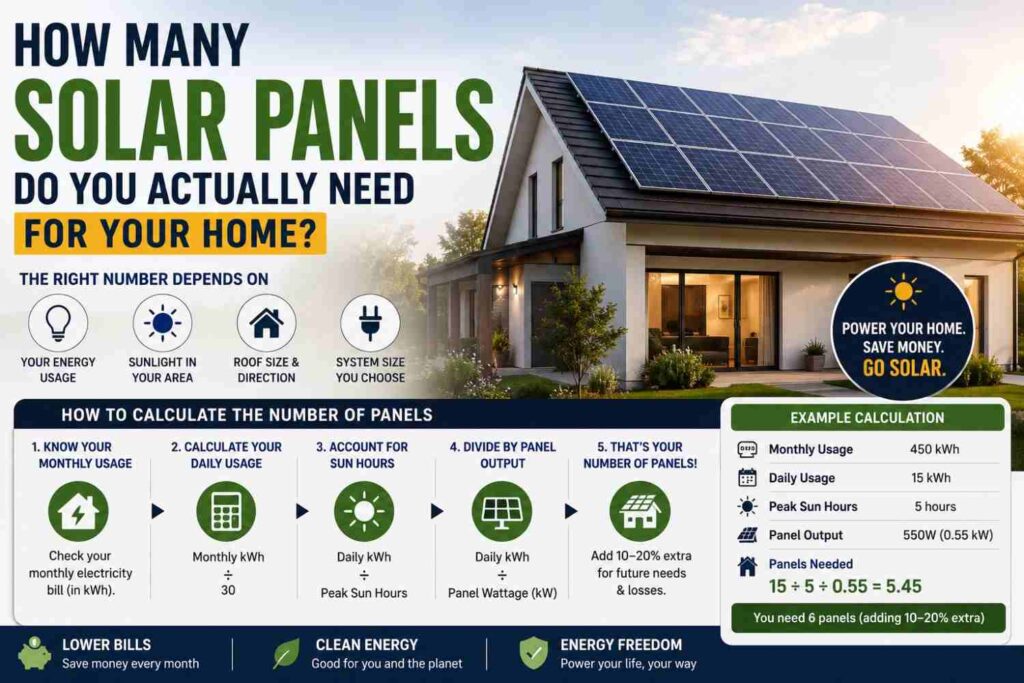
This article walks through the real calculation process, step by step, so you can arrive at a genuinely informed number rather than relying on rules of thumb that may not fit your specific situation.
Step 1: Calculate Your Actual Daily Energy Consumption
Before any panel count makes sense, you need your actual energy consumption in kilowatt-hours (kWh) per day, covered in more depth in our dedicated kWh explainer. List every appliance you intend to power, its wattage, and roughly how many hours per day it runs, then multiply watts by hours and divide by 1,000 to get kWh for each appliance, summing across all of them for your total daily consumption. This step is worth doing carefully and honestly, including appliances you might be tempted to omit, since underestimating consumption is one of the most common reasons homeowners end up with an undersized system that can’t actually meet their needs.
Step 2: Understand Nigeria’s Solar Irradiance
Nigeria generally receives good solar irradiance, typically averaging around 4.5 to 6.5 peak sun hours per day depending on region, with northern areas generally receiving more consistent sunlight than the more cloud-prone south. “Peak sun hours” represents the equivalent number of hours per day the sun delivers a standard reference intensity, a more useful figure than simply counting daylight hours, since actual solar intensity varies considerably throughout the day and with weather conditions, particularly during the rainy season discussed in our dedicated rainy weather article.
Step 3: Calculate Required Panel Capacity
Divide your daily energy need (in kWh) by your region’s peak sun hours to get your required system size in kW, then divide that figure by your intended panel’s individual wattage rating to get an approximate panel count. For example, a home needing 10kWh daily, in a region averaging 5 peak sun hours, needs roughly a 2kW system; using 400W panels, that’s approximately five panels, though this is a simplified baseline before the adjustments discussed below.
Step 4: Build in a Realistic Safety Margin
Real-world solar systems never operate at their theoretical maximum efficiency continuously, due to factors including panel degradation over time, temperature losses (discussed in our monocrystalline vs polycrystalline comparison), dust accumulation, inverter and charge controller conversion losses, and less-than-ideal panel angle or orientation. A commonly used safety margin adds 20-30% additional capacity beyond the baseline calculation, meaning our five-panel example might realistically become six or seven panels to reliably meet actual daily needs across varying conditions rather than only under ideal circumstances.
A Worked Example Table
| Step | Example Value |
|---|---|
| Total daily consumption | 10 kWh |
| Regional peak sun hours | 5 hours |
| Baseline system size needed | 2 kW |
| Panel wattage chosen | 400W |
| Baseline panel count | 5 panels |
| With 25% safety margin | 6-7 panels |
Why Battery Capacity Also Affects the Right Panel Count
Your panel count decision isn’t entirely independent from your battery storage capacity: a system with limited battery storage may not be able to fully use excess panel capacity generated during peak sunlight hours, effectively wasting some of that potential generation, while a system with generous battery storage can better capture and use surplus daytime generation for evening and nighttime use. When sizing your system, panels and batteries should be considered together as a matched pair rather than independently, ideally with the help of a qualified solar installer who can balance both against your actual usage pattern.
Accounting for Future Growth in Your Household’s Needs
Many homeowners size their system precisely for current needs, only to find themselves wanting to add appliances, expand their home, or increase usage within a few years, at which point retrofitting additional panel capacity is often more complex and costly than if extra capacity had been planned for from the start. Where budget allows, sizing your system with some deliberate headroom beyond your current precise needs is a reasonable hedge against this common scenario, particularly for a growing household or business.
Why a Load Audit Should Distinguish Essential From Optional Appliances
Rather than treating every appliance in your consumption list as equally important, a more sophisticated approach separates genuinely essential loads, lighting, refrigeration, basic communication and security equipment, from optional or high-power loads like air conditioning, water heating, or entertainment systems that you might be willing to reduce or run only during peak generation hours. This distinction lets you size a smaller, more affordable core system confidently covering essentials, while treating higher-power discretionary appliances as a stretch goal dependent on available budget, rather than forcing your entire system size to accommodate every possible load at full, simultaneous capacity.
Getting a Second Opinion on the Calculation
Because panel count directly drives a significant portion of your total system cost, it’s worth having more than one installer independently perform this calculation for your specific home and comparing their results, along with the underlying assumptions each used for daily consumption, regional peak sun hours, and safety margin. Significant discrepancies between quotes often trace back to different assumptions in this underlying calculation rather than genuinely different equipment recommendations, and understanding exactly where the numbers diverge helps you evaluate which quote actually reflects a more realistic, honest assessment of your true needs.
Revisiting Your Calculation as Your Home Changes
Your original panel-count calculation shouldn’t be treated as permanently fixed; adding new appliances, expanding your home, or noticing your actual usage pattern differs meaningfully from your original estimate are all good reasons to revisit the calculation periodically, comparing your system’s real-world delivered performance against your original assumptions and adjusting future expansion plans accordingly rather than only relying on the original one-time estimate indefinitely.
Common Misconceptions
- “More panels is always better regardless of cost.” Oversizing beyond your realistic needs and battery capacity wastes money on capacity you can’t fully use or store.
- “The same panel count works for every home in Nigeria.” Regional solar irradiance differences and household-specific consumption patterns mean the right answer varies considerably by location and household.
- “You can accurately estimate your needs without listing actual appliances.” Rough guesses based on house size or number of rooms are far less reliable than an actual appliance-by-appliance consumption calculation.
Frequently Asked Questions
Should I size my system for my absolute peak usage or my average daily usage?
Generally your average daily usage, with the safety margin discussed above absorbing typical variation; sizing for rare peak days alone often results in significant oversizing and wasted cost for capacity used only occasionally.
Does panel orientation and angle affect how many panels I need?
Yes, panels not optimally oriented toward the sun or improperly angled for your latitude produce less than their rated output, potentially requiring additional panels to compensate; a qualified installer can advise on optimal positioning for your specific roof and location.
Is it better to start smaller and expand later, or install the full system upfront?
This depends on budget and how your installer’s system design accommodates future expansion; some setups are more easily and cost-effectively expanded later than others, worth discussing explicitly with your installer if phased installation is a possibility you’re considering.
Final Thoughts
Determining how many solar panels you actually need is a genuine calculation, not a guess, involving your real consumption, your region’s solar irradiance, and a sensible safety margin for real-world losses and future growth. Taking the time to work through this properly, or insisting your installer show you their own calculation rather than a rough estimate, is one of the most important steps toward a solar system that actually, reliably meets your household’s needs.