
Walk into any solar equipment shop in Nigeria today and you’ll be offered a choice between monocrystalline and polycrystalline panels, often at noticeably different price points, with sellers sometimes pushing whichever they happen to stock more of rather than whichever genuinely suits your situation.
This article breaks down the real, practical differences between the two technologies so you can make an informed choice rather than relying on a salesperson’s recommendation alone.
What Actually Distinguishes the Two Technologies
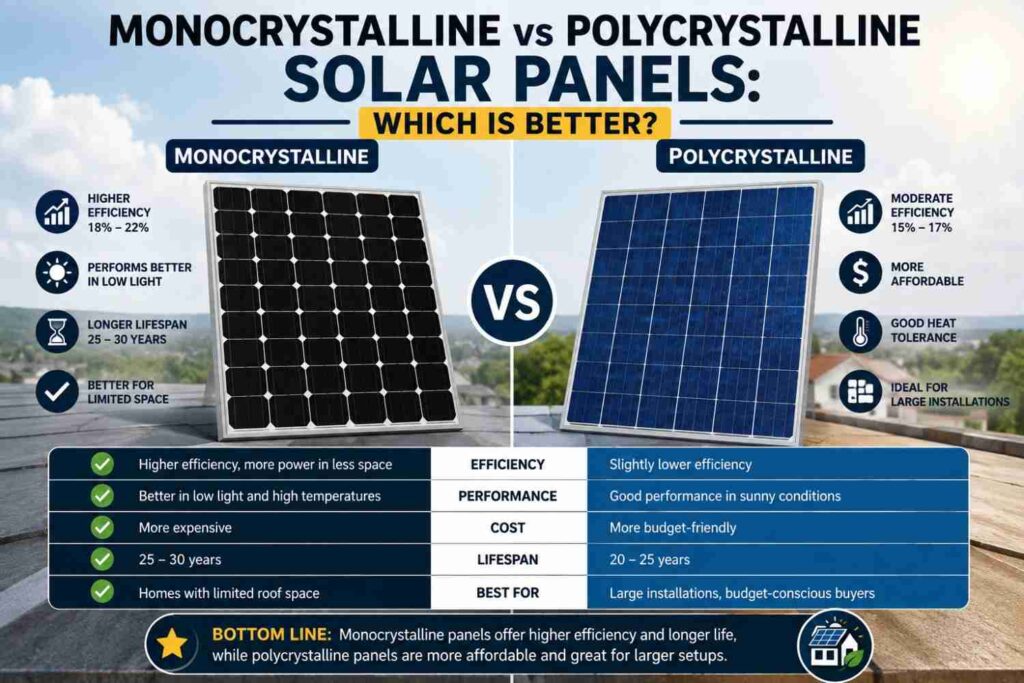
Both monocrystalline and polycrystalline panels are made from silicon, the same base material, but differ fundamentally in how that silicon is manufactured into usable solar cells. Monocrystalline cells are cut from a single, continuous silicon crystal, grown as one large cylindrical ingot and sliced into thin wafers, giving the cells their distinctive uniform black or dark blue appearance and rounded-corner shape. Polycrystalline cells, by contrast, are made by melting multiple silicon fragments together into a mold, producing a bluish, speckled appearance with a visible fragmented crystal structure, and are generally simpler and less energy-intensive to manufacture.
Efficiency: The Headline Difference
Monocrystalline panels generally achieve higher efficiency, typically in the range of 19-22%, compared to polycrystalline panels which typically fall in the 15-17% range. This efficiency difference means a monocrystalline panel produces more power from the same physical surface area than an equivalent polycrystalline panel, which matters significantly if your available roof or mounting space is limited relative to your power needs. For installations where you have abundant space, this efficiency gap matters less, since you can simply install more polycrystalline panels to reach the same total output.
Cost Comparison
Polycrystalline panels are typically cheaper to manufacture and purchase, often by 10-20% compared to monocrystalline panels of equivalent wattage, reflecting their simpler manufacturing process. This makes polycrystalline an attractive option for budget-conscious installations where space isn’t a limiting constraint, while monocrystalline’s higher upfront cost is often justified by its space efficiency and, in many cases, slightly better performance in real-world Nigerian conditions, discussed further below.
Performance in Nigeria’s Heat and Conditions
An often-overlooked factor: monocrystalline panels generally have a slightly better temperature coefficient, meaning their output degrades less as panel temperature rises under intense sun, a genuinely relevant consideration given Nigeria’s consistently high ambient temperatures and strong solar irradiance. Monocrystalline panels also tend to perform somewhat better in low-light or overcast conditions, relevant during Nigeria’s rainy season, though the difference here is generally smaller than the temperature performance gap.
A Side-by-Side Comparison
| Factor | Monocrystalline | Polycrystalline |
|---|---|---|
| Efficiency | 19-22% | 15-17% |
| Appearance | Uniform black, rounded corners | Bluish, speckled, square corners |
| Cost per watt | Higher | Lower |
| Space efficiency | Higher (fewer panels for same output) | Lower (more panels needed) |
| Heat performance | Slightly better | Slightly more degradation in heat |
| Typical lifespan | 25-30+ years | 25-30 years |
Which One Should You Actually Choose?
If your available roof or mounting space is limited relative to your household’s power needs, monocrystalline’s higher efficiency generally justifies its higher cost, since it lets you meet your energy needs within a smaller physical footprint. If you have generous, unconstrained space, such as a large flat roof or a dedicated ground-mount area, polycrystalline can deliver the same total system output at a lower overall cost, since you simply add more panels to compensate for the lower per-panel efficiency. Neither choice is objectively wrong; the right answer depends specifically on your space constraints and budget priorities.
Beyond the Cell Type: Other Factors That Matter Just as Much
While the monocrystalline versus polycrystalline decision gets significant attention, panel brand reputation, warranty terms, and the quality of your inverter and charge controller, covered in our dedicated MPPT and MPPT vs PWM articles, often matter just as much or more for your system’s real-world performance and longevity. A quality polycrystalline system with a well-matched MPPT controller can outperform a poorly designed monocrystalline system with mismatched components, underscoring that panel type is only one piece of a larger system design decision.
How Manufacturing Quality Varies Within Each Category
It’s worth recognizing that “monocrystalline” and “polycrystalline” describe the underlying cell technology, not a single fixed quality tier; both categories include a wide range of manufacturers with varying quality control, cell binning practices, and long-term reliability track records. A premium polycrystalline panel from an established manufacturer with rigorous quality control can genuinely outperform, in terms of real-world reliability and consistent output over time, a cheap, unbranded monocrystalline panel from a manufacturer cutting corners on cell quality or lamination processes. This is part of why brand reputation and warranty terms deserve as much attention as the mono-versus-poly decision itself, since the technology category alone doesn’t guarantee a specific quality outcome.
Newer Hybrid and Advanced Technologies Worth Knowing About
Beyond the basic mono-versus-poly distinction, the solar industry has introduced several enhancement technologies applicable to either base cell type, including PERC (Passivated Emitter and Rear Cell) designs that improve light capture and efficiency, and bifacial panels capable of capturing reflected light from both the front and rear surfaces, potentially boosting total output in installations with reflective surroundings like light-colored roofing or ground surfaces. These technologies generally add cost but can meaningfully improve real-world output per panel, and are worth asking about specifically when comparing quotes, since a seller’s marketing materials don’t always clearly distinguish base cell type from these additional enhancement technologies layered on top of it.
Questions Worth Asking Any Solar Seller Before Buying
Beyond simply asking “mono or poly,” a more useful set of questions includes the specific efficiency rating and temperature coefficient for the exact panel model being quoted, the manufacturer’s warranty terms and how long that manufacturer has been in business, and whether the panels carry recognized international certification marks confirming they’ve passed standardized quality and safety testing. Sellers unable or unwilling to answer these specific questions clearly, defaulting instead to general reassurances about mono being “better” or poly being “cheaper,” are worth treating with some caution regardless of which technology they’re recommending.
Common Misconceptions
- “Monocrystalline is always the better choice regardless of budget.” For space-unconstrained installations, polycrystalline often delivers better value for the same total output.
- “Polycrystalline panels don’t last as long.” Both technologies, from reputable manufacturers, typically carry similar 25-year performance warranties and comparable real-world lifespans.
- “You can’t mix panel types in one system.” While not generally recommended for panels wired together in the same string, due to performance mismatches, different panel types can coexist in a system on separate strings or charge controllers.
Frequently Asked Questions
Is there a noticeable visual way to tell the two apart without checking the specification label?
Yes: monocrystalline cells appear uniformly black or dark blue with visibly rounded corners on each cell, while polycrystalline cells show a bluish, speckled, fragmented pattern with square corners.
Does one type handle Nigeria’s dust and harmattan conditions better than the other?
Both are similarly affected by dust accumulation, discussed in our dedicated panel cleaning article; the cell technology itself doesn’t meaningfully change dust sensitivity, which depends more on panel surface coating and cleaning frequency.
Are newer panel technologies like bifacial or PERC relevant to this comparison?
These newer technologies can be applied to either monocrystalline or polycrystalline base cells and represent a separate axis of improvement, generally offering incremental efficiency gains over standard versions of either type, worth asking about but not strictly part of the mono vs poly decision itself.
Final Thoughts
Monocrystalline and polycrystalline panels represent a genuine tradeoff between efficiency and cost rather than a simple better-or-worse choice, and the right decision depends on your specific space constraints, budget, and priorities. Understanding this tradeoff, rather than simply following a seller’s default recommendation, puts you in a much stronger position to choose a solar system that actually fits your home’s needs and constraints.