
Finding the source of a short circuit can feel like searching for a needle in a haystack, especially in a home with extensive wiring, multiple circuits, and dozens of connected appliances.
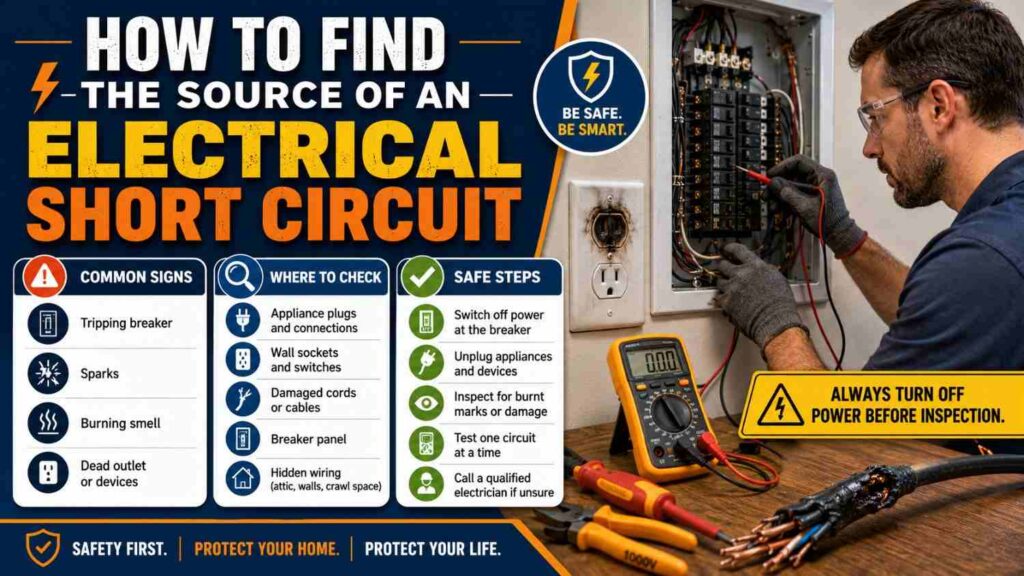
This article walks through the systematic, logical process electricians actually use to narrow down and locate a short circuit, giving you a clear understanding of what proper diagnosis involves, even if the hands-on work itself belongs to a qualified professional.
What a Short Circuit Actually Is
A short circuit occurs when live and neutral (or live and earth) conductors make unintended direct or very low-resistance contact, bypassing the normal load and creating a path of extremely low resistance. Following Ohm’s Law (V = I × R), very low resistance for a fixed voltage means extremely high current, which is why short circuits cause breakers to trip almost instantly, often accompanied by a loud snap and, in more severe cases, visible sparking at the point of fault.
Step 1: Determine Which Circuit Is Affected
The first step is identifying exactly which circuit tripped, information usually available directly from your distribution board by seeing which specific breaker has switched to the “off” or tripped position. If multiple breakers tripped simultaneously, this may indicate either a more severe fault or a cascading issue worth mentioning specifically to your electrician, since it can provide useful diagnostic information.
Step 2: Disconnect Everything on That Circuit
Before resetting the breaker, unplug or switch off every appliance connected to the affected circuit. This isolates the wiring itself from any connected appliance that might be the actual source of the fault, an important distinction covered further below.
Step 3: Attempt to Reset With Nothing Connected
With everything disconnected, carefully attempt to reset the breaker. If it holds (doesn’t immediately trip again) with nothing connected, this strongly suggests the fault lies within one of the appliances that was connected, not the fixed wiring itself. If it trips again immediately even with everything disconnected, this points toward a fault in the fixed wiring, sockets, or connections themselves, a more serious finding requiring professional wiring investigation.
Step 4: Reconnect Appliances One at a Time (If Wiring Tested Clear)
If the circuit held with nothing connected, reconnecting appliances one at a time, resetting and testing after each addition, can identify which specific appliance is causing the short. The appliance that causes the breaker to trip again when reconnected is the likely culprit and should be taken out of service for proper inspection or repair.
Professional Techniques for Locating Wiring Faults
If the fault appears to be in the fixed wiring itself rather than a specific appliance, locating the exact physical point of the short circuit typically requires professional testing equipment and techniques beyond what a homeowner can safely or effectively perform:
- Insulation resistance testing, using a specialized meter (often called a “megger”) to test insulation integrity across circuit segments, helping narrow down which section of wiring contains the fault.
- Visual inspection at accessible points, including junction boxes, sockets and switches, looking for obvious signs of damage, scorching or loose connections.
- Time-domain reflectometry or specialized cable fault locators, used by some professional electricians for more complex or hard-to-locate faults, particularly in longer cable runs or concealed wiring.
- Sectional isolation testing, systematically isolating and testing individual sections of a circuit to narrow down the fault’s location step by step.
Common Locations Where Short Circuits Develop
| Location | Why It’s Vulnerable |
|---|---|
| Socket and switch connections | Loose terminals, wear from frequent use |
| Junction boxes | Multiple connections, potential for poor workmanship |
| Cable runs through walls | Physical damage from nails, drilling, or renovation work |
| Appliance power cords | Wear, damage, or pest damage (rodents chewing insulation) |
| Outdoor or damp-area wiring | Moisture-related insulation breakdown |
Why DIY Short Circuit Hunting Has Real Limits
While the basic disconnect-and-test process described in steps 1-4 above is reasonably safe for a careful homeowner to perform (always working with the circuit switched off before connecting or disconnecting anything), actually opening sockets, junction boxes, or wall cavities to physically locate a wiring-based short circuit involves working with or near live electrical components and requires both proper testing equipment and training to do safely and effectively. This is squarely a task for a qualified electrician rather than a DIY project, both for personal safety and to avoid inadvertently causing further damage to the wiring during an amateur search.
Why Short Circuits Sometimes Seem Intermittent
A short circuit fault caused by a wire that only makes contact under certain conditions, such as when a cable is disturbed by vibration, temperature-related expansion, or a specific appliance’s operation, can behave intermittently, tripping the breaker only occasionally rather than consistently. This intermittent pattern can make diagnosis more challenging, sometimes requiring an electrician to test under multiple different conditions or monitor a circuit over time to catch the fault in the act.
Common Misconceptions
- “A short circuit and an overload are the same thing.” They are related but distinct: overload involves excess current from too much connected load, while a short circuit involves an unintended low-resistance fault path, typically causing a much more sudden, extreme current spike.
- “If the breaker resets and holds, the problem is definitely gone.” An intermittent fault may not manifest every time, meaning a breaker holding once doesn’t guarantee the underlying issue has been resolved.
- “I can safely investigate wiring myself if I switch off the breaker first.” While switching off reduces risk, properly diagnosing and repairing wiring faults still requires professional testing equipment and training beyond simple visual inspection.
Why Rewiring Sometimes Beats Repeated Fault-Finding
For older properties with a long history of repeated short circuit faults, particularly if previous faults have already required multiple separate repairs over the years, an electrician may reasonably suggest that a partial or full rewiring of the affected circuit is more cost-effective and reliable than continuing to chase individual faults one at a time as they arise. Aging insulation, especially older rubber or early PVC-insulated cabling well past its practical service life, tends to develop new weak points faster than they can be individually repaired, meaning fault-finding on such wiring can become an ongoing, recurring expense rather than a one-time fix. This is a judgment call best made jointly with a qualified electrician who can assess your specific wiring’s age, condition and fault history.
Keeping a Simple Fault History Log
Homeowners who experience more than one short circuit fault over time benefit from keeping a basic record, roughly when each fault occurred, which circuit or area was affected, and what repair was made, since this history can be genuinely valuable information for an electrician investigating a new fault. A pattern of recurring faults in the same general area, or a property with an unusually high frequency of faults compared to what would be normal, often points toward a systemic issue (aging wiring generally, a poorly executed earlier repair, or an environmental factor like persistent dampness) rather than a series of unrelated, coincidental faults, and this kind of pattern is much easier to spot with a written record than from memory alone.
How Short Circuit Diagnosis Differs From Overload Diagnosis
It’s worth distinguishing short circuit fault-finding from the process of diagnosing a circuit overload, discussed in our dedicated overload article, since the two are sometimes confused despite having quite different underlying causes and diagnostic approaches. An overload is fundamentally about total connected load exceeding a circuit’s safe carrying capacity, resolved by reducing load or adding circuit capacity, and doesn’t require hunting for a specific physical fault point. A short circuit, by contrast, involves an actual unintended contact between conductors at some specific physical location, meaning the diagnostic process is inherently about locating a point in space rather than simply reducing a quantity of connected load. Recognizing which situation you’re actually dealing with, based on symptoms like whether the trip is immediate and forceful (more typical of a short) versus gradual under increasing load (more typical of overload), helps set the right expectations for what kind of investigation and repair will actually be needed.
Why Some Short Circuits Only Appear Under Specific Conditions
Beyond the vibration and temperature-related intermittent faults already discussed, some short circuits only manifest when a specific combination of conditions aligns: a particular appliance running alongside another, a specific humidity level, or even the physical position of a movable cable or appliance at a given moment. These condition-dependent faults are among the most challenging for even experienced electricians to catch, sometimes requiring the fault to be actively monitored or recreated under controlled conditions rather than found through a single static inspection, which is part of why persistent, hard-to-pin-down intermittent faults sometimes take multiple visits or a more extended diagnostic process to fully resolve.
Frequently Asked Questions
Is it dangerous to keep resetting a breaker that trips repeatedly?
Yes, repeatedly resetting a breaker without identifying and resolving the underlying cause risks continued arcing and potential fire or equipment damage each time the fault recurs.
Can a short circuit damage my appliances even if the breaker trips quickly?
The very high current involved, even briefly, can sometimes damage the appliance or cable at the fault point itself, even though the breaker’s quick response typically prevents more widespread damage.
How much does it typically cost to have a short circuit professionally diagnosed?
Costs vary considerably depending on the complexity of the fault and how quickly it can be located; simpler appliance-related faults are typically much less costly to diagnose than concealed wiring faults requiring more extensive investigation.
Final Thoughts
Finding a short circuit’s source is fundamentally a process of systematic elimination, starting broad (which circuit) and narrowing down step by step (which appliance, or which section of wiring) using logic, careful testing, and proper equipment. Understanding this process, even without performing the hands-on work yourself, helps you communicate more effectively with an electrician and better understand what’s actually happening when this common but genuinely important electrical fault occurs in your home.