
An appliance that suddenly becomes “live,” meaning its casing carries dangerous voltage that wasn’t there before, represents one of the more serious electrical fault categories a household can encounter.
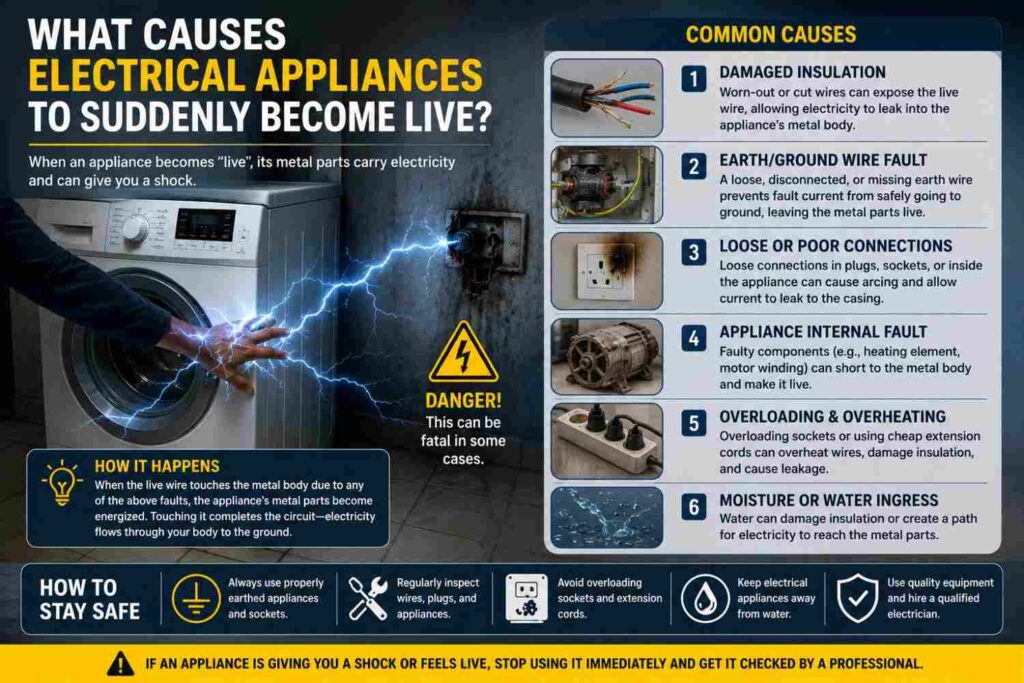
This article explains the underlying causes of this specific and genuinely dangerous phenomenon, why it happens suddenly rather than gradually in many cases, and what protective measures actually prevent it from becoming a shock hazard.
What “Becoming Live” Actually Means
An appliance’s exposed metal parts, its casing, housing, or other touchable components, are never supposed to carry voltage under normal operation. When we say an appliance has “become live,” it means a fault has created an unintended electrical connection between a live (voltage-carrying) conductor inside the appliance and these exposed parts, turning something meant to be safe to touch into something carrying dangerous voltage, closely related to the shock scenario discussed in our dedicated small shock article.
Why This Often Seems to Happen “Suddenly”
While the underlying insulation breakdown or wiring damage causing this fault often develops gradually, sometimes over months or years of wear, vibration, heat cycling, or moisture exposure, the moment it actually results in a completed fault path to the casing can feel sudden and unpredictable, since it depends on the exact point at which degraded insulation finally fails completely, or when moisture finally bridges a previously safe gap. This is part of why an appliance can seem to work perfectly for years and then, seemingly overnight, develop this serious fault.
Common Underlying Causes
- Insulation breakdown on internal wiring, from age, heat, or physical wear, eventually allowing a live conductor to contact the casing
- Water or moisture ingress, particularly relevant for washing machines, and appliances used or stored in humid conditions
- Physical damage to the appliance or its power cord, including from impacts, being crushed, or pest damage (rodents chewing through cord insulation is a genuinely common cause in many households)
- Manufacturing defects, present from the start but only manifesting once a specific stress or condition triggers the fault
- Component failure within the appliance, such as a failing heating element or motor winding breaking down internally
Why Proper Earthing and RCD Protection Are the Real Safety Net
The genuinely critical point to understand is that appliances becoming live due to internal faults is not entirely preventable through appliance design and maintenance alone; some degree of eventual component failure is a normal part of any appliance’s lifecycle. What prevents this from becoming a shock or fatality is the protective system around it: a properly connected earth wire providing a path for fault current, combined with a functioning RCD or RCBO that detects this fault current and disconnects power within milliseconds, well before a dangerous voltage can persist long enough to harm anyone touching the appliance.
Why Some Homes Are More at Risk Than Others
| Risk Factor | Why It Matters |
|---|---|
| Missing or poor earthing | No safe path for fault current to trigger protection |
| No RCD/RCBO protection on sockets | Fault current may not trip fast enough to prevent shock |
| Older appliances nearing end of life | Higher likelihood of internal insulation breakdown |
| Appliances used in wet areas | Elevated risk of moisture-related insulation failure |
| Informal or DIY appliance repairs | Risk of improper reassembly compromising internal insulation |
What to Do If You Suspect an Appliance Has Become Live
- Avoid touching the appliance, especially with wet hands or while standing on a wet or bare concrete floor.
- If safe to do so without touching the appliance itself, switch off and unplug it, or switch off the circuit at the distribution board.
- Do not attempt to use the appliance again until it has been properly tested and, if necessary, repaired by a qualified technician.
- Have the circuit’s earthing and RCD/RCBO protection checked by an electrician if you’re not confident it’s adequate, since this is the protective layer that should have prevented the fault from being dangerous in the first place.
The Importance of Not “Just Living With It”
Some households, upon discovering an appliance gives a mild shock or tingle, respond by simply being more careful, avoiding touching it while wet, or unplugging it when not needed, rather than addressing the fault directly. This approach is genuinely risky, since it relies on consistent, perfect caution from every person who might interact with the appliance, including guests, children, or household members who may not know about the issue, none of whom can be relied upon to remember a specific hazard every single time.
How Often Should Appliance Earthing Actually Be Checked?
Unlike bulbs or extension boxes, which announce their problems fairly visibly, a compromised earth connection on an appliance or its supply socket can remain completely invisible until the exact moment a live fault occurs, which is precisely why periodic, proactive testing matters rather than waiting for symptoms. Many electricians recommend a basic earth continuity and RCD function check as part of routine electrical maintenance, roughly every few years for an average home, more frequently for older properties or those with a history of electrical issues. This kind of periodic check is inexpensive relative to the risk it addresses and is one of the more valuable, if easily overlooked, items on a general home electrical maintenance checklist.
Why Double-Insulated Appliances Are a Different Case
Appliances marked with the double-insulated symbol (a square within a square) are specifically designed without a reliance on earthing for safety, instead using two independent layers of insulation between internal live components and any externally touchable part, meaning there is no exposed conductive casing for a live fault to reach in the first place. This doesn’t make such appliances completely immune to every possible fault, but it does mean the specific “casing becomes live” scenario discussed throughout this article is a fundamentally different, generally lower risk for double-insulated appliances compared to those relying on earthing as their primary protective mechanism, an important distinction when assessing relative risk across different appliances in your home.
The Difference Between a Nuisance Trip and a Genuine Save
Homeowners sometimes view an RCD tripping as an annoyance, especially if it happens during appliance use and interrupts whatever was being done at the time, and are tempted to simply reset it repeatedly without investigating further. It’s worth reframing this: every genuine RCD trip in response to an earth fault is the protective system working exactly as intended, catching a dangerous condition before it becomes a shock. Repeatedly resetting without investigating the cause defeats the entire purpose of having the protection in the first place, turning a system designed to prevent injury into, at best, a delay before the same dangerous fault eventually causes harm through some other path or moment of inattention.
Appliance Maintenance Habits That Reduce This Risk Over Time
While no amount of maintenance eliminates the possibility of an appliance eventually developing an internal fault, a few consistent habits meaningfully reduce the odds and catch problems earlier: periodically inspecting power cords for visible wear, cracking or damage, avoiding appliances that have been dropped, crushed, or exposed to significant water damage without a proper inspection first, and retiring appliances that are visibly aging or have a history of minor issues rather than continuing to push them toward eventual failure. These habits don’t replace the protective role of earthing and RCD protection but work alongside it as an additional, sensible layer of risk reduction.
What to Tell an Electrician When Reporting This Kind of Fault
When calling an electrician about a suspected live appliance, providing specific details speeds up their assessment considerably: which appliance was involved, whether the sensation was a shock, tingle, or buzzing feeling, whether it happened once or repeatedly, and whether you know if that circuit has RCD protection already. This level of detail, rather than a general “something felt off with my appliance,” helps the electrician arrive prepared with the likely tools and tests needed rather than starting the diagnostic process from a completely blank slate.
Common Misconceptions
- “New appliances can’t develop this fault.” Manufacturing defects and physical damage can affect appliances of any age, though the risk does generally increase with age and wear.
- “If I don’t feel a shock, the appliance isn’t live.” A live casing might not always produce a noticeable shock depending on the specific contact conditions and current path, meaning the absence of a felt shock doesn’t guarantee safety.
- “This only happens with cheap or poor-quality appliances.” While build quality matters, any appliance can eventually develop this kind of fault given enough time, wear, or an unlucky manufacturing defect.
Frequently Asked Questions
Can a live appliance be safely repaired, or should it always be replaced?
Many such faults can be properly repaired by a qualified technician, particularly if caught early and the underlying cause (a specific wire, component or seal) is identified and correctly fixed; the appliance should be properly tested afterward before returning to use.
Does this risk apply equally to all appliance types?
Appliances with metal casings and higher power draw, such as washing machines, refrigerators and water heaters, are more commonly involved than smaller plastic-cased electronics, though the underlying fault mechanism can technically affect any appliance with exposed conductive parts.
How can I proactively reduce this risk in my home?
Ensure proper earthing throughout your property, install RCD/RCBO protection on socket circuits if not already present, and retire aging appliances showing any signs of wear rather than continuing to use them indefinitely.
Final Thoughts
Appliances becoming live is a genuinely serious fault category, but it is also one that a properly designed and protected electrical system is specifically built to catch and neutralize before it causes harm. Understanding this reinforces why proper earthing and RCD protection are not optional extras but fundamental, non-negotiable safety infrastructure for every home, regardless of how new, well-maintained, or seemingly reliable your appliances are.