
Few household electrical frustrations are as persistent as light bulbs that seem to burn out far sooner than they should, sometimes within weeks of installation. While an occasional early failure can simply be bad luck, a consistent pattern across multiple bulbs points to an underlying electrical cause worth understanding and addressing.
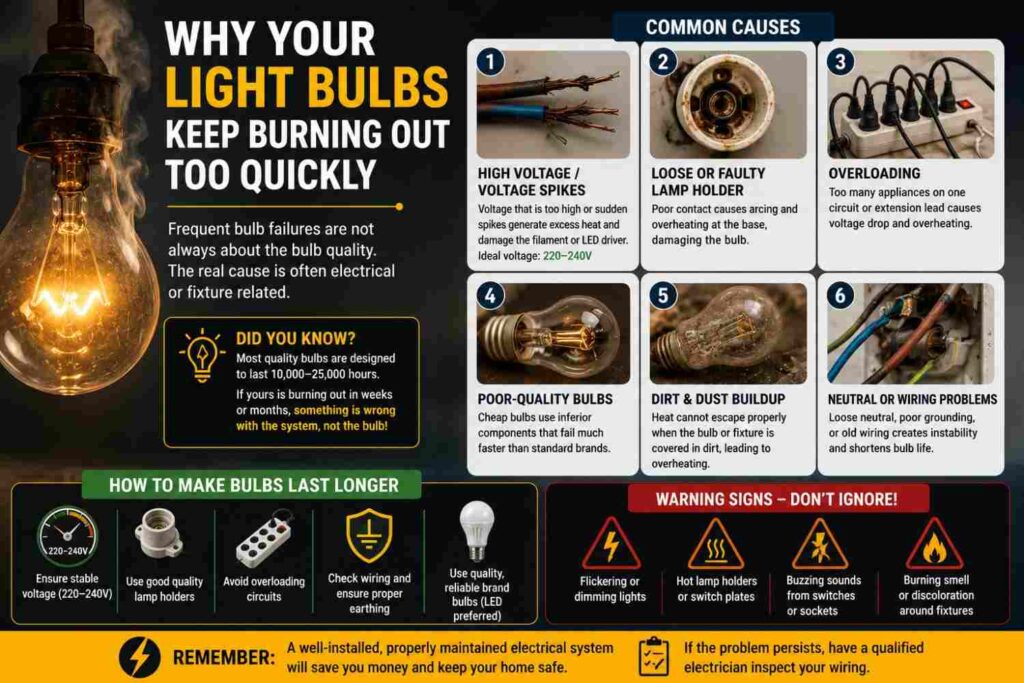
This article walks through the most common reasons bulbs fail prematurely and what can be done about each one.
How Long Should a Bulb Actually Last?
Modern LED bulbs are typically rated for 15,000 to 25,000 hours or more of use, translating to many years of normal household use, while older incandescent bulbs were rated much lower, often around 1,000 hours. If bulbs are failing well short of their rated lifespan, particularly if this happens repeatedly across multiple bulbs and fixtures, something beyond simple bad luck is likely at play.
1. Overvoltage or Voltage Fluctuations
Bulbs are designed to operate within a specific voltage range, and sustained or repeated overvoltage significantly shortens their lifespan by stressing the filament (incandescent) or internal driver electronics (LED) beyond their design tolerance. Nigeria’s grid, while generally supplying a nominal 230V, can experience voltage fluctuations depending on location, time of day, and local grid conditions, and homes on the higher end of these fluctuations, or those experiencing occasional voltage spikes, often see noticeably shorter bulb lifespans as a direct consequence.
2. Poor Quality or Loose Fixture Connections
A loose bulb socket connection, similar in principle to the loose socket connections discussed in our dedicated wall socket heating article, can cause intermittent poor contact, arcing, and localized heat that damages a bulb’s base or internal components well before its rated lifespan is reached.
3. Excessive Heat Buildup in the Fixture
Enclosed fixtures, particularly those without adequate ventilation, trap heat around the bulb, and since heat is one of the primary factors that degrades both LED driver electronics and incandescent filaments over time, poorly ventilated fixtures are a common, often overlooked cause of premature bulb failure, especially for higher-wattage bulbs installed in fully enclosed fittings not designed for them.
4. Frequent Switching On and Off
Both incandescent and, to a lesser extent, LED bulbs experience additional stress each time they are switched on, due to the brief current surge (inrush current) that occurs at power-up. Fixtures switched on and off very frequently, such as those on motion sensors triggered often, can experience accelerated wear compared to fixtures left on for longer, steady periods.
5. Poor Quality Bulbs
Not all bulbs are manufactured to the same standard, even within the same wattage and type category. Substandard bulbs, sometimes using inferior driver electronics (in the case of LEDs) or lower-quality filament and internal components (in the case of incandescent and halogen bulbs), can fail well short of their advertised rated lifespan even under otherwise normal conditions.
6. Vibration
Bulbs installed in locations subject to regular vibration, such as near doors that slam frequently, ceiling fans, or garage door mechanisms, can experience mechanical stress that shortens lifespan, particularly for incandescent and halogen bulbs with more delicate internal filament structures.
7. Incompatible Dimmer Switches
LED bulbs require dimmer switches specifically designed for LED compatibility; using an LED bulb with an older dimmer designed for incandescent bulbs can cause flickering, buzzing, and significantly reduced LED lifespan, since the dimming technology and the bulb’s internal driver electronics are not properly matched.
A Practical Diagnostic Table
| Pattern Observed | Likely Cause |
|---|---|
| Bulbs fail across many different fixtures | Voltage issue (overvoltage or fluctuation) |
| Only bulbs in one specific fixture fail repeatedly | Loose connection or poor ventilation in that fixture |
| Bulbs fail specifically in enclosed fittings | Heat buildup |
| Bulbs fail specifically on a dimmer circuit | Dimmer incompatibility |
| Failures are inconsistent, no clear pattern | Possibly bulb quality; try a different brand |
How to Test for a Voltage Problem
If you suspect overvoltage is contributing to premature bulb failures across multiple fixtures, a qualified electrician can measure your supply voltage at different times of day using a multimeter to check whether it consistently runs high or experiences significant fluctuation. Sustained readings meaningfully above 240V, or frequent spikes, may indicate a grid-side issue worth reporting to your DisCo, or may suggest installing a voltage stabilizer to protect sensitive equipment and lighting throughout your home.
When to Involve an Electrician
While occasional individual bulb failures are normal and not worth investigating, a consistent pattern of premature failures, especially across multiple fixtures or accompanied by other symptoms like flickering (covered in our dedicated flickering lights article) or warm sockets, warrants a proper electrical assessment rather than simply continuing to replace bulbs repeatedly without addressing the underlying cause.
How Voltage Fluctuations Specifically Shorten Bulb Life
Incandescent and halogen bulbs are especially sensitive to overvoltage because their light output and heat generation both rise dramatically, roughly with the fourth power of voltage, meaning even a modest 10% overvoltage can noticeably shorten filament life. LED bulbs behave differently: their driver circuitry regulates current, but a cheap or poorly designed LED driver can still fail prematurely under repeated voltage spikes or sustained overvoltage, since the driver’s internal components have their own voltage tolerance limits, just like any other electronic circuit board. This is part of why bulb quality matters as much as electrical supply quality when diagnosing recurring failures, since a well-built driver can absorb minor fluctuations that would destroy a cheaper one.
The Role of Generator and Inverter Switching in Bulb Failures
Homes that regularly switch between grid power, generator power, and inverter power expose their bulbs to an additional stress: the brief voltage transient that can occur at the moment of switchover, particularly with older or poorly maintained generators, or automatic transfer switches that don’t cleanly break before making the new connection. A generator running at an incorrect frequency or voltage setting, common with poorly serviced units, can also deliver sustained overvoltage to every bulb in the house for as long as it’s running, quietly shortening their lifespan well before any obvious fault is noticed. If your bulbs seem to fail more often during periods of heavy generator use compared to periods of stable grid supply, this pattern itself is a useful diagnostic clue worth mentioning to an electrician.
How to Test Whether Overvoltage Is Actually the Cause
Rather than guessing, a multimeter reading taken at a socket near the affected fitting, ideally at different times of day and under different supply conditions (grid, generator, inverter), can confirm whether voltage is consistently running high. Standard Nigerian residential supply should sit close to 230V, and a sustained reading meaningfully above this, especially anything above roughly 240-250V, is worth flagging to your DisCo or investigating further with a qualified electrician, since it affects not just bulbs but every piece of connected electronic equipment in the home.
Comparing Bulb Types and Their Real-World Failure Patterns
Not every bulb technology fails the same way under the same stress, and understanding these differences helps set realistic expectations. Incandescent bulbs fail almost entirely through filament degradation and eventual breakage, a purely mechanical and thermal process with a fairly predictable relationship to voltage and switching frequency. CFL bulbs sit in between, with both a filament-like element and electronic ballast components that can each fail independently, sometimes producing a bulb that flickers or dims before failing completely rather than simply going dark. LED bulbs, despite their reputation for longevity, concentrate their vulnerability almost entirely in the driver electronics, meaning a household with a genuine voltage problem may see LED bulbs fail in clusters around the same general timeframe, since the same underlying electrical stress is acting on similar components across every fitting simultaneously, a pattern less common with incandescent bulbs where failures tend to be more randomly distributed over time.
Building Good Habits Around Bulb Purchases and Fixtures
Beyond addressing any specific electrical fault, a few consistent habits meaningfully reduce premature bulb failure over the long run: buying from established, reputable brands rather than the cheapest unbranded option available, matching bulb wattage to what a fixture is actually rated for rather than assuming higher is always fine, and periodically checking that bulb bases are seated firmly and fixtures show no signs of heat damage or looseness. None of these habits require an electrician’s involvement, and together they address several of the most common non-electrical contributors to short bulb life discussed throughout this article.
Common Misconceptions
- “LED bulbs never fail early since they last so long.” LEDs are more resistant to some failure modes than incandescent bulbs but remain vulnerable to overvoltage, heat and dimmer incompatibility.
- “Bulb failure is always just random bad luck.” A consistent pattern across multiple bulbs and fixtures usually points to an identifiable underlying cause rather than pure chance.
- “Buying the cheapest bulbs available is fine since they’re replaceable anyway.” Frequent replacement of low-quality bulbs often costs more over time than investing in quality bulbs, beyond the inconvenience of frequent replacement itself.
Frequently Asked Questions
Can a generator or inverter cause bulbs to fail faster?
Poorly regulated or unstable generator output, or a modified sine wave inverter output (discussed in our dedicated pure vs modified sine wave article) can, in some cases, contribute to premature bulb and electronics wear compared to clean, stable grid or pure sine wave inverter power.
Should I switch to LED bulbs if I’m having frequent incandescent failures?
LED bulbs generally offer better energy efficiency and longer rated lifespan, though switching alone won’t resolve an underlying voltage or connection issue if one is present.
Is it worth having my home’s voltage checked if bulbs keep failing?
Yes, particularly if failures are widespread across multiple fixtures, since a genuine voltage issue affects far more than just your lighting and is worth identifying and addressing.
Final Thoughts
Premature bulb failure is rarely just bad luck when it happens repeatedly; it is usually a signal worth investigating, whether the cause turns out to be a voltage issue, a fixture problem, or simply bulb quality. Paying attention to the pattern of failures, rather than treating each one in isolation, is the key to diagnosing and resolving the underlying issue rather than continuing an expensive, frustrating cycle of frequent replacement.