
Electrical fires are rarely the result of a single dramatic failure; far more often, they are the endpoint of small, seemingly minor wiring mistakes that accumulate and compound over time.
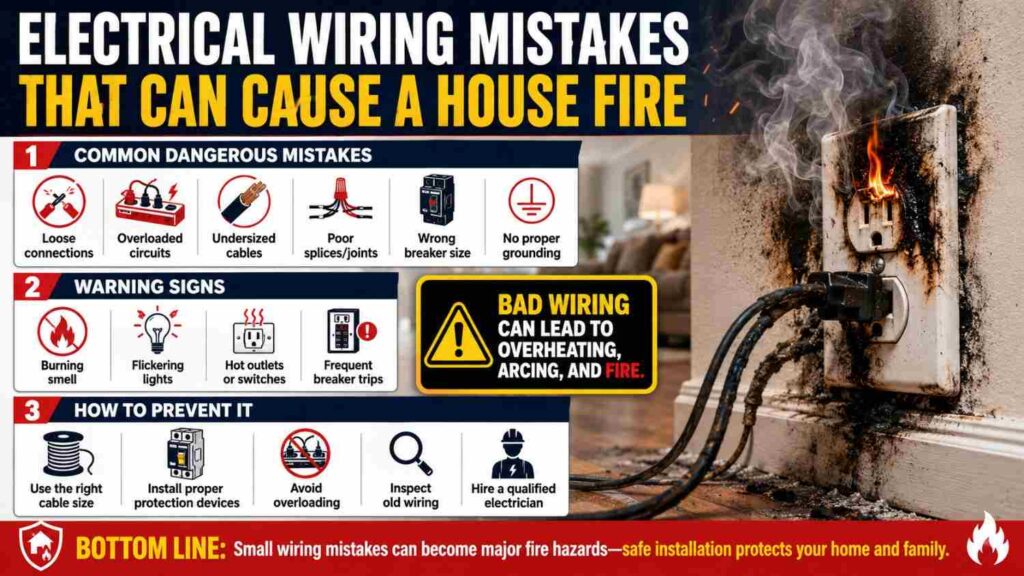
This article brings together the most common electrical wiring mistakes that contribute to house fires, drawing on the specific hazards covered throughout our wiring and safety articles, into one practical, actionable reference.
1. Undersized Cable for the Connected Load
As covered in detail in our dedicated cable sizing article, using cable too small for the current it carries causes chronic overheating, gradually degrading insulation until a fault, arc or fire eventually results. This remains one of the single most consequential wiring mistakes, whether from informal wiring work, cost-cutting during installation, or simply adding new high-power appliances to circuits never designed for the additional load.
2. Overloading Circuits and Sockets
Connecting more appliances to a circuit or socket than it was designed to carry, often through daisy-chained extension cords and “octopus” multi-plug adapters, generates excess heat throughout the affected wiring and connections, discussed extensively in our circuit overload article.
3. Loose or Poor-Quality Connections
Loose terminal screws, poor-quality sockets and switches, and improperly made joints concentrate resistance, and therefore heat, at specific points rather than distributing it safely along a cable’s length, a common root cause behind hot sockets and melted plugs covered in our dedicated articles on those specific symptoms.
4. Missing or Faulty Earthing
Without a properly functioning earth connection, a fault that causes an appliance’s metal casing to become live has no automatic mechanism to trigger a protective trip, leaving a serious shock hazard in place, as explained in our live, neutral and earth article. While this specific failure mode relates more directly to shock risk than fire risk, faults that go undetected due to inadequate earthing can also develop into more serious electrical faults over time.
5. Bypassing or Incorrectly Rating Protective Devices
Installing a breaker or fuse rated higher than the cable it protects, or otherwise defeating protective devices to “stop nuisance tripping,” removes the safety margin the entire circuit design relies on, allowing dangerous conditions to persist without the automatic disconnection that would otherwise occur.
6. DIY Electrical Work Beyond One’s Competence
Informal or unlicensed electrical work, whether from a well-meaning homeowner or an inadequately trained installer, is a significant contributing factor behind many of the specific mistakes on this list, since proper cable sizing, connection technique, earthing and protective device selection all require genuine technical knowledge to get right consistently.
7. Ignoring Early Warning Signs
Warm sockets, flickering lights, burning smells, and breakers that trip repeatedly are all warning signs discussed throughout our wiring safety articles, and ignoring or working around them, rather than investigating and addressing the underlying cause, allows developing problems to progress toward a genuinely dangerous outcome.
8. Improper Extension Cord Use
Using extension cords as a permanent wiring solution rather than a temporary one, running them under carpets or through doorways where they can be damaged, or using cords rated for light duty with heavy appliances, all introduce heating and physical damage risks beyond what a properly installed, permanent wiring solution would present.
9. Improper Backup Power Connections
Connecting a generator directly to household wiring without a proper changeover switch, discussed in our dedicated changeover switch article, creates serious backfeeding hazards and can also stress household wiring in ways it was not designed to handle, particularly if voltage or frequency from an improperly maintained generator fluctuates significantly.
10. Water Exposure Without Proper Protection
Sockets and wiring in bathrooms, kitchens, and outdoor areas without appropriate RCD protection and correctly rated, water-resistant fittings create elevated shock and fault risk in precisely the areas where water exposure is most likely, a gap addressed by proper RCD/RCBO protection as covered in our dedicated article on that topic.
A Quick Self-Assessment Checklist
| Check | Why It Matters |
|---|---|
| Any sockets, switches or extension cords feel warm? | Early sign of overload or poor connection |
| Breakers tripping repeatedly? | Indicates overload or developing fault |
| Any burning smells near electrical fittings? | Urgent warning sign, act immediately |
| Multiple high-power appliances on one extension board? | Overload risk |
| Generator connected without a proper changeover switch? | Serious backfeeding and safety hazard |
| Home wiring more than 15-20 years old with no recent inspection? | Worth a professional assessment |
Why These Mistakes Often Compound Each Other
It is worth emphasizing that electrical fires rarely result from a single isolated mistake; more often, several factors combine, undersized cable plus an overloaded circuit plus a bypassed protective device, for example, each individually concerning but together substantially more dangerous than any one factor alone. This is part of why a holistic professional inspection, rather than addressing symptoms individually as they appear, is genuinely valuable for older properties or those with an uncertain electrical work history.
11. Concealing Wiring Faults Behind Cosmetic Fixes
Painting over a discolored socket, replacing a faceplate without investigating why it discolored in the first place, or simply relocating an appliance away from a “problem” socket without addressing the underlying issue, are all forms of treating a symptom while leaving the actual electrical fault in place, often allowing it to continue developing unseen behind a fresh, normal-looking surface.
12. Using the Wrong Cable or Accessories for Outdoor and Wet Locations
Standard indoor-rated cable, sockets and fittings are not designed to withstand moisture, UV exposure and temperature cycling the way properly rated outdoor equipment is; using indoor-rated components outdoors, whether for garden lighting, outdoor sockets, or generator connection points, accelerates insulation degradation and connection corrosion, both significant contributing factors to the kinds of faults that can lead to fire.
How to Use This List Practically
Rather than treating this as an abstract checklist, consider walking through your own home with this list in hand, room by room, noting anything that matches one of these twelve patterns, however minor it might seem in isolation. A single matching item might genuinely be low risk on its own, but two or three matching items in the same area of your home, an overloaded extension board feeding an aging socket that already feels slightly warm, for example, represent exactly the kind of compounding risk pattern discussed above, and are well worth a professional assessment before they develop further.
Common Misconceptions
- “Electrical fires only happen in old, poorly maintained buildings.” New installations with poor workmanship or substandard materials can be just as, or more, dangerous than older but properly maintained wiring.
- “If nothing has gone wrong yet, the wiring must be fine.” Many of the mistakes listed here develop gradually, with real risk building silently before any dramatic failure occurs.
- “A working smoke detector is enough protection against electrical fire risk.” Smoke detectors provide valuable early warning once a fire has started, but preventing the fire from starting in the first place, through good wiring practice, remains far preferable.
Building a Culture of Electrical Safety at Home
Beyond addressing specific technical mistakes, meaningfully reducing electrical fire risk over the long term benefits from a broader household culture that treats electrical safety as an ongoing responsibility rather than a one-time installation concern. This means having a trusted, qualified electrician’s contact readily available rather than searching for one only during an emergency, budgeting for periodic inspections as a normal part of home maintenance alongside things like plumbing and structural upkeep, and encouraging every household member, not just whoever handles “the technical stuff,” to recognize and report warning signs promptly. Households that adopt this mindset consistently tend to catch and address the kinds of small, compounding mistakes covered in this article long before they progress toward a genuinely dangerous outcome, turning electrical safety from a source of anxiety into a routine, manageable part of responsible home ownership.
Frequently Asked Questions
How often should home wiring be professionally inspected?
General guidance suggests every few years for typical homes, or sooner following any significant renovation, new major appliance addition, or observed warning signs; older properties or those with an uncertain wiring history benefit from more frequent checks.
What’s the single most important step I can take to reduce fire risk?
Responding promptly to warning signs, warmth, smells, repeated tripping, rather than ignoring or working around them, combined with having a qualified electrician handle any new wiring work or modifications, addresses the majority of the risk factors covered in this article.
Are electrical fires more common with certain appliances?
High-power appliances, particularly those with heating elements like kettles, irons and space heaters, are disproportionately involved in electrical fire incidents, simply because they draw more current and therefore amplify the consequences of any underlying wiring weakness.
Final Thoughts
Nearly every electrical fire traces back to one or more of the wiring mistakes covered in this article, which means nearly every electrical fire is, in principle, preventable through proper installation, prompt attention to warning signs, and periodic professional inspection. Treating your home’s electrical system with the same seriousness you would apply to structural safety, rather than an invisible, out-of-sight utility, is the mindset shift that meaningfully reduces this genuinely significant but genuinely preventable risk.