
Power surges are a genuine and often underestimated threat to household electronics, and nowhere is this more relevant than in regions with less stable grid power, frequent switching between grid, generator and inverter sources, and periodic lightning activity.
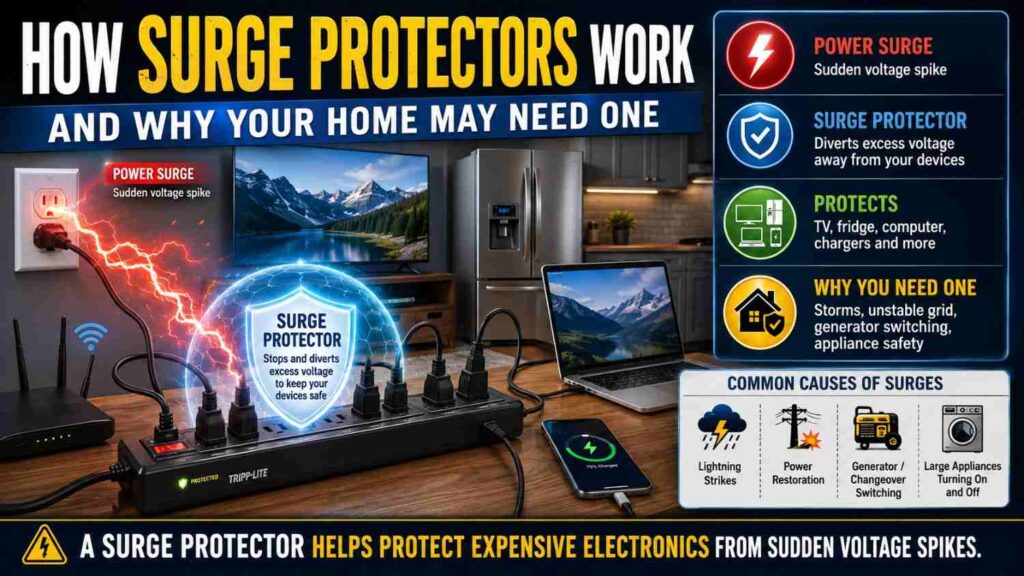
This article explains what a surge protector actually does, how it differs from a simple extension board with an on/off switch, and why your home may benefit from one, or several, depending on your equipment and power situation.
What Is a Power Surge?
A power surge is a brief, sudden increase in voltage significantly above the normal supply level, lasting anywhere from a fraction of a second to a few seconds. Surges can range from relatively mild, caused by large appliances switching on or off elsewhere on the same circuit or nearby grid, to severe, caused by lightning strikes or major grid switching events, capable of instantly destroying sensitive electronic components.
How a Surge Protector Actually Works
Most surge protectors use a component called a metal oxide varistor (MOV), which behaves like a voltage-sensitive switch: under normal voltage conditions, it presents very high resistance and has no effect on the circuit, but when voltage spikes above a certain threshold, the MOV’s resistance drops dramatically, diverting the excess voltage safely away from your connected equipment, typically to the earth conductor, before it can reach and damage sensitive electronics. This entire process happens in a fraction of a second, fast enough to intercept most surge events before they reach connected devices.
Surge Protector vs Simple Extension Board
A common point of confusion is that many surge-protected power strips look nearly identical to ordinary extension boards, but the difference lies entirely in the internal protective components. A simple extension board with just a switch and sockets provides no protection against voltage spikes at all; it simply distributes the incoming supply, spikes and all, to whatever is plugged into it. Only a board specifically labeled and rated as a surge protector includes the internal MOV or equivalent protective circuitry, so checking the specific rating and labeling matters more than visual similarity when purchasing.
Why Surges Are a Particular Concern in Nigeria
Several factors make surge protection especially relevant in the Nigerian context: frequent switching between grid power, generator and inverter sources can introduce switching transients, particularly with informal or improperly designed changeover arrangements; grid voltage stability varies across different areas and DisCo networks; and lightning activity, significant in many parts of the country during rainy seasons, poses a real risk to both grid-connected and, in some cases, generator and solar installations. Combined, these factors make surge protection a genuinely practical, worthwhile investment for protecting sensitive and often expensive electronics like televisions, computers, routers and modern appliances with electronic control boards.
What Surge Protectors Can and Cannot Protect Against
| Scenario | Surge Protector Helps? |
|---|---|
| Minor voltage spikes from appliance switching | Yes, effectively |
| Moderate grid switching transients | Yes, generally effective |
| Direct or very close lightning strike | Limited; may not fully protect against extreme surges |
| Sustained overvoltage (not a brief spike) | No; a voltage stabilizer is needed for this instead |
| Undervoltage / brownout conditions | No; surge protectors don’t address low voltage |
This distinction matters: a surge protector is not the same device as a voltage stabilizer (AVR), which addresses sustained voltage fluctuations rather than brief spikes, and many sensitive installations benefit from both types of protection working together.
Types of Surge Protection
- Point-of-use surge protectors: Power strips or single-outlet devices installed where equipment plugs in, protecting individual devices or small groups of devices.
- Whole-house / main panel surge protectors: Installed at the main distribution board, providing a first line of defense for the entire property against surges entering from the grid or generator supply.
- Combined approach: Many professionals recommend layered protection, a main panel surge protector as a first line of defense, combined with point-of-use protectors for particularly sensitive or expensive equipment.
Key Specifications to Look For
When choosing a surge protector, several specifications indicate its actual protective capability, beyond simply having “surge protector” printed on the packaging:
- Joule rating: Indicates how much surge energy the device can absorb before needing replacement; higher joule ratings generally indicate greater protective capacity and, often, longer effective lifespan.
- Response time: How quickly the device reacts to a detected surge; faster is better, though most quality surge protectors respond quickly enough for typical household needs.
- Clamping voltage: The voltage level at which the device begins diverting excess voltage; lower clamping voltage generally means more sensitive, protective performance.
Surge Protectors Wear Out Over Time
An important and often overlooked fact is that surge protectors do not last forever; the MOV component gradually degrades with each surge event it absorbs, eventually losing its protective capability even though the device may still function as an ordinary power strip with no visible indication that protection has been lost. Many quality surge protectors include an indicator light showing whether protection is still active, and replacing surge protectors periodically, particularly after any known significant surge event or lightning activity nearby, is a worthwhile precaution rather than assuming a surge protector purchased years ago is still providing meaningful protection.
Surge Protection and Sensitive Modern Electronics
Modern homes contain a growing number of devices with sensitive electronic control boards, smart televisions, routers, inverters themselves, modern refrigerators with electronic controls, and countless other appliances, all of which are considerably more vulnerable to surge damage than the simpler, more robust electromechanical appliances of previous decades. A single significant surge event can potentially damage several such devices simultaneously if they share an unprotected circuit, turning what might have once been a minor, inconvenient blown fuse into a costly multi-appliance repair or replacement bill. This growing concentration of sensitive electronics in the average home is part of why surge protection has shifted from a niche precaution to an increasingly mainstream recommendation for any household with meaningful investment in modern appliances and electronics.
Surge Protection for Solar and Inverter Systems Specifically
Solar and inverter systems introduce their own specific surge vulnerabilities worth considering separately from general household electronics. Solar panel installations, often mounted outdoors and connected via longer cable runs, can be particularly exposed to surges induced by nearby lightning activity, even without a direct strike, since a lightning strike’s electromagnetic field can induce damaging voltage spikes in extended cable runs without any direct contact at all. Many quality solar charge controllers and inverters include some built-in surge protection, but dedicated DC-side surge protection devices, installed between the solar panels and the charge controller, are increasingly recommended for larger installations specifically because of this elevated exposure, an detail worth discussing with your solar installer particularly for systems with panels mounted in exposed, elevated locations like rooftops.
Common Misconceptions
- “Any power strip with a switch is a surge protector.” Only devices specifically designed and rated with surge-suppressing components provide actual protection; a plain extension board does not.
- “A surge protector protects against all power problems.” Surge protectors address brief voltage spikes specifically; sustained overvoltage, undervoltage and frequency issues require different protective equipment.
- “Once purchased, a surge protector protects indefinitely.” The protective components degrade with use and should be periodically checked or replaced, particularly after significant surge events.
Installing a Whole-House Surge Protector: What’s Involved
A whole-house or main panel surge protector is typically installed directly at the distribution board by a qualified electrician, connected across the incoming supply to intercept surges before they can propagate through the building’s internal wiring to individual circuits and appliances. Installation involves selecting a device appropriately rated for the property’s incoming supply characteristics, ensuring a suitably short, low-impedance earth connection (since the device’s effectiveness depends partly on how quickly and cleanly it can divert surge energy to earth), and integrating it correctly alongside existing protective devices like MCBs and RCDs. Because this work involves the main distribution board and correct earthing considerations specific to surge protection, it is not a task suited to DIY installation, and is best planned in consultation with an electrician who can assess your property’s specific supply characteristics and protection needs.
Frequently Asked Questions
Do I need a surge protector if I already use a voltage stabilizer or AVR?
Yes, ideally both, since they protect against different types of power quality issues; a stabilizer addresses sustained voltage fluctuations while a surge protector addresses brief, sharp voltage spikes.
Can a surge protector protect equipment during a direct lightning strike?
Standard surge protectors offer limited protection against a very close or direct lightning strike, which can involve energy levels far beyond what typical consumer surge protectors are designed to absorb; disconnecting sensitive equipment during severe storms remains a sensible additional precaution.
Is whole-house surge protection worth the investment?
For homes with significant investment in electronics and appliances, or frequent exposure to grid switching and lightning activity, whole-house protection combined with point-of-use protection for critical devices is generally considered a worthwhile investment relative to the potential replacement cost of damaged electronics.
How do I know if my surge protector still works?
Check for a built-in protection indicator light if your model has one; otherwise, periodic replacement, particularly after known surge events, is the safest approach since degraded protection is not otherwise visibly obvious.
Practical Buying Guidance
When shopping for surge protection, resist the temptation to choose based purely on price or the number of outlets offered; instead, look specifically for the joule rating, warranty terms (many quality manufacturers offer connected-equipment warranties, a strong signal of manufacturer confidence in their product’s protective performance), and clear labeling indicating genuine surge suppression circuitry rather than a plain power strip marketed loosely as a “protector.” For whole-house protection, consulting a qualified electrician familiar with your specific distribution board and local grid conditions ensures the device is correctly matched and properly installed, since incorrect installation can compromise even a genuinely high-quality surge protection device’s effectiveness.
Final Thoughts
Surge protectors offer a genuinely valuable, relatively inexpensive layer of defense for sensitive electronics against the brief but potentially damaging voltage spikes that occur more often than most people realize, particularly in environments with variable grid stability and frequent power source switching. Understanding what they actually protect against, and what they don’t, helps you build a more complete, appropriately layered protection strategy for your home’s valuable electronic equipment.