
“How many sockets can I put on one circuit?” is a question that sounds like it should have a simple numeric answer, but the honest answer is: it depends on what you actually plan to plug into them, not merely how many sockets exist.
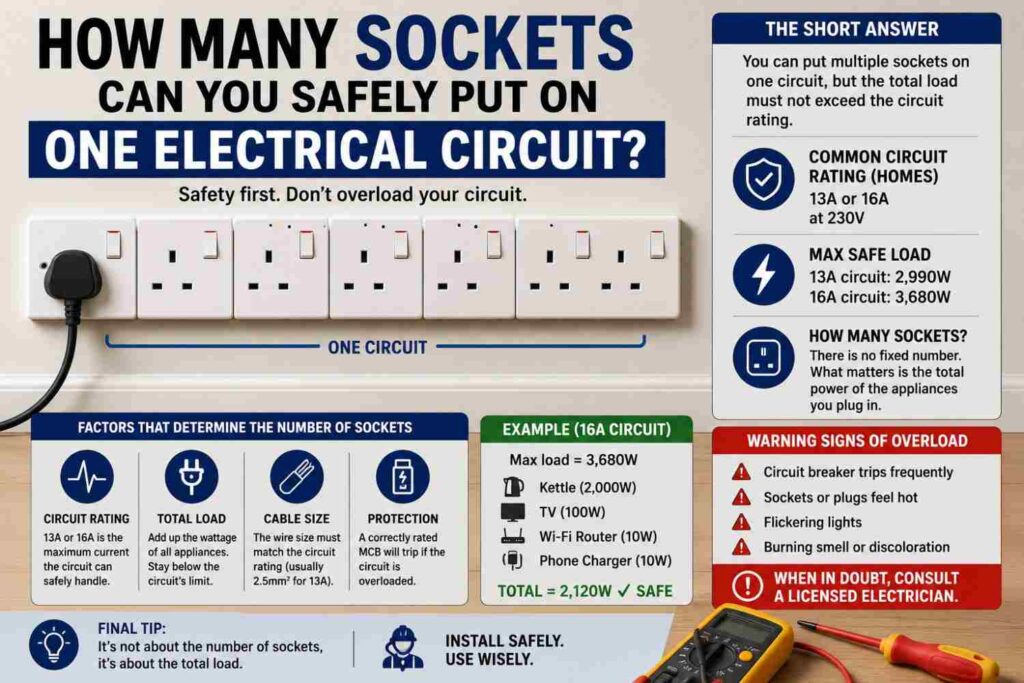
This article explains the real logic behind socket circuit limits, why the number of sockets themselves is almost never the limiting factor, and how to think about distributing sockets and appliances safely across your home’s circuits.
The Core Principle: It’s About Load, Not Socket Count
A common misconception is that electrical codes specify a maximum number of physical sockets per circuit. In reality, most standards do not strictly limit the number of sockets on a general-purpose circuit; instead, they limit the total current (and therefore total connected load) that circuit can safely carry, determined by its cable size and protective device rating, as covered in our dedicated cable sizing article. A circuit could technically have a dozen sockets and be perfectly safe if the combined load of everything plugged in and switched on at once stays within the circuit’s rated capacity, or it could have just three sockets and be dangerously overloaded if all three feed high-power appliances simultaneously.
Calculating Safe Load for a Circuit
To determine how much you can safely connect to a given circuit, you need to know the circuit’s rated current (typically found on its breaker, commonly 15A, 20A or 32A for general socket circuits in many installations) and calculate total wattage using P = V × I. For a 20A circuit at 230V, for example, the maximum safe continuous load is approximately 20 × 230 = 4,600W. This is the ceiling for everything running simultaneously on that circuit, not per individual socket.
Why This Matters More Than Socket Count
Consider two scenarios on the same 20A circuit: in the first, five sockets each power a phone charger (roughly 10W each), totaling just 50W, using a tiny fraction of the circuit’s capacity. In the second, just two sockets power a 2kW electric kettle and a 1.8kW iron simultaneously, totaling 3,800W, already approaching the circuit’s 4,600W limit despite using far fewer sockets. This illustrates clearly why socket count alone tells you almost nothing useful about whether a circuit is safely loaded.
Practical Guidelines for Distributing Sockets and Appliances
- Group similar, lower-power devices together on shared general-purpose circuits: lighting, phone chargers, televisions, laptops and similar low-current electronics.
- Give high-power fixed appliances their own dedicated circuits: water heaters, air conditioners, electric cookers and similar heavy loads should generally not share a circuit with general-purpose sockets.
- Consider realistic simultaneous use, not just theoretical maximum: a kitchen circuit should account for the realistic likelihood of a kettle, toaster and microwave all being used around the same time, even if not always at the exact same second.
- Plan for future load growth: circuits designed with some spare capacity accommodate new appliances more gracefully than circuits designed to their absolute calculated limit from day one.
Why “Octopus” Multi-Plug Adapters Are Risky
Multi-plug adapter blocks, sometimes informally called “octopus” adapters in Nigeria, allow many appliances to be connected to a single socket, but they do not increase that socket’s or circuit’s actual current-carrying capacity at all. Using one to connect several high-power appliances to a single socket can easily exceed both the adapter’s own rating and the underlying circuit’s safe capacity, concentrating significant heat generation at a single point, exactly the kind of scenario that contributes to the circuit overload risks discussed in our dedicated overload article, and a genuinely common contributing factor in Nigerian residential electrical fires.
Typical Circuit Ratings and Reasonable Load Guidelines
| Circuit Rating | Approx. Max Load (230V) | Typical Use |
|---|---|---|
| 15A | ~3,450W | General lighting and light sockets |
| 20A | ~4,600W | General-purpose socket circuits |
| 32A | ~7,360W | Kitchen, water heater or dedicated appliance circuits |
These figures represent the circuit’s rated ceiling; good practice generally avoids designing for continuous operation right at that maximum, leaving reasonable headroom for safety margin and future growth.
How Many Sockets Is “Reasonable” in Practice?
While there is no strict numerical limit on sockets themselves, practical electrical design guidance in most standards suggests a reasonable number of sockets per general-purpose circuit, often somewhere in the range of eight to twelve standard sockets for a typical 20A residential circuit, based on realistic assumptions about typical, non-simultaneous-maximum household use. This is a design guideline rather than a hard safety limit, since the actual determining factor remains total simultaneous load, but it reflects accumulated professional experience about what tends to work well in practice for typical usage patterns.
Special Considerations for Kitchens and High-Load Rooms
Kitchens deserve particular attention when planning socket and circuit distribution, since they concentrate an unusually high density of high-power appliances, kettles, microwaves, toasters, blenders and sometimes electric cookers, in a relatively small area. Many professional electrical designs deliberately split kitchen sockets across multiple circuits, or provide dedicated circuits for specific high-power fixed appliances, precisely because the realistic simultaneous load in a busy kitchen can be substantially higher than in other rooms with a similar number of sockets.
A Worked Example: Planning a Living Room Circuit
Consider a living room with a television (120W), a satellite/streaming box (30W), a games console (150W), two phone chargers (10W each), a standing fan (70W), and a small side-table lamp (15W) — realistically, most or all of which might run simultaneously during an evening. Adding these together gives a total of roughly 405W, a tiny fraction of even a modest 15A circuit’s ~3,450W capacity. This same living room, however, might also occasionally host a portable air conditioner unit (1,200W) or a vacuum cleaner (1,000W) used briefly; even including these occasional higher loads, total realistic simultaneous demand remains comfortably within a standard circuit’s capacity. This kind of realistic worked-through exercise, appliance by appliance, is exactly the thinking a competent electrician applies when planning socket and circuit layouts room by room, rather than relying on a generic sockets-per-circuit rule of thumb alone.
When to Split a Room Across Two Circuits
Certain rooms genuinely warrant splitting sockets across two or more circuits rather than relying on a single one, particularly kitchens (as discussed above), home offices with multiple computers and peripherals running continuously, and rooms with window-unit or portable air conditioners alongside other substantial loads. A useful practical heuristic is to add up the wattage of the two or three highest-power items likely to run simultaneously in a room, and if that total alone approaches 60-70% of a proposed circuit’s rated capacity, it is worth discussing a split or dedicated circuit design with your electrician rather than assuming a single standard circuit will comfortably suffice long-term.
Common Misconceptions
- “There’s a legal maximum number of sockets per circuit.” Most standards focus on load capacity rather than a strict socket count, though practical design guidelines exist based on typical usage patterns.
- “Adding an adapter effectively adds circuit capacity.” Adapters only add physical connection points; they do not increase the underlying circuit’s safe current-carrying capacity in any way.
- “If the breaker hasn’t tripped, the circuit isn’t overloaded.” Circuits can be chronically mildly overloaded without tripping every time, particularly with loads close to but not exceeding the breaker’s threshold, while still generating excess heat and wear over time.
Frequently Asked Questions
Is it safe to add more sockets to an existing circuit myself?
Adding sockets involves both the physical wiring work and a load assessment to ensure the circuit remains safely within capacity; this should be done by a qualified electrician who can verify both aspects properly.
Does the number of sockets affect voltage drop?
Socket count itself has minimal direct effect on voltage drop; what matters is the total current drawn and the distance from the distribution board, as covered in our cable sizing article.
How do I know if my kitchen circuit is adequately designed?
Warning signs of an inadequately designed kitchen circuit include frequent breaker trips during normal cooking activity; a qualified electrician can assess whether your kitchen’s circuit design matches realistic usage patterns.
Should I avoid using extension cords to add more outlets?
Occasional, appropriately rated extension cord use for temporary needs is generally fine, but permanent reliance on extension cords to compensate for too few sockets suggests the room may benefit from additional properly installed sockets and, if needed, an additional circuit.
Does this same logic apply to sockets powered by a generator or inverter?
Yes, the same load-based thinking applies; a generator or inverter’s kVA/kW rating represents the same kind of ceiling on total simultaneous connected load that a circuit breaker represents for grid-supplied circuits.
Final Thoughts
The number of sockets on a circuit is far less important than the realistic total load those sockets will actually carry at once. Thinking in terms of watts and realistic simultaneous use, rather than simply counting sockets, is the mental shift that leads to genuinely safe electrical planning, whether you are designing a new kitchen, adding an extra socket to a bedroom, or simply trying to understand why your electrician recommended a particular circuit layout for your home.