
Live, neutral and earth are three words printed on nearly every plug, socket and wiring diagram you will ever encounter, yet many people using electricity every day could not confidently explain what each one actually does.
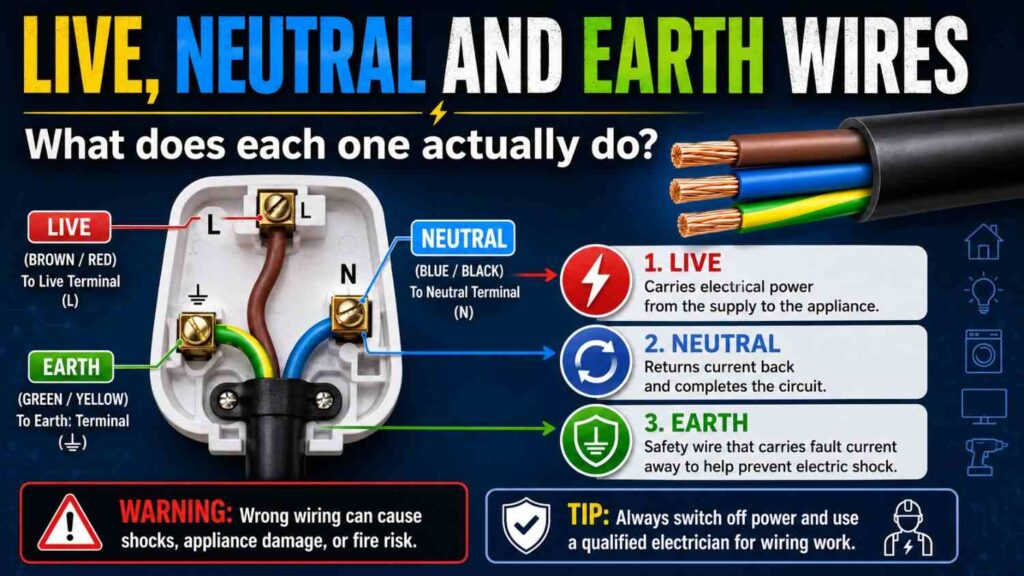
This guide breaks down the role of each conductor in plain language, explains why all three matter for both function and safety, and clears up some of the most common points of confusion.
What Is the Live Wire?
The live wire (also called the “line” or “phase” conductor, and typically colored brown in modern wiring standards) is the conductor that carries current from the electrical supply to your appliance. It is the wire that is “energized” relative to earth, meaning it carries the full supply voltage (around 230V in Nigeria) whenever the circuit is switched on, and touching it while also being in contact with earth or a neutral path completes a circuit through your body, which is why the live wire is the primary source of electric shock risk.
What Is the Neutral Wire?
The neutral wire (typically colored blue) provides the return path for current after it has passed through your appliance, completing the circuit back toward the supply source. Under normal conditions, the neutral is close to earth potential (close to 0V relative to ground), which is why it is generally, though not always, considered less dangerous to touch than the live wire — a distinction that should never be treated as a reason to touch it carelessly, since faults can cause the neutral to carry dangerous voltage under certain conditions, discussed further below.
What Is the Earth Wire?
The earth wire (typically colored green and yellow, and also called the ground or protective earth conductor) serves a fundamentally different purpose from live and neutral: it does not carry current during normal operation at all. Instead, it exists purely as a safety measure, providing a low-resistance path to the ground for fault current in the event that a live conductor accidentally makes contact with an appliance’s metal casing or other exposed conductive parts. Without a properly connected earth wire, a fault of this kind could leave an appliance’s casing dangerously live without tripping any protection, creating a serious shock hazard for anyone who touches it.
How the Three Work Together: A Simple Circuit
Consider a simple appliance like an electric kettle. Current flows from the supply, through the live wire, through the kettle’s heating element (doing useful work), and back through the neutral wire to complete the circuit. The earth wire, connected to the kettle’s metal casing, plays no role at all during this normal operation. But if a fault develops, say, a live wire inside the kettle accidentally touches the metal casing, the earth wire immediately provides a path for that fault current to flow to ground, which should cause a large current surge that trips the circuit breaker almost instantly, disconnecting power before the casing can remain dangerously live for any meaningful length of time.
Why Earthing Matters So Much for Safety
Without proper earthing, a fault like the one described above could leave an appliance’s metal casing energized indefinitely, with no automatic mechanism to detect or clear the fault, since the breaker would have no low-resistance path to trigger a trip. Anyone touching the appliance while also in contact with a genuinely grounded object, a concrete floor, a water pipe, or simply damp ground, could become that low-resistance path instead, receiving a potentially fatal electric shock. This is precisely why properly installed and maintained earthing systems, along with correctly functioning protective devices, are considered absolutely fundamental to electrical safety, not merely a regulatory formality.
Can Neutral Ever Be Dangerous to Touch?
While neutral is close to earth potential under normal, healthy circuit conditions, several fault conditions can cause it to carry dangerous voltage, a topic covered in more depth in our dedicated article on why a neutral wire might have voltage when it shouldn’t. Common causes include a broken or high-resistance neutral connection somewhere upstream in the distribution system, causing voltage to appear on the neutral conductor at points beyond the break, or incorrect wiring where live and neutral have been accidentally swapped. This is exactly why properly trained electricians never assume a neutral wire is safe to touch without testing, and why DIY electrical work carries real risk even when working with what seems like the “safer” conductor.
Single-Phase vs Three-Phase: How This Changes
The live-neutral-earth model described above applies directly to single-phase supplies, the standard configuration for most Nigerian homes. Three-phase supplies, common in larger commercial and industrial installations, use three live conductors (often labeled R, Y and B, or L1, L2 and L3) offset from each other in timing, along with a shared neutral and earth. Three-phase systems allow more efficient power delivery for larger loads and enable certain types of equipment, particularly larger motors, to operate more efficiently than they could on single-phase supply, a topic explored further in our dedicated article on how induction motors work.
Common Wiring Color Standards
| Conductor | Common Color (modern standard) | Function |
|---|---|---|
| Live | Brown | Carries current to the load |
| Neutral | Blue | Provides return path for current |
| Earth | Green/Yellow | Safety path for fault current |
It is important to note that older wiring, or wiring in some regions and older buildings, may use different color conventions (such as red for live and black for neutral, an older standard in some countries), which is why relying on color alone without verification, particularly in older properties, can be risky, and why testing with proper equipment rather than assuming based on color is always the safer professional practice.
What Happens If Earth Is Missing or Disconnected?
An appliance or circuit without a properly connected earth loses its critical safety backstop against casing faults, relying entirely on the appliance’s insulation remaining perfectly intact to prevent a dangerous fault from reaching exposed metal parts. This is why double-insulated appliances (marked with a small square-within-a-square symbol) are designed without requiring an earth connection at all, using additional insulation layers as their safety mechanism instead, but standard metal-cased appliances without this double-insulation rating absolutely require a properly functioning earth connection to be considered safe.
Why RCDs Add an Extra Layer of Protection
Residual current devices (RCDs), covered in depth in our dedicated article comparing RCDs, RCBOs and MCBs, monitor the balance of current flowing through live and neutral conductors, and trip almost instantly if they detect current escaping through an unintended path, such as through a person’s body to earth. This provides valuable additional protection beyond earthing and standard breakers alone, particularly important in areas of higher shock risk like bathrooms, kitchens and outdoor circuits, and is increasingly considered a standard, recommended addition to any modern electrical installation rather than an optional extra.
How Electricians Test and Identify Each Conductor
Rather than relying on wire color alone, particularly in older or unfamiliar installations, qualified electricians use proper testing equipment, including voltage testers, multimeters and dedicated socket testers, to positively identify live, neutral and earth conductors before working on any circuit. A simple plug-in socket tester, widely available and inexpensive, can quickly indicate whether a socket’s wiring is correctly configured, whether earth is properly connected, and whether live and neutral have been accidentally reversed, making it a genuinely useful tool for homeowners to periodically check their own sockets, even though any actual remedial wiring work should always be left to a qualified professional. Reversed live and neutral, while sometimes not immediately obvious since many appliances will still function, can create unexpected shock hazards, particularly with appliances that have exposed switches or components that are meant to interrupt the live conductor specifically, which is another reason proper testing rather than assumption matters.
Earthing Systems: A Brief Overview
Different countries and installations use various earthing system configurations, generally classified under standards using terms like TN-S, TN-C-S and TT, which describe how the earth and neutral conductors relate to each other back at the supply source. Without getting deep into the technical distinctions, the practical point for most homeowners is that the specific earthing system in use affects how earth fault protection behaves, and why earthing arrangements should always be designed and verified by a qualified electrician familiar with the applicable local standards and the specific supply configuration serving a given property, rather than assumed to be identical across every building or region.
Common Misconceptions
- “Neutral is completely safe to touch since it’s near 0V.” Fault conditions can cause dangerous voltage to appear on a neutral conductor, so it should never be treated as inherently safe to touch.
- “Earth wires are optional if the appliance seems to work fine without one.” An appliance can function electrically without a properly connected earth, since earth carries no current during normal operation, but this leaves it without its critical safety backstop against casing faults.
- “Wire color always tells you definitively which conductor is which.” While standard colors are a helpful guide, older installations, incorrect wiring, or regional variations mean color should be verified with proper testing, not assumed, especially in unfamiliar or older wiring.
Live, Neutral and Earth in Generator and Inverter Systems
The same live-neutral-earth principles apply directly to generator and inverter output, though proper implementation is sometimes overlooked in informal backup power installations. A generator’s frame and neutral point should be properly earthed, and where a generator or inverter is connected to a property’s existing wiring through a changeover switch, that switch must correctly isolate the neutral as well as the live conductor from the grid supply during backup operation, not merely the live conductor, to avoid dangerous backfeeding conditions and to keep protective devices functioning as designed. Improper changeover wiring, sometimes done informally without a proper changeover switch at all, is a genuinely dangerous practice that can create shock hazards for utility workers and neighbors, in addition to compromising the safety protections within the property itself, which is why this specific aspect of backup power wiring deserves professional installation rather than an improvised solution.
Frequently Asked Questions
Why do some older Nigerian buildings lack a proper earth connection?
Older buildings were sometimes wired to standards that predated widespread mandatory earthing requirements, or earthing systems may have degraded over time due to corrosion or poor maintenance; retrofitting proper earthing is a common and worthwhile upgrade for such properties.
Can I test whether my earth connection is working properly?
A qualified electrician can test earth continuity and earth loop impedance using proper testing equipment; this is not something that should be assumed safe to test with improvised methods.
Does a generator need to be earthed the same way as grid supply?
Yes, generators require proper earthing for the same fundamental safety reasons as grid-supplied circuits, and improper generator earthing is a common and serious safety gap in some informal backup power installations.
What is the difference between “earth” and “earth leakage”?
Earth refers to the physical safety conductor and grounding system itself, while earth leakage refers to the fault condition where current unintentionally flows to earth through an unintended path, which is exactly what RCDs are designed to detect and respond to.
Why do three-pin plugs have an earth pin even for some plastic-cased appliances?
Some appliances include internal metal components that could become live under fault conditions even with a plastic outer casing, or the plug design itself is standardized across a manufacturer’s product range regardless of individual appliance earthing requirements.
Final Thoughts
Live, neutral and earth each play a distinct and essential role in how electricity is safely delivered to and used by every appliance in your home. Live carries the power, neutral completes the circuit, and earth stands ready as a critical safety mechanism for the moment something goes wrong. Understanding this trio, and taking earthing seriously rather than treating it as an afterthought, is one of the most fundamental pieces of knowledge underlying safe electrical installation and use.