
Choosing the correct cable size is one of the most consequential decisions in any electrical installation, yet it is often treated as an afterthought by people focused on brand names or price per meter. Get it wrong, and you risk anything from nuisance voltage drop to a genuine fire hazard.
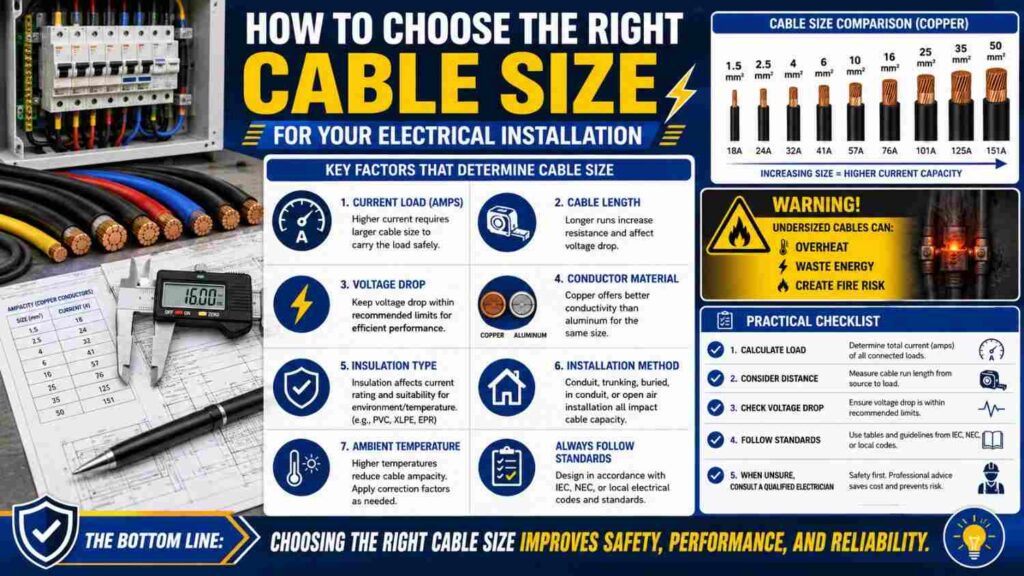
This guide walks through exactly how professionals think about cable sizing, the factors that go into the decision, and practical reference points you can use to sanity-check any electrical work in your home or business.
Why Cable Size Matters So Much
Every cable has a maximum current it can safely carry continuously, called its ampacity or current-carrying capacity, determined largely by its cross-sectional area (commonly measured in square millimeters, such as 1.5mm², 2.5mm², 4mm², and so on). Undersized cable for a given load causes the conductor to overheat, since more current flowing through a given cross-section generates more resistive heat (P = I²R, discussed in our article on voltage, current, resistance and power). Sustained overheating degrades insulation, increases fire risk, and is one of the most common root causes of the electrical fires discussed in our dedicated article on wiring mistakes that cause house fires.
The Core Factors That Determine Cable Size
1. Current (Load) Requirements
The starting point for any cable sizing calculation is the expected current the circuit will carry, determined by adding up the wattage of everything the circuit will supply and converting to amps using I = P ÷ V. A circuit feeding a single 100W light fixture has very different requirements from one feeding a 3kW water heater.
2. Cable Length and Voltage Drop
Longer cable runs experience more voltage drop for a given current, since resistance increases with length. Excessive voltage drop causes appliances to receive less than their rated voltage, leading to poor performance, overheating in motors, and dimming lights. Standard practice limits voltage drop to around 3-5% of nominal voltage for most circuits, sometimes requiring a larger cable size than current-carrying capacity alone would suggest, purely to keep voltage drop within acceptable limits on long runs.
3. Installation Method
How a cable is installed significantly affects how much heat it can safely dissipate. A cable buried in insulation, bundled tightly with several others, or run through a poorly ventilated conduit will run hotter for the same current than one run openly in free air, and therefore may need to be uprated (sized larger) to compensate.
4. Ambient Temperature
Cables rated for a specific ampacity are typically rated at a standard reference ambient temperature (often 30°C). In hotter environments, including many parts of Nigeria during peak temperatures, or in poorly ventilated ceiling spaces, derating factors reduce the safe current-carrying capacity of a given cable size, which is why professional cable sizing tables include temperature correction factors.
5. Type of Insulation
Different cable insulation materials (PVC, XLPE, and others) tolerate different maximum operating temperatures, directly affecting rated ampacity for a given conductor size. XLPE-insulated cables, for example, generally tolerate higher operating temperatures than standard PVC-insulated cables of the same conductor size, allowing somewhat higher current ratings.
A Simplified Reference Table for Common Household Circuits
| Circuit Type | Typical Load | Common Cable Size |
|---|---|---|
| Lighting circuit | Up to ~6A | 1.5mm² |
| General socket circuit | Up to ~20A | 2.5mm² |
| Water heater / cooker circuit | Up to ~32A | 6mm² |
| Air conditioner (dedicated circuit) | Up to ~25-32A | 4-6mm² |
| Main distribution feed (small home) | 60-100A | 16-25mm² or larger |
These figures are general reference points only, not a substitute for a proper calculation by a qualified electrician for your specific installation, since actual requirements depend on the installation-specific factors described above.
A Worked Sizing Example
Suppose you are wiring a dedicated circuit for a 3.5kW water heater on a 230V supply, with the cable running about 15 meters from the distribution board.
- Calculate current: I = P ÷ V = 3,500W ÷ 230V ≈ 15.2A
- Apply a safety margin: Professionals typically size for somewhat more than the calculated load to allow headroom; here, a circuit designed for 20A would provide reasonable margin.
- Select cable based on ampacity: A 2.5mm² cable is commonly rated for around 20-27A depending on installation method and insulation type, which would appear to suffice on current-carrying capacity alone.
- Check voltage drop over the 15m run: At this length and current, voltage drop with 2.5mm² cable may approach or exceed recommended limits, particularly if installation conditions are unfavorable, which is why many electricians would size up to 4mm² for this specific run to keep voltage drop safely within limits.
This example illustrates why cable sizing is not a single lookup but a multi-step check, since current-carrying capacity and voltage drop can each independently dictate a larger cable size depending on the specific circumstances of the installation.
Why Undersized Cable Is So Dangerous
An undersized cable does not necessarily fail immediately or dramatically. Instead, it often runs hotter than it should for months or years, gradually degrading its insulation, particularly at connection points and anywhere the cable is bent, bundled or otherwise stressed. This gradual, often invisible degradation is one of the more insidious causes of Nigeria’s not infrequent building electrical fires, since the wiring may appear to function normally for a long time before the accumulated damage results in a fault, an arc, or a fire, often at the least convenient and most dangerous possible moment.
Common Cable Sizing Mistakes
- Copying cable size from a similar-looking installation without checking load, length or installation method — conditions that look similar on the surface can have very different requirements.
- Undersizing to save on material cost — a common but genuinely dangerous shortcut, since the cost difference between an undersized and correctly sized cable is typically small relative to the risk involved.
- Ignoring voltage drop on long cable runs, particularly relevant for outbuildings, boreholes, or garden/outdoor installations some distance from the main distribution board.
- Failing to account for future load growth, such as adding an air conditioner to a circuit originally designed only for lighting and small appliances.
- Mismatching cable size and breaker rating, where a breaker rated higher than the cable it protects effectively removes the safety margin the cable relies on for protection.
Matching Cable Size to Breaker Rating
A frequently overlooked but critical principle is that a circuit’s protective device (breaker or fuse) must be rated appropriately for the cable it protects, not simply for the load it is expected to carry. The breaker’s job is to trip before the cable is damaged by excess current, which means the breaker rating should never exceed the cable’s safe current-carrying capacity, even if the connected load itself is smaller. Installing an oversized breaker on undersized cable — sometimes done informally to “stop the breaker from tripping” — removes this critical safety margin and is one of the more dangerous, if unfortunately common, mistakes seen in informal electrical work.
Cable Sizing for Generators, Inverters and Solar Systems
Cable sizing principles apply just as strictly to backup power wiring as to grid-connected circuits, and arguably deserve even more careful attention in Nigerian installations given how heavily backup power systems are relied upon. The cabling between a battery bank and inverter, in particular, often carries very high current at relatively low DC voltage (12V, 24V or 48V systems), meaning even modest power levels translate into substantial current, following the same P = V × I relationship covered in our kW vs kWh article. A 5kW inverter running on a 24V battery bank, for example, may draw over 200A from the battery under full load, requiring very heavy-gauge cable and proper connections to avoid dangerous overheating at the battery terminals, a detail sometimes overlooked by installers focused primarily on the AC side of the system.
Derating Factors Explained Simply
Professional cable sizing tables typically apply several “derating” or correction factors that reduce a cable’s nominal ampacity to account for real installation conditions, rather than the idealized laboratory conditions the base rating was tested under. Common derating factors include grouping (multiple cables bundled or run together, each contributing heat to its neighbors), ambient temperature above the standard reference, and thermal insulation (a cable run through or covered by building insulation loses its ability to dissipate heat to surrounding air). In practice, this means a cable that appears adequately sized based on a simple current lookup alone might actually need to be one or two sizes larger once these real-world factors are properly applied, which is exactly the kind of detail a qualified electrician accounts for but an informal, rule-of-thumb installation often overlooks entirely.
Why Professional Cable Sizing Software and Tables Exist
Given the number of interacting factors, professional electrical engineers rarely calculate cable sizing purely from first-principles formulas for every project; instead, they rely on standardized cable sizing tables (published by national or international wiring standards) or dedicated cable sizing software that accounts for current, length, voltage drop, installation method, grouping and temperature simultaneously. For homeowners and small business owners, the practical takeaway is not to memorize these tables, but to recognize that proper cable sizing is a genuine technical calculation worth paying a qualified electrician to get right, rather than a simple lookup that can be safely approximated by comparing to a neighbor’s installation or a generic internet chart alone.
Common Misconceptions
- “Bigger cable is always better, so oversizing is always safe.” While oversizing (within reason) is generally safer than undersizing, excessively oversized cable adds unnecessary cost and can be harder to terminate correctly in standard fittings; appropriate sizing, not simply maximum sizing, is the actual goal.
- “If the cable isn’t visibly hot, it must be correctly sized.” Cables can run hotter than is safe for long-term insulation health without feeling dangerously hot to a brief touch, which is why proper calculation, not touch-testing, is the reliable method.
- “Cable sizing tables are universal regardless of local conditions.” Ambient temperature, installation method and cable type all affect the correct size for a given load, which is why generic online tables should be treated as starting references rather than final answers for a specific installation.
Frequently Asked Questions
Can I use the same cable size for both lighting and socket circuits?
While technically possible for light loads, it is standard best practice to run separate circuits for lighting and general sockets, each sized appropriately for its typical load, partly so that a fault or overload on one circuit does not affect the other.
Does cable color matter for sizing, or only for identification?
Cable color (commonly denoting live, neutral and earth conductors) is purely for identification and safety during installation and maintenance; it has no bearing on current-carrying capacity, which is determined by conductor size and insulation type.
How do I know if my existing wiring is undersized for my current appliance load?
Warning signs include warm cables or sockets, frequent breaker trips under normal use, and dimming lights when large appliances start; a qualified electrician can perform a proper load assessment and inspection to confirm.
Is it safe to run a generator or inverter through my existing house wiring?
Generally yes, provided the existing wiring was correctly sized for the loads you intend to run, and provided proper changeover switching is used to prevent backfeeding into the grid, a critical safety topic covered in our dedicated changeover switch article.
Why do some electricians recommend larger cable than the “minimum” size for a given load?
This is usually a deliberate safety margin accounting for future load growth, voltage drop over the specific run length, and installation conditions, rather than strictly the bare minimum current-carrying requirement.
What happens if I use aluminum cable instead of copper?
Aluminum has higher resistance than copper for the same cross-sectional area, meaning aluminum cable typically needs to be sized larger than copper for an equivalent ampacity, and requires specific termination methods and connectors rated for aluminum to avoid connection problems over time.
Should cable sizing be different for a circuit that will run continuously versus one used only briefly?
Yes, in principle. Continuous loads (running for three hours or more at a time, such as some air conditioning or water heating circuits) are often sized with additional margin compared to intermittent loads of the same peak current, since sustained heating over a long period behaves differently from a brief current draw that has time to cool between uses.
Is it worth paying extra for a qualified electrician to size cables rather than doing it myself?
Given that incorrect cable sizing is a leading contributor to electrical fires, and that the cost difference between correctly and incorrectly sized cable is usually modest relative to the overall cost of an installation, professional sizing is widely considered one of the more worthwhile investments in any electrical project, particularly for circuits carrying significant load such as air conditioners, water heaters or full-house rewiring.
Final Thoughts
Cable sizing sits at the intersection of physics, safety and practical engineering judgment, and getting it right is one of the single most important factors in whether an electrical installation remains safe and reliable for decades, or becomes a slow-developing hazard. Whether you are planning a new circuit, adding an air conditioner to an older home, or simply trying to understand why your electrician recommended a particular cable size, understanding the core factors, current, length, installation method, temperature and insulation type, gives you the knowledge to ask the right questions and recognize good practice when you see it.