
If you have ever driven past massive steel pylons carrying electricity across the countryside, strung with cables high above the ground, you have seen one of the most important engineering decisions in the entire power industry in action: the choice to transmit electricity at extremely high voltage, often 132,000 volts, 330,000 volts, or more.
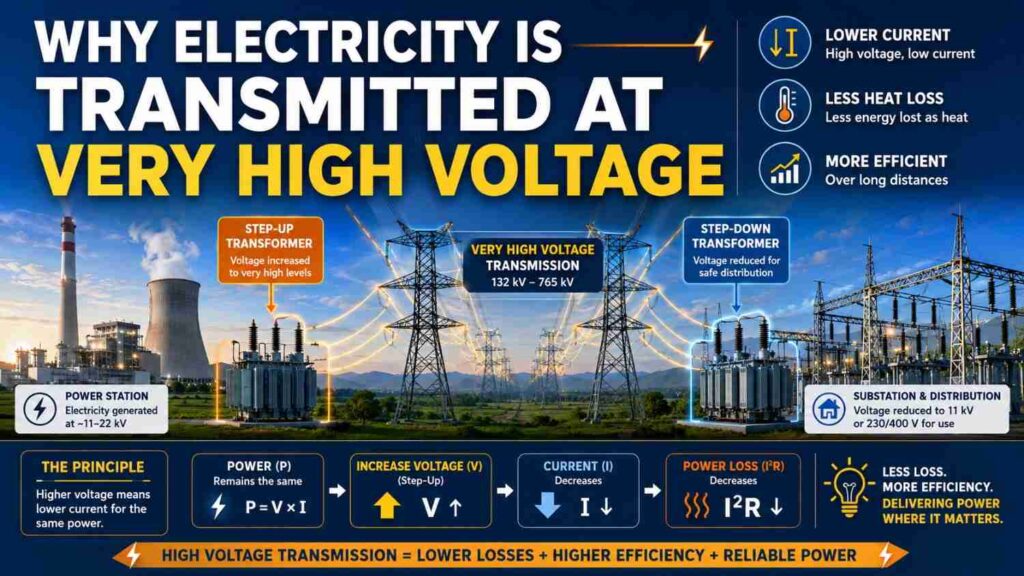
This might seem counterintuitive at first; after all, high voltage sounds more dangerous, and your home only needs 230V. So why does the grid go to such lengths, quite literally, to push electricity through the system at such enormous voltages? The answer comes down to a single, elegant piece of physics that saves enormous amounts of energy and money.
The Core Problem: Power Loss Over Distance
Whenever current flows through a conductor, some energy is lost as heat due to the conductor’s resistance, an effect described by the formula:
Power Loss = I² × R
Where I is current and R is the resistance of the transmission line. This formula reveals something critical: power loss increases with the square of current. Double the current, and you quadruple the losses. This single relationship is the entire reason high-voltage transmission exists.
How High Voltage Reduces Current
Recall the basic power formula: P = V × I. For any fixed amount of power that needs to be delivered from a power station to a distant city, there is a trade-off between voltage and current: the higher the voltage used, the lower the current needs to be to deliver that same amount of power.
Since power loss depends on the square of current (I²R), reducing current even modestly produces a dramatic reduction in losses. This is why grid engineers step voltage up to very high levels, using step-up transformers at power stations, specifically to minimize the current that needs to flow through the long transmission lines connecting generating stations to the cities and towns they serve.
A Worked Example
Suppose a power station needs to deliver 100 MW (100,000 kW) of power to a city 200km away, and the transmission line has a total resistance of 10Ω.
At 11kV transmission voltage: Current = 100,000,000W ÷ 11,000V ≈ 9,091A. Power loss = 9,091² × 10 ≈ 826,000,000W — more power lost as heat than is even being delivered, making this voltage completely impractical for this distance and power level.
At 330kV transmission voltage: Current = 100,000,000W ÷ 330,000V ≈ 303A. Power loss = 303² × 10 ≈ 918,000W, or about 0.9 MW — less than 1% of the power being delivered.
This dramatic difference, from losing more power than is delivered at low voltage, to losing less than 1% at high voltage, is the entire reason transmission grids worldwide operate at voltages in the hundreds of thousands of volts.
Why Not Just Use Thicker Cables Instead of Higher Voltage?
An alternative way to reduce I²R losses would be to reduce resistance by using thicker conductors, since resistance decreases as conductor cross-sectional area increases. However, this approach has severe practical limits: cables thick enough to meaningfully reduce resistance for the kind of currents involved at low voltage over long distances would be extraordinarily heavy, expensive, and difficult to support on transmission towers, requiring vastly more copper or aluminum than raising voltage does. Raising voltage, by contrast, achieves the same loss reduction using far more economical amounts of conductor material, which is why the electricity industry settled on high-voltage transmission rather than simply oversizing cables.
The Staged Voltage Journey
Electricity typically passes through several voltage levels between generation and final use, each stepped down progressively by transformers, discussed in more depth in our dedicated step-up versus step-down transformer article:
| Stage | Typical Voltage |
|---|---|
| Generation (power station) | 11kV–25kV |
| Transmission (step-up) | 132kV–330kV |
| Sub-transmission/distribution | 33kV–11kV |
| Final household/business supply | 230V/400V |
Why High Voltage Is Also More Dangerous
The same high voltage that makes long-distance transmission efficient also makes it extremely dangerous to work with or approach without proper training and equipment. High voltage can cause current to arc across significant air gaps, meaning direct contact is not even necessary for a dangerous shock or fatal injury to occur near exposed high-voltage equipment. This is why transmission towers are built tall, with cables kept well clear of the ground and any structures, why substations are heavily fenced and marked with warning signage, and why only trained, properly equipped personnel are permitted to work on or near high-voltage transmission infrastructure.
Insulation and Design Challenges at High Voltage
Designing equipment for high-voltage transmission introduces significant engineering challenges beyond simply choosing a voltage level. Insulators supporting transmission cables on towers must be carefully designed, often using long strings of ceramic or composite disc insulators, to prevent flashover (an unwanted electrical arc across the insulator’s surface), particularly in humid, dusty or polluted environments. Transformers and switchgear rated for transmission voltages require substantially more robust insulation, larger physical clearances, and more sophisticated protection systems than their lower-voltage counterparts, all of which adds significantly to the cost and engineering complexity of transmission infrastructure compared to lower-voltage distribution equipment.
Corona Discharge: A Side Effect of High Voltage
At sufficiently high voltages, transmission lines can experience a phenomenon called corona discharge, where the electric field around the conductor becomes strong enough to ionize the surrounding air, creating a faint glow, a hissing or crackling sound, and a small amount of additional power loss. This is why transmission line conductors are often designed as bundled conductors (multiple parallel cables per phase) rather than a single large cable, which helps reduce the surface electric field intensity and minimize corona losses, particularly on the highest-voltage lines such as Nigeria’s 330kV network.
Why This Matters for Nigeria’s Grid
Nigeria’s transmission backbone, operated by the Transmission Company of Nigeria (TCN), relies on this same high-voltage principle to move power from generating stations like Egbin, Kainji, Jebba and Shiroro across long distances to load centers throughout the country. The efficiency gains from high-voltage transmission are part of what makes centralized, large-scale power generation practical at national scale in the first place; without it, generating stations would need to be built much closer to every population center to avoid unacceptable transmission losses, which is neither economically nor geographically practical given the location of major hydroelectric and gas resources relative to Nigeria’s population centers.
Why Extra-High and Ultra-High Voltage Levels Exist
Beyond standard transmission voltages like 132kV and 330kV, some countries with very large grids or extremely long transmission distances use even higher levels, sometimes called extra-high voltage (EHV, typically 345kV to 765kV) or ultra-high voltage (UHV, above 800kV), particularly for bulk power transfer over very long corridors, such as moving hydroelectric power from remote generation sites to distant major cities. These higher voltage classes push the same underlying loss-reduction principle even further, but at the cost of substantially more expensive towers, insulation, and switching equipment, meaning grid planners must always balance the capital cost of higher-voltage infrastructure against the ongoing savings from reduced transmission losses when designing a transmission network. Nigeria’s current backbone, built primarily around 330kV and 132kV, reflects a balance appropriate to the country’s present generation capacity, geography and load distribution, though grid expansion plans do periodically evaluate higher-voltage options as demand grows.
Transmission Line Losses vs Distribution Losses
It is worth distinguishing between losses on high-voltage transmission lines and losses on the lower-voltage distribution network that ultimately delivers power to individual customers. Because transmission lines operate at very high voltage and correspondingly low current, their percentage losses relative to power transferred are typically quite low despite covering very long distances. Distribution networks, operating at much lower voltages (11kV down to 230V) and correspondingly higher currents for a given power level, tend to experience proportionally higher losses per kilometer, even though individual distribution lines are usually much shorter than transmission lines. This is part of why utilities and grid planners pay close attention to both transmission and distribution loss figures separately, since improvements at each level involve different equipment, investment priorities and engineering trade-offs, and why total system losses reported for a country’s grid usually combine both categories together.
How Engineers Decide on a Transmission Voltage
Selecting an appropriate transmission voltage for a new power line involves balancing several factors: the amount of power that needs to be transferred, the distance involved, the cost of higher-voltage towers and equipment versus the value of reduced losses over the line’s operating lifetime, and compatibility with the existing voltage levels already used elsewhere in the surrounding grid. A short line carrying modest power might reasonably use a lower transmission voltage, while a long line carrying bulk power from a major generating station would justify the higher upfront cost of a higher voltage class through its substantially reduced ongoing losses over decades of operation. This kind of technical and economic trade-off analysis is a core part of power systems engineering, a career path discussed further in our dedicated article on power systems engineering as a career.
Common Misconceptions
- “Higher voltage means more energy is being wasted.” The opposite is true — higher transmission voltage specifically reduces energy wasted as heat losses compared to transmitting the same power at lower voltage.
- “High voltage transmission lines are dangerous to live near under any circumstances.” Properly designed and maintained transmission infrastructure, built to appropriate clearance standards, is designed to operate safely; danger arises primarily from direct contact, close approach, or damaged/substandard infrastructure.
- “Transmission losses can be reduced to zero with better technology.” Some loss is unavoidable with conventional conductors due to inherent resistance; even highly optimized modern transmission systems still experience some losses, though ongoing technology such as high-temperature superconducting cables aims to reduce this further in specialized applications.
What Happens During Maintenance on High-Voltage Lines
Because transmission lines form the backbone connecting generating stations to the entire distribution network, taking one out of service for maintenance or repair requires careful planning by grid operators to ensure remaining lines and generation can safely cover the load, often scheduled during periods of lower expected demand. Live-line maintenance techniques, where specially trained and equipped technicians work on energized high-voltage lines using insulated tools, protective equipment and carefully controlled procedures, are used in some cases to avoid the need for a full outage, though many maintenance activities still require the line to be de-energized and safely earthed first as a standard safety precaution. This careful coordination is part of why planned transmission maintenance is typically scheduled well in advance and communicated to affected DisCos and, where relevant, directly to major industrial customers who may need to adjust their operations accordingly.
Putting the Numbers in Perspective
It can help to see the loss-reduction principle expressed as a simple ratio: increasing transmission voltage by a factor of ten reduces current, for the same delivered power, by the same factor of ten, which in turn reduces I²R losses by a factor of one hundred, since losses scale with the square of current. This is why the jump from, say, 33kV to 330kV transmission voltage does not merely offer a modest improvement in efficiency but a dramatic, order-of-magnitude reduction in losses for the same power delivered over the same distance. Grid planners rely on exactly this kind of squared relationship when justifying the higher upfront capital cost of high-voltage infrastructure, since the ongoing energy savings compound significantly over the many decades a transmission line typically remains in service.
Frequently Asked Questions
Why don’t we just generate electricity at low voltage and use low voltage all the way to homes?
Because the resulting current for any meaningful amount of power would be enormous, causing prohibitive I²R losses and requiring impractically thick, expensive conductors over any significant distance.
Is DC transmission ever used instead of AC for long distances?
Yes, High Voltage Direct Current (HVDC) transmission is used in some very long-distance or undersea transmission projects worldwide, offering certain efficiency and stability advantages for specific applications, though it requires expensive converter stations at each end and is not yet widely used within Nigeria’s domestic transmission network.
How much energy is typically lost in transmission and distribution combined?
This varies by country and grid condition, but well-maintained modern grids often report combined transmission and distribution losses in the range of roughly 6-15%, while grids facing infrastructure or maintenance challenges can experience meaningfully higher losses.
Why do transmission towers get taller as voltage increases?
Higher voltage requires greater clearance distances from the ground and surrounding structures to maintain safety and prevent flashover, which is why extra-high-voltage lines (330kV and above) use noticeably taller and larger towers than lower-voltage distribution lines.
Does high-voltage transmission affect electricity bills directly?
Indirectly, yes — lower transmission losses mean less generated electricity is wasted before reaching customers, which affects overall system costs and efficiency, though your individual bill is calculated based on your metered consumption at the point of use.
Why do transmission lines use multiple cables bundled together per phase instead of one thick cable?
Bundled conductors reduce the electric field intensity at the surface of each individual conductor, which helps minimize corona discharge losses and radio interference, while also providing a larger effective conductor cross-section for carrying current, an approach commonly used on the highest-voltage lines such as Nigeria’s 330kV network.
Could underground cables replace overhead transmission lines to reduce losses further?
Underground high-voltage cables are technically possible and are used in some urban or environmentally sensitive areas, but they are dramatically more expensive to install and maintain than overhead lines at transmission voltage levels, which is why overhead transmission remains the dominant approach for long-distance bulk power transfer in most grids worldwide, including Nigeria’s.
Final Thoughts
Transmitting electricity at very high voltage is one of the most consequential and elegant engineering decisions in the history of the power industry, rooted in a simple but powerful piece of physics: reducing current reduces losses far more dramatically than the voltage increase might suggest, thanks to the squared relationship in the I²R loss formula. Every time you see a transmission tower striding across the landscape, you are looking at the direct physical result of that one insight, quietly saving enormous amounts of energy on every single unit of electricity that eventually reaches your home. It is a reminder that some of the most impactful engineering decisions are not the most visible ones on your own street, but the ones happening far away, high above the ground, on towers most people drive past without a second thought. The next time you see one striding across a field or along a highway, you will know it represents not a hazard to be feared without reason, but a carefully engineered solution to one of the most fundamental challenges in delivering electricity across any meaningful distance.